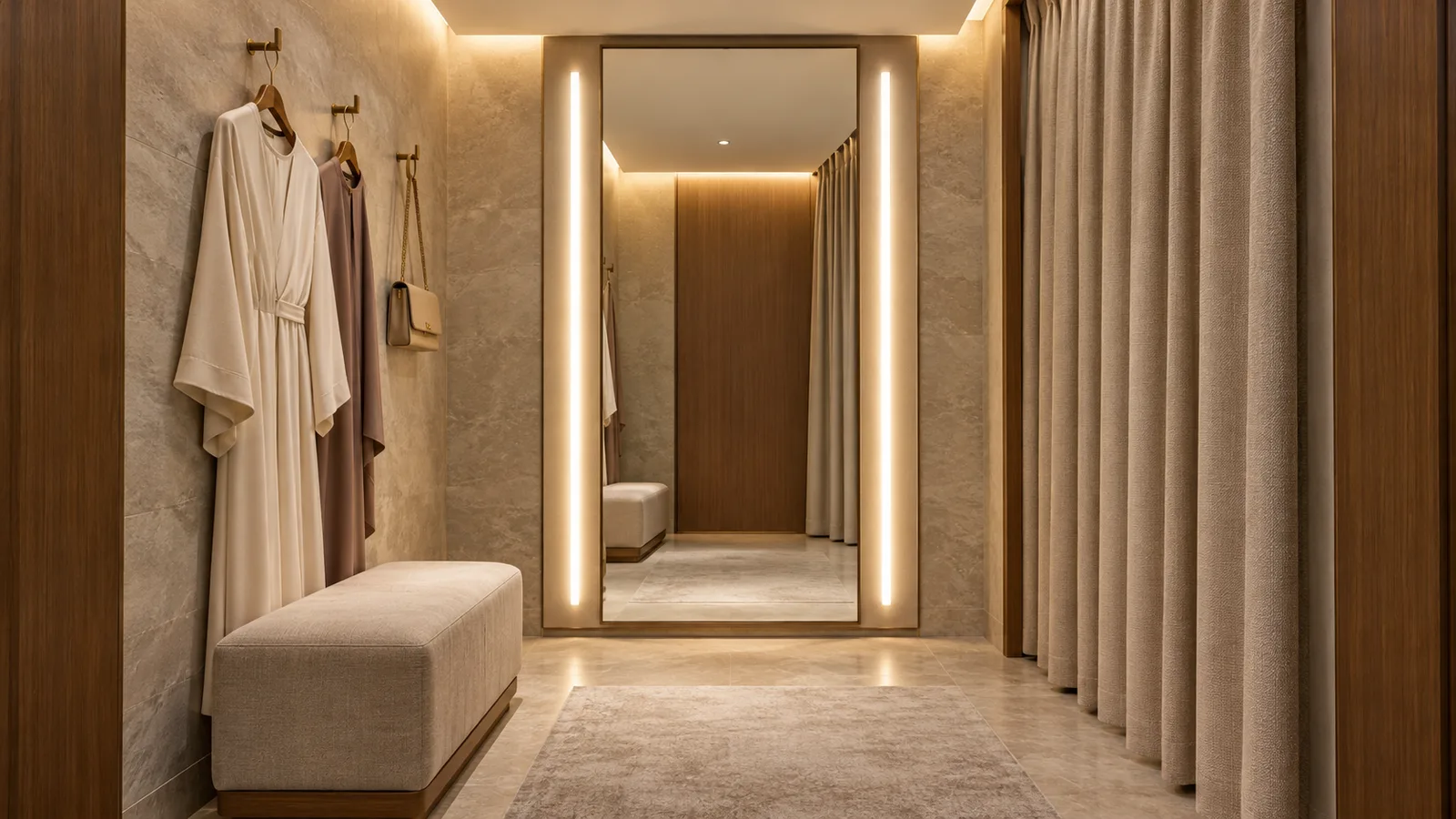
For a GCC retail fitting room, start with shielded vertical light beside a full-length mirror and add background light where needed. The customer needs to inspect a whole garment, not just see a decorative mirror outline. Evaluate the layout from the standing position with the privacy curtain closed and the actual finishes installed.
The five options below address garment visibility, reflected glare, repeatable color appearance, privacy and service access. Choose between them using the cubicle geometry and merchandise. For UAE and Saudi fit-outs, each option needs project evaluation and local approval where required; this comparison contains no measured project results.
Select by the viewing task
Decide which parts of the garment must be visible in the mirror and how far a customer can stand back. The same lighting can look different in a narrow cubicle and an open showroom. Include the dark curtains, glossy walls and mirror edges in the sample.
ERCO’s retail-lighting guidance emphasizes vertical illumination and the light reaching the target plane. Apply that principle here by assessing the person and garment, rather than approving only a ceiling or a reel’s stated lumens. The recommendations below are a practical application of those principles, not ERCO fitting-room specifications.
Five layouts and their limits
| Layout | Suitable role | Main approval check |
|---|---|---|
| Diffused vertical lines beside the mirror | Primary candidate for full-length viewing | Garment visibility and reflected source brightness |
| Concealed ceiling cove | Background light in a suitable cubicle | Useful contribution without relying on it alone |
| Shielded side-wall wash | Additional light across the standing area | Body shadows and uneven illumination |
| Separate backlit mirror perimeter | Decorative depth and orientation | Halo does not replace useful forward light |
| Controlled tunable-white viewing zone | Comparing appearance under agreed settings | Repeatable presets and staff control |
1. Diffused vertical mirror-side lines
Trial the assembly beside the full-length mirror, facing toward the customer’s position. Inspect upper and lower clothing, not just the face. Check from different standing heights and distances, including the closest usable position. A bright diffuser reflected in the mirror can remain uncomfortable even when the line is smooth.
Kichler’s mirror-lighting advice explains the benefit of side lighting for grooming compared with overhead light alone. Full-length fitting-room evaluation extends that placement principle to clothing; do not copy bathroom dimensions or treat them as retail requirements.
2. Concealed ambient cove
A concealed cove can light the background and reduce the impression of a dark cubicle. Check how much it contributes when the curtain is closed. It may complement mirror-side lighting, but a luminous ceiling does not establish adequate light on the garment.
Keep the strip and power equipment maintainable after the room is finished. A cove that requires damaging a privacy partition for replacement is an inconvenient choice for repeated retail use.
3. Shielded side-wall wash
Where mirror-side mounting is restricted, trial concealed or shielded light on an adjacent wall. Aim the assembly to contribute across the standing area without placing an exposed strip in the mirror’s view. Test both turning directions: the customer’s body may block one source and change the visible shadows.
This layout needs an actual section drawing. A strip’s beam-angle label cannot predict the result after the profile, shielding and wall reflection are included.
4. A separate decorative mirror perimeter
Backlighting can separate a mirror from its wall and give the room a finished appearance. Treat it as a decorative layer with a separate control where necessary. Check the forward lighting with the halo switched off, so the sample does not pass only because a bright outline makes the room look illuminated.
Avoid unprotected assemblies near routine cleaning exposure. Confirm the selected construction and cleaning restrictions; indoor use does not establish resistance to cleaning chemicals.
5. A controlled tunable-white viewing zone
Use adjustable white tone only when the retailer has defined the settings customers should compare and staff can restore them. Different customer-selected scenes can otherwise make adjoining rooms appear inconsistent. Record a default scene and check startup after a supply interruption.
An adjustable source cannot reproduce every destination lighting condition or guarantee how a fabric will look elsewhere. Compare real garments under the agreed settings; do not describe the feature as a universal daylight match.
Shortlist sources for the assembled sample
These fields are from the current catalog, not measurements of a fitting-room installation. Confirm the selected voltage, color and construction before ordering.
| Catalog source | Listed PCB width / CRI | Question for the mock-up |
|---|---|---|
| 8mm CRI95 COB | 8mm / CRI95 | Does the assembled profile give usable vertical light without distracting reflections? |
| SMD2835 CRI98 | 8mm / CRI98 | Are individual source points hidden by the selected diffuser? |
| Tunable-white COB | 8mm / CRI90 | Are the ordered endpoints and compatible controls established? |
A CRI label is one filter, not proof that every fabric will appear acceptable. Compare merchandise with varied colors and textures, including items that are difficult to judge under the retailer’s existing lighting.
Approve one complete cubicle before repeating it
Include the finished mirror, closed curtain, bench, wall surfaces and planned controls. Ask staff to inspect the whole garment from normal positions, then assess direct and reflected glare separately. Test the working scene and any comparison preset. If a project requires measured lighting levels, have its lighting designer define the target and measurement plan independently.
Send the cubicle plan, section, intended roles, model variants and quantities through the enquiry form. Keep the accepted settings and replacement details in the handover record, so the next room or later repair can reproduce the approved arrangement.
Catalog & Sourcing Note
This article is prepared from our current product catalog and B2B specification workflow. Electrical, waterproofing and installation requirements vary by model and market, so confirm the final specification and approved sample before ordering.
Discuss Your Specification