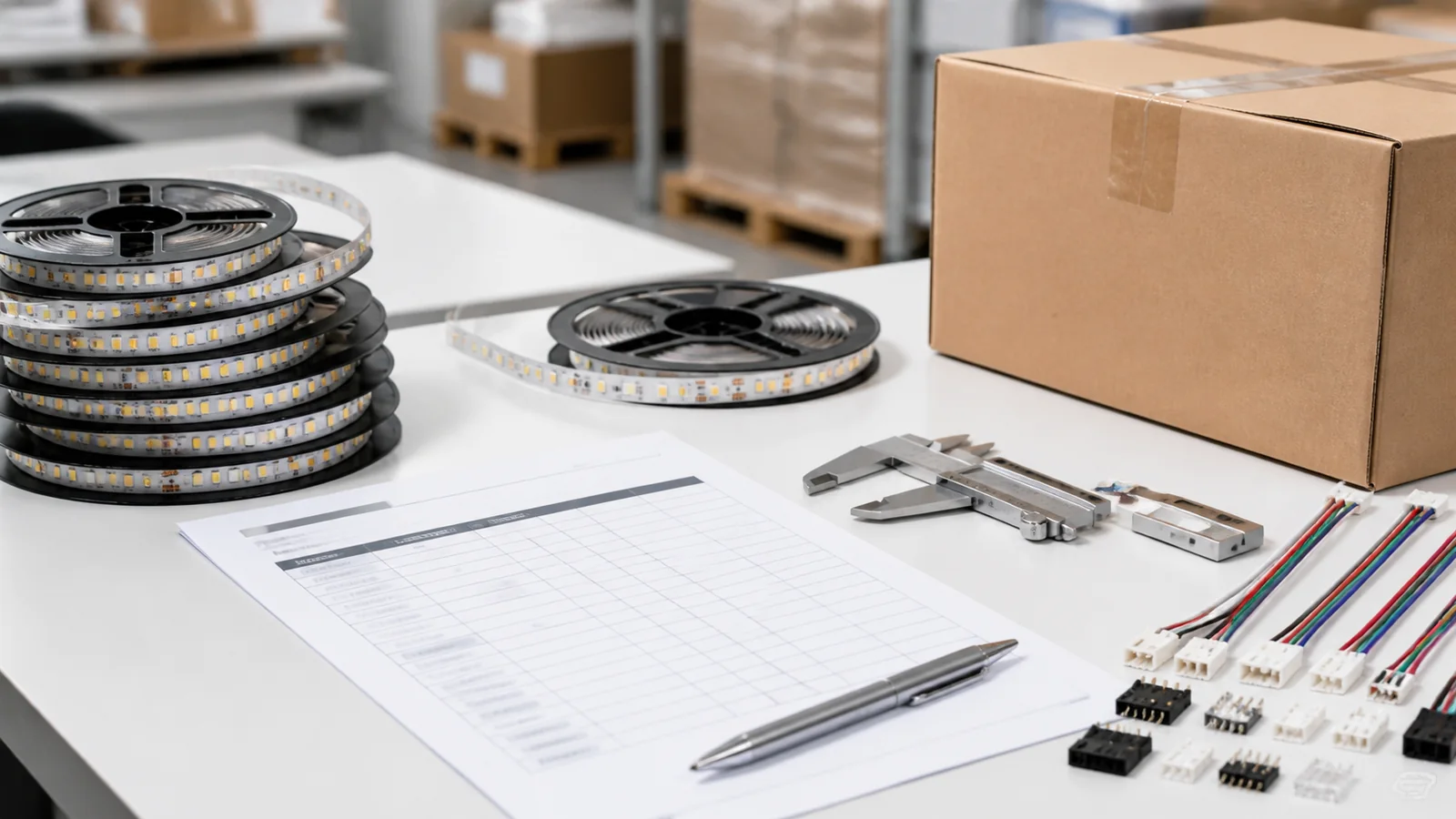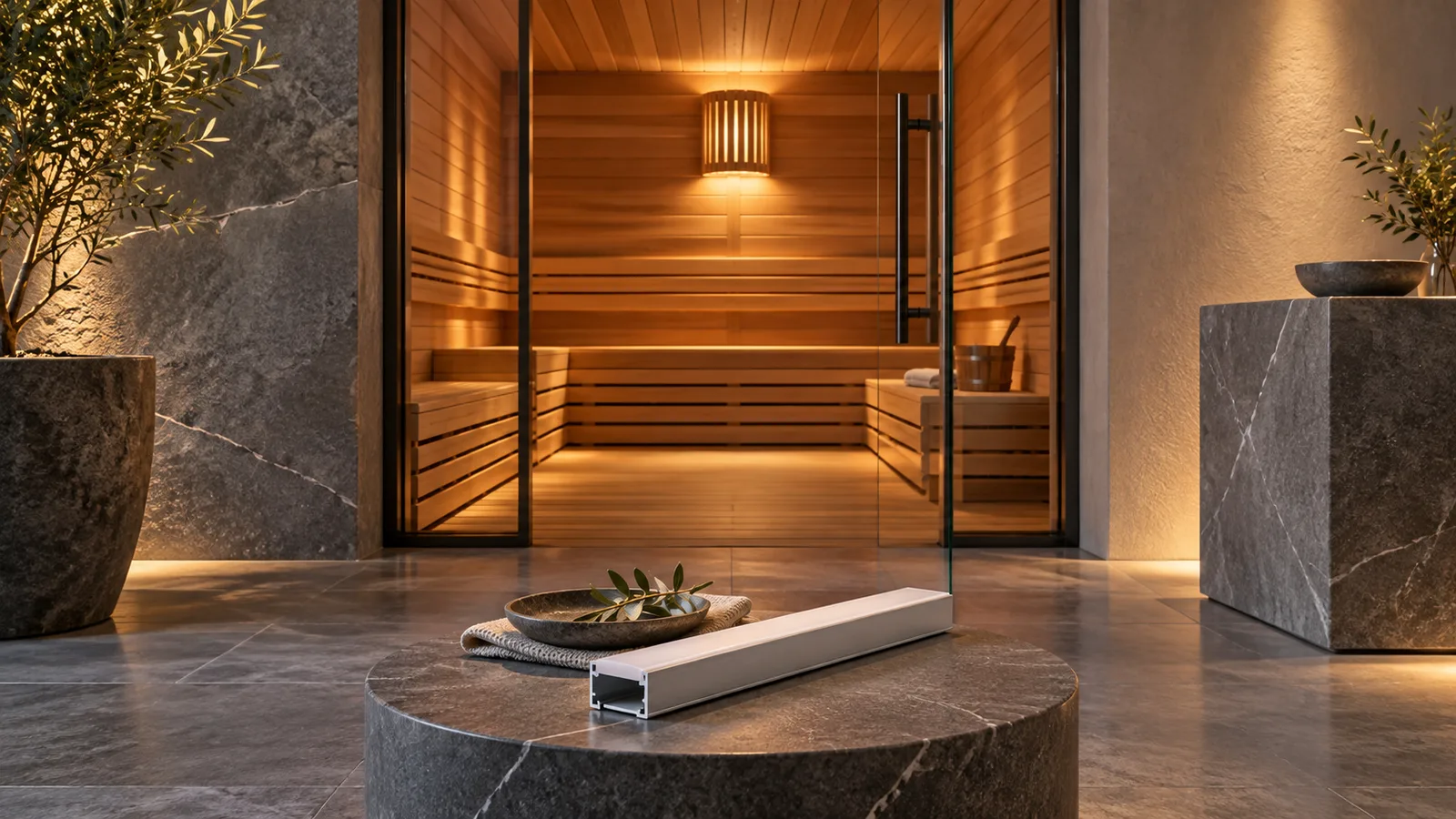
Use LED lighting in a sauna or steam room only when the exact product and complete installation are explicitly suitable for that environment and location. An ordinary waterproof LED strip is not automatically a sauna light. LEDStripStar’s current catalog does not establish a sauna- or steam-room-rated strip configuration, so it is not enough to approve a hot-room order.
A GCC hotel or spa may need the same warm-white appearance in its hot room, reception and changing areas. Specify those zones separately because their environmental demands differ. One protected strip ordered for every zone leaves the hot-room requirement unresolved.
An IP rating does not answer the temperature question
The IEC public scope for IEC 60529 describes enclosure protection classification. It does not give a sauna operating-temperature limit for a particular tape. The supplier must state the allowable conditions for the complete proposed light source and its accessories.
Check heat and water exposure independently. A product may have a stated water-protection rating while its operating-temperature or humidity limits exclude the intended position. Steam, condensation, cleaning chemicals and repeated heating and cooling also need review. Do not infer those capabilities from silicone construction alone.
Harvia’s LED-SP-RGBW-18 product information explicitly describes a sauna lighting product, steam-bath suitability and a temperature-resistant connection cable. It also specifies a constant-current control arrangement. That demonstrates the kind of application-specific information to seek; it is a different luminaire, not a performance comparison with our tape or a compatible constant-voltage strip kit. Confirm its manual and regional availability with the vendor if considering it.
The COB-8MM-320LED (RA80) silicone-IP68 family lists IP68 construction and DC12/24V variants. Those catalog fields do not establish sauna temperatures, steam exposure or heater-adjacent installation. This product link identifies the limitation buyers must resolve; it is not a hot-room recommendation.
| Requirement | Evidence to request | What does not settle it |
|---|---|---|
| Heat at the proposed position | Explicit product limit and permitted mounting location | A water-protection code |
| Steam and condensation | Stated environmental suitability and installation conditions | A claim that silicone is waterproof |
| Joints and cable entries | Specified materials, connectors, cable and sealing procedure | A rating for uncut tape alone |
| Supply and controls | Compatible output, location and control arrangement | Matching nominal voltage only |
| Maintenance | Permitted replacement parts, access and inspection procedure | A successful short bench demonstration |
Record conditions at the actual mounting location
A room-air measurement at the doorway does not establish the temperature behind a bench, inside a recess or near a heater. Have the project team define the intended mounting position and assess the conditions under normal operation, including the relevant heat cycle and cleaning exposure. Do not place temporary electrical instruments or unapproved samples inside an operating hot room.
Ask the lighting manufacturer which locations its system permits. A statement that a product belongs in a sauna does not establish that it may be placed anywhere in that room. Keep to the heater, room and lighting equipment instructions, with installation by qualified personnel under applicable local requirements.
Review the entire path: light source, fixing, diffuser, joints, lead wires and cable entry. Place the driver and controller where their own instructions allow, with appropriate access and environmental protection. Moving the driver outside the hot room does not make an unsuitable strip inside it suitable.
Do not use the heater’s terminal or a spare control output simply because it is nearby. The output type, permitted load and switching function must be documented for the lighting system. A sauna controller’s lighting output is not necessarily the direct DC supply a tape needs.
Approve an application-specific system before ordering
Pause the purchase if the supplier cannot establish heat and steam suitability for the exact configuration. Ask the project’s lighting and sauna-equipment team to select a purpose-designed system. A replacement promise does not establish that the installation is suitable.
Include these items in the approval record:
- The sauna or steam-room type and exact proposed light location.
- The product and accessory references, plus explicit permitted environmental conditions.
- The supply and controller arrangement, with installation responsibilities.
- Joint, mounting and cable-entry instructions for the completed assembly.
- The project’s required verification, service access and replacement procedure.
A sample may be used in the supplier’s approved review process, but casually running an ordinary strip in a hot room is not a qualification method. Keep unsupported temperature or lifetime figures out of the acceptance sheet. The datasheet guide helps identify the missing fields before purchase.
For the adjacent normal-area scope, separately evaluate the 8mm CRI95 COB family in its intended reception or changing-area detail. Confirm humidity, cleaning, mounting and the selected construction there too. A nearby location is not automatically dry or suitable.
Send the normal-area strip requirement through the quotation form, clearly separating any unresolved sauna or steam-room scope. Standard MOQ is 500 meters and custom MOQ is 2,000 meters. Ordinary 2-year warranty terms do not establish high-temperature or steam-room suitability.
Catalog & Sourcing Note
This article is prepared from our current product catalog and B2B specification workflow. Electrical, waterproofing and installation requirements vary by model and market, so confirm the final specification and approved sample before ordering.
Discuss Your Specification