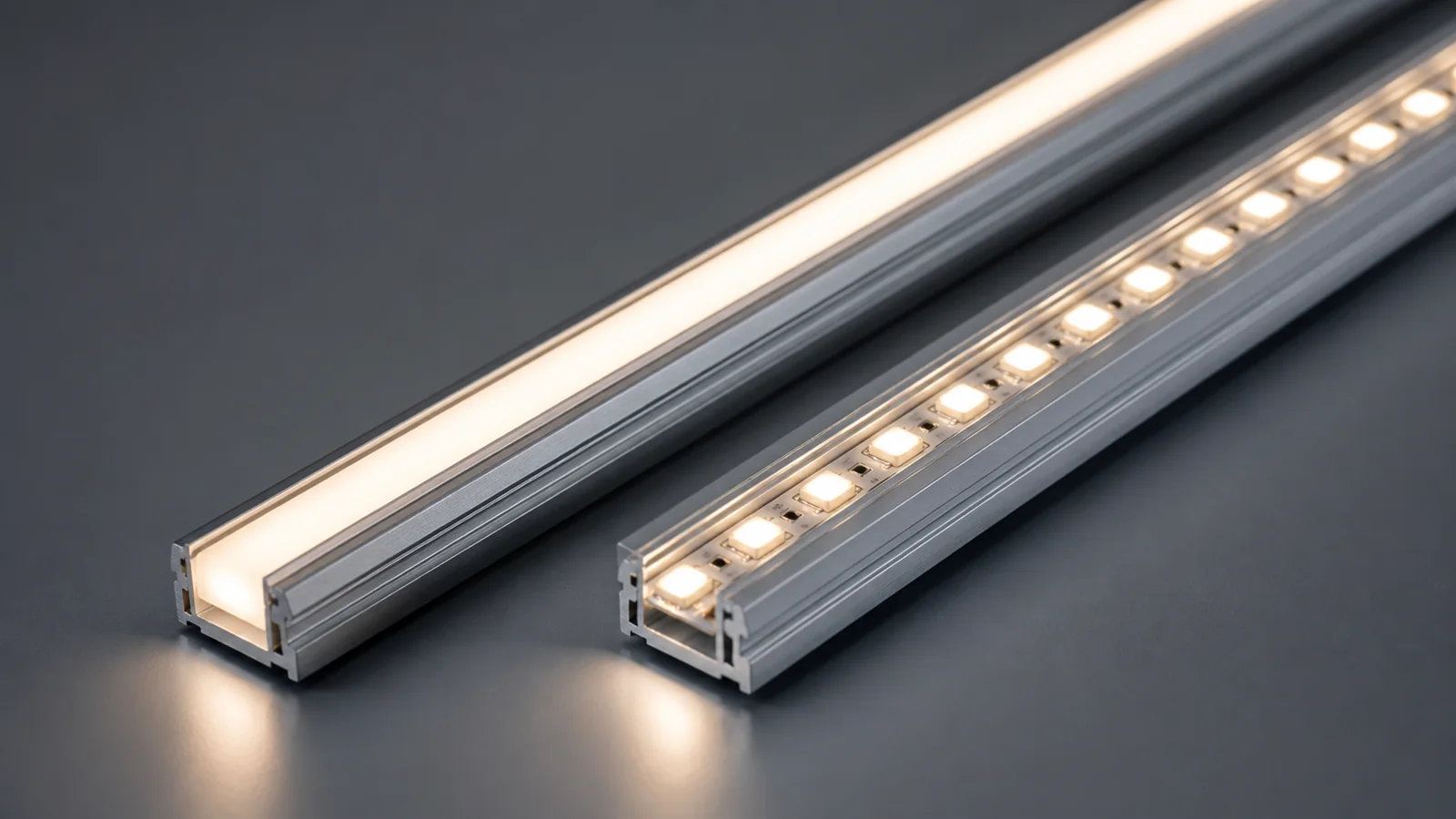
COB and SMD are both proven LED strip technologies. The better choice depends on what the customer sees, how the strip is installed, which colors and controls are required, and how the buyer balances specification against target cost.
In one sentence: choose COB when a smooth, low-dot appearance is the priority; choose SMD when you need broad model choice, specific LED packages, high-output or color-control options, and familiar sourcing economics.
Answer in One Minute
| Buying factor | COB strip | SMD strip |
|---|---|---|
| Light appearance | Dense continuous-looking line | Individual points may be visible without diffusion |
| Shallow profiles | Often performs well | High-density versions or deeper diffuser may be needed |
| Product variety | Rapidly expanding | Very broad LED package, density, and color range |
| RGB/addressable options | Available on selected models | Widely available across many platforms |
| Repair and inspection | Chip-level construction is covered | Individual packages are easier to identify visually |
| Price comparison | Compare by full specification | Compare by full specification |
Do not compare “COB price” with “SMD price” without matching voltage, power, color rendering, PCB width, copper, waterproofing, adhesive, reel length, warranty terms, and inspection criteria.
How COB and SMD Differ
COB LED strip
COB places many small LED dies closely along the PCB and covers them with a continuous phosphor or silicone layer. The dense emitting surface produces a smooth line, especially useful when the strip or diffuser is visible from a short distance.
Common reasons buyers select COB include:
- dot-free or reduced-dot appearance;
- shallow cabinet and furniture profiles;
- reflective surfaces where point sources are distracting;
- clean cove and decorative lines;
- flexible product families including tunable white and selected RGB types.
Browse our current COB LED strip categories, including low-voltage, high-voltage, waterproof, and special configurations.
SMD LED strip
SMD strips mount packaged LEDs on the PCB. Package names such as 2835, 5050, 3528, 3014, or 2216 refer to dimensions and construction families, not an automatic quality grade.
SMD remains useful because buyers can choose from a wide range of LED densities, powers, colors, RGB/RGBW options, and established accessory systems. With a suitable LED density, profile depth, and diffuser, SMD can also produce a visually smooth line.
Review SMD LED strip options by package and application rather than package name alone.
Application Selection
Retail shelves and cabinets
COB is attractive where customers can see the reflection of the light source on glass, metal, or polished products. SMD may be preferred where the strip is hidden, a deeper aluminum profile is available, or a specific high-output/color model is required.
Hotels and residential developments
For headboards, wardrobes, shallow coves, and mirrors, smooth visual comfort often favors COB. For long coves, also compare voltage drop, feed points, driver access, and replacement strategy.
Commercial and architectural projects
The choice may be driven by photometric targets, control system, profile design, operating hours, and maintenance access. Request samples in the actual profile and diffuser. A bare-strip comparison on a table is not enough.
RGB, RGBW, and addressable effects
Both technologies can support color effects on selected models. Confirm controller protocol, voltage, pixel grouping, maximum data distance, power injection, and white-channel requirements. Never assume two RGB products are interchangeable because they use the same connector count.
Sample Evaluation
Create a simple approval sheet and test both options under identical conditions. Record:
- exact model and production batch;
- voltage and measured watts per meter;
- profile and diffuser;
- viewing distance and reflective surfaces;
- color temperature and color consistency;
- dimming behavior and camera flicker;
- thermal condition after realistic operating time;
- connection and cutting process;
- waterproof construction if required.
Photograph the samples using locked camera exposure and white balance. Automatic camera settings can make the comparison misleading. Keep the approved physical sample for incoming and pre-shipment reference.
For bulk sourcing, also confirm PCB width, adhesive, roll length, cable, connectors, packaging, labels, document scope, and acceptable tolerances. A good supplier quotation should identify the model clearly enough that these details can be repeated.
FAQ
Is COB always dot-free?
COB greatly reduces visible points, but the final appearance still depends on LED density, power, viewing distance, profile depth, diffuser, and reflective surfaces. Test it in the real fixture.
Is SMD brighter than COB?
Technology name alone does not determine brightness. Compare measured lumens per meter, watts per meter, efficacy, thermal conditions, and optical losses for the exact models.
Which is better for wholesale inventory?
That depends on your customer base. COB can serve premium dot-free applications; SMD offers broad coverage and familiar price points. Many distributors stock both, using a small number of clearly differentiated core specifications.
Which strip is easier to customize?
Both can support OEM changes, but feasibility and MOQ depend on PCB, LED/chip availability, voltage, density, waterproofing, packaging, and production schedule. Submit a target specification for review.
Specifications vary by model. Approve samples and a written specification before mass production.
Catalog & Sourcing Note
This article is prepared from our current product catalog and B2B specification workflow. Electrical, waterproofing and installation requirements vary by model and market, so confirm the final specification and approved sample before ordering.
Discuss Your Specification