The short answer
LED strip lights do not have one honest, universal lifespan. A useful answer must name the exact model, the definition of end of life, the mounting and ambient conditions, the daily operating schedule, and the evidence behind the claim.
An LED package may still emit light after its output has fallen below an accepted level. The complete strip can also become unsuitable earlier because of color shift, a failed solder joint, damaged encapsulation, lifting adhesive, or a driver or controller failure. That is why “50,000 hours” printed without a test basis is not enough for a purchasing decision.
For a bulk order, treat lifetime as a qualification question rather than a catalog slogan: what is being measured, under which conditions, and what failure modes are excluded?
What does an LED lifetime number mean?
The first distinction is between LED package lumen maintenance and the life of the finished strip system.
The U.S. Department of Energy lists ANSI/IES LM-80-2020 as the method for measuring luminous-flux and color maintenance of LED packages, arrays and modules. TM-21 uses LM-80 data to project long-term flux maintenance. These methods are useful, but package data alone does not test the flexible PCB, resistors, solder joints, adhesive, waterproof material, connectors, power supply or controller in the buyer’s installation.
L70 is a lumen-maintenance point
L70 is the projected time when light output falls to 70% of its initial value under stated conditions. It does not mean every strip suddenly stops working at that hour. It also does not prove that color, waterproofing or electrical connections will remain acceptable until then.
DOE’s LED luminaire lifetime guidance makes the same limitation clear: LM-80 data and TM-21 can project LED package lumen depreciation, but package lumen depreciation is not the only possible product failure.
Warranty and rated life are different
A warranty states what the seller will remedy, for how long, and under which exclusions. Rated life describes a performance threshold and test basis. A three-year warranty is not evidence of a three-year life, and a long projected L70 value does not automatically create a matching warranty.
Read the warranty for operating-hour limits, approved mounting, ambient temperature, driver requirements, labor coverage, batch traceability and the evidence required for a claim. Compare those terms with the actual project rather than only comparing the headline duration.
What can make a strip unacceptable before L70?
| Failure mode | What the buyer or installer sees | Evidence or check to request |
|---|---|---|
| Lumen depreciation | The installation remains lit but is visibly dimmer | Initial and maintained output basis, LED package data, operating temperature |
| Color shift | Adjacent runs no longer match, especially on white walls or retail displays | Initial bin, color-tolerance requirement and aged color data where available |
| Open circuit or local segment failure | One segment, section or complete run goes dark | Bend limits, solder and connector checks, powered aging sample |
| Adhesive or material degradation | Strip lifts, silicone yellows, coating cracks or end seals separate | Surface preparation, material compatibility and environmental qualification |
| Electrical accessory failure | Flicker, dropout, noise or no output while the strip itself may be intact | Driver and controller model, load range, thermal conditions and warranty |
Color-sensitive work should not accept a lumen-only claim. The DOE’s LM-80 data study explains that LED packages can experience both flux degradation and chromaticity shift. Define both where matching matters.
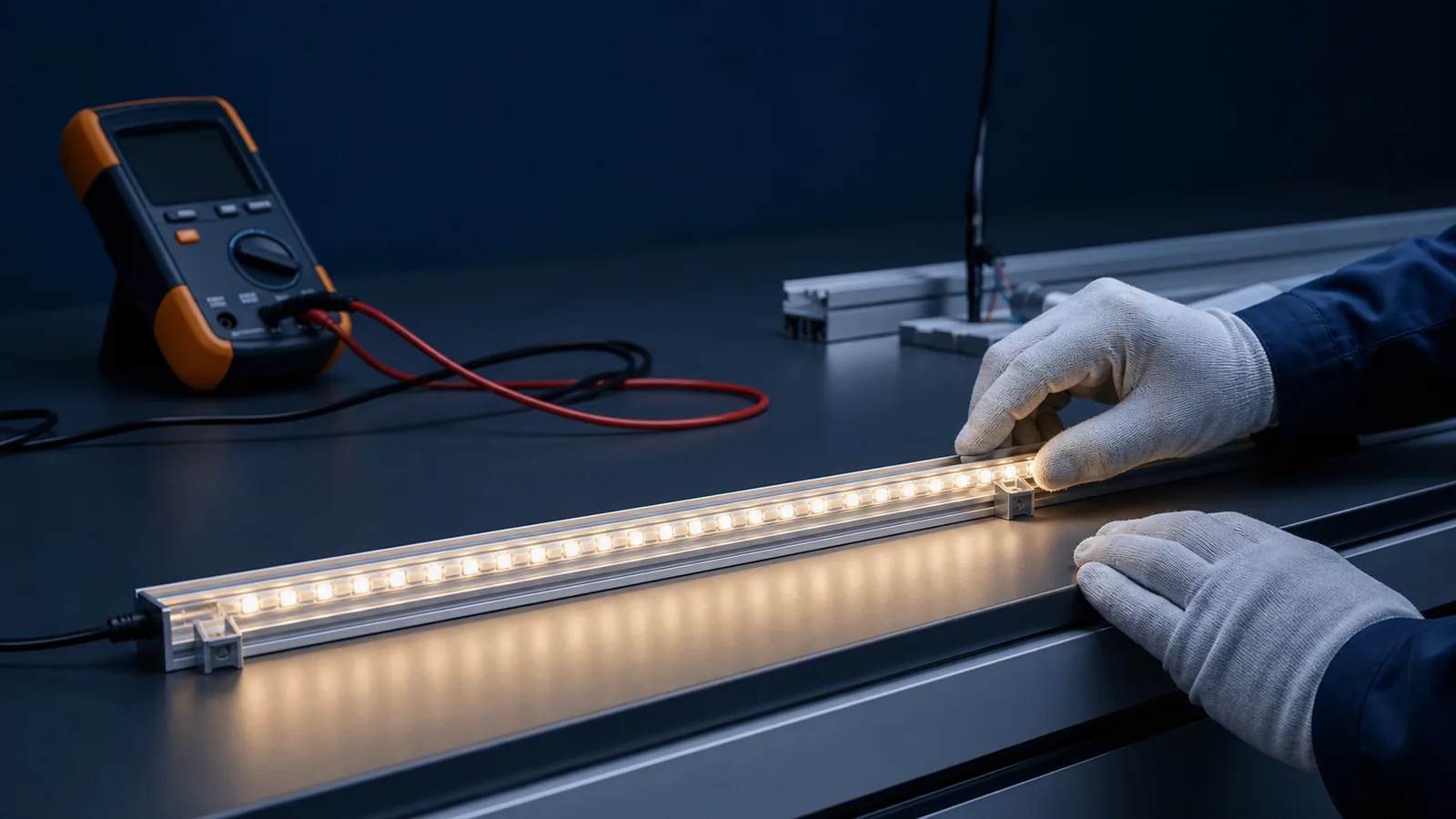
For long continuous lines, segment-to-segment solder quality and the feed layout can matter more to early field failures than the nominal LED life. A pre-shipment sample should therefore be powered and inspected as an assembled run, not only viewed as an unpowered reel.
Five conditions that change service life
Temperature at the strip
Heat accelerates several degradation mechanisms. Watts per meter, PCB width, copper construction, mounting contact, airflow and waterproof encapsulation all affect temperature. Use the exact IP construction in the thermal trial; an indoor sample does not qualify an encapsulated version.
Our guide to LED strip temperature and aluminum profiles gives a repeatable way to define the measurement point and test the intended assembly.
Input voltage and electrical loading
Overvoltage can increase power and temperature. Poor contacts create local hot spots. A long feed may leave the far end dim while the section nearest the supply is heavily loaded. Confirm the strip, driver and controller voltage, then check the voltage at the strip input under load.
Mounting and bending
A strip installed flat in a suitable profile is mechanically and thermally different from a strip folded around a sharp corner or bridged over screw heads. Repeated bending near solder joints and connectors can break copper tracks even when the LEDs remain healthy.
Moisture, chemicals and ultraviolet exposure
An IP rating describes ingress protection for a defined construction; it is not a general promise of resistance to cleaning chemicals, salt spray, pool chemicals or sunlight. State the exposure and request a material and sealing recommendation for it. See the IP20, IP65 and IP68 selection guide before choosing an outdoor version.
Switching and control quality
The control system can introduce flicker, excessive current, incompatible dimming or repeated thermal cycling. Evaluate the power supply and controller with the selected strip at full output and at the lowest required dimming level.
How should a B2B buyer check a lifetime claim?
Start with the claim exactly as written. If the quotation says “50,000 hours,” ask the supplier to complete the missing sentence.
- Is the number L70, L80, catastrophic failure rate, or another criterion?
- Does it refer to the LED package, a strip sample, or the complete strip and driver system?
- Which LED package, drive current and case temperature support the projection?
- Is there an LM-80 report and a TM-21 projection for the LED package actually used?
- What PCB temperature or solder-point limit applies to the finished strip?
- Which mounting profile, ambient range and waterproof construction were assumed?
- Does a component substitution require buyer approval and new evidence?
- What does the product warranty cover, and what does it exclude?
The public TM-21 calculator supported by DOE illustrates why projection inputs matter: the calculation uses LM-80 data at stated temperatures and drive currents. A projection from one LED package or operating condition should not be silently transferred to a different build.
Convert hours only after the basis is credible
To translate a supported hourly value into calendar time:
Calendar years = rated hours ÷ operating hours per day ÷ 365
For example, 30,000 hours divided by 12 hours per day is about 6.8 years. This is arithmetic, not a promise that a strip will last 6.8 years. The result still depends on the claimed threshold, test basis, installation and system components.
A practical qualification plan before a large order
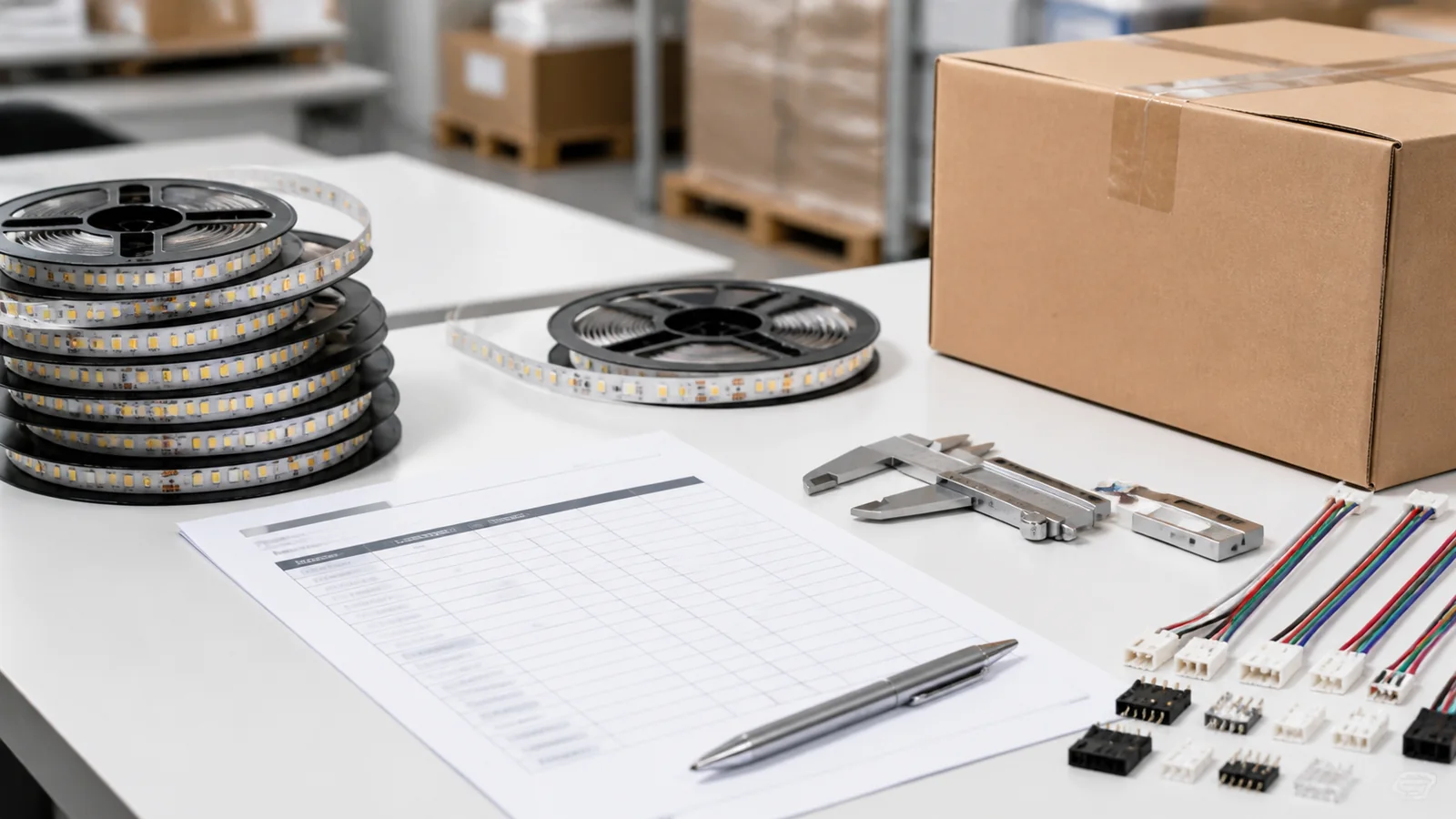
Use the intended driver, controller, profile, diffuser, cable and waterproof version. Record the exact model and batch so the result can be traced.
- Inspect PCB width, cut length, solder joints, connectors, encapsulation and reel marking against the approved specification.
- Measure input voltage, current and power at full output after the assembly reaches stable temperature.
- Record strip temperature at agreed points in the expected worst-case ambient condition.
- Check initial output and color with an agreed method. Keep the results with the sealed approval sample.
- Cycle the control states needed by the project and inspect for flicker, dropout, noise and abnormal local heating.
- Run an agreed powered-aging screen. Define its duration and acceptance criteria in the purchase specification; do not invent a duration after a failure appears.
- Recheck electrical, visual and color results after the screen.
- Apply the same critical checks to production using the pre-shipment inspection plan.
This screen cannot prove a multi-year lifetime. It can expose assembly defects and compatibility problems before thousands of meters are shipped.
What to put in the RFQ
- exact strip model, voltage, watts per meter, PCB width, CRI, CCT and IP construction;
- meters per powered branch, feed-point plan and connector type;
- mounting profile, diffuser, surface and enclosure details;
- expected ambient range, operating hours per day and dimming schedule;
- lifetime criterion required by the project, such as a stated lumen-maintenance point;
- supporting evidence required for the LED package and finished assembly;
- color-tolerance and color-maintenance requirement where visual matching matters;
- powered-aging, thermal and production-inspection methods;
- change-control rule for LEDs, PCB, resistors, adhesive, silicone, driver and controller;
- warranty period, exclusions, claim evidence and remedy.
Use the COB LED strip range or SMD LED strip range to identify a candidate model, then send its installation and operating conditions through the quotation form. We can confirm the current specification and available supporting documents for that model; a lifetime value should not be assumed from the product family name alone.
Catalog & Sourcing Note
This article is prepared from our current product catalog and B2B specification workflow. Electrical, waterproofing and installation requirements vary by model and market, so confirm the final specification and approved sample before ordering.
Discuss Your Specification