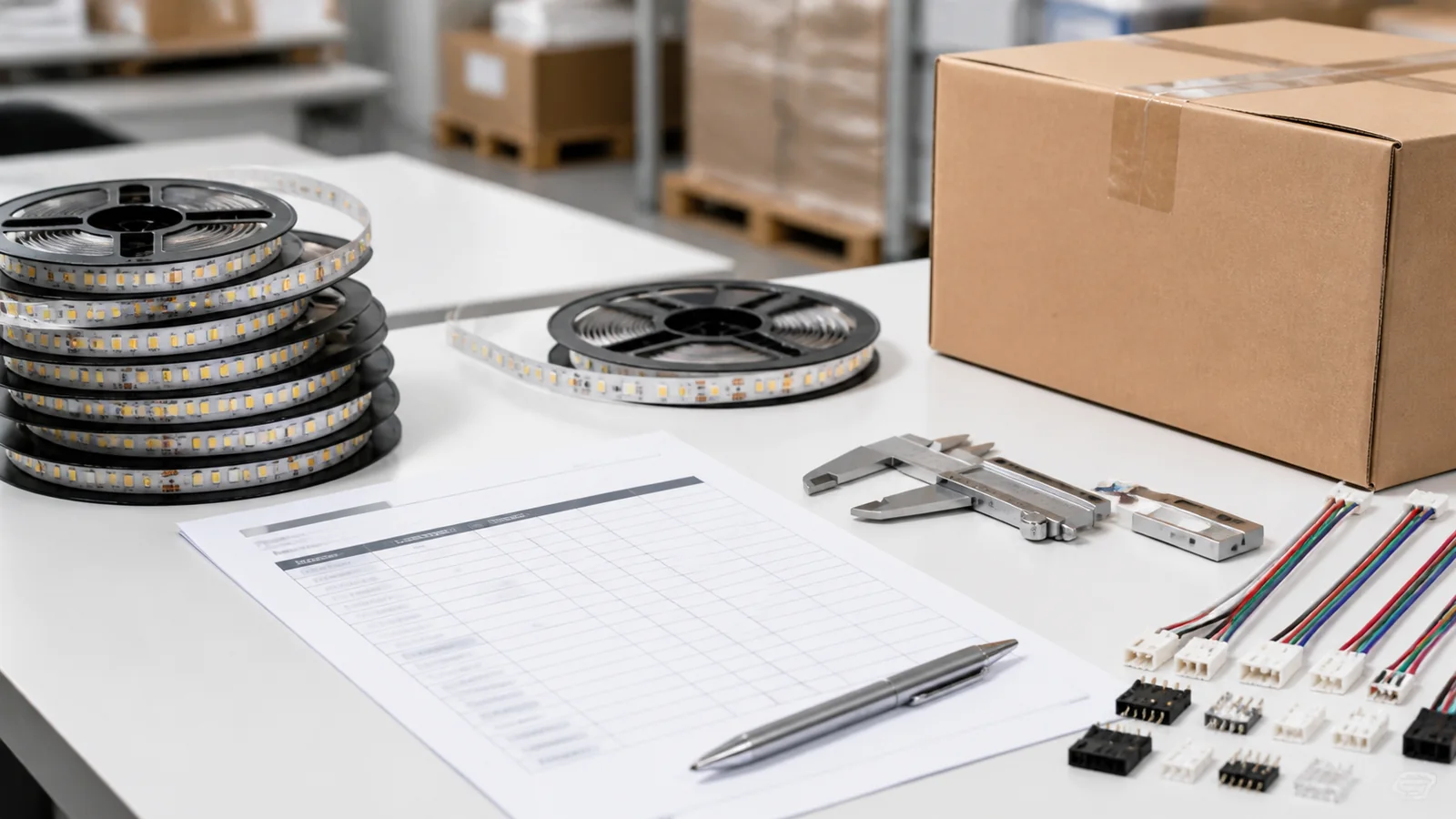
Importing LED strips successfully requires more than finding the lowest price per meter. The buyer must control the model definition, sample approval, document scope, production inspection, packaging, and change management.
Use the following 18 questions as an RFQ and order-review checklist. They are designed for importers, distributors, private-label brands, and project contractors.
Before the Quotation
1. What is the application?
State where the strip will be installed: cabinet, cove, shelf, facade, landscape, sign, vehicle, seasonal decoration, or another use. Include viewing distance, operating hours, indoor/outdoor conditions, and whether the strip is visible directly or through a diffuser.
2. What is the exact electrical requirement?
Specify voltage, watts per meter, total length per circuit, feed arrangement, dimming or controller type, and destination-market frequency where relevant. Ask the supplier to recommend cable and maximum powered length for the exact model.
3. What light quality is required?
Define color temperature, tolerance, CRI target, brightness, consistency, RGB/RGBW/addressable function, and any project-specific color requirement. “Warm white” alone is not a complete specification.
4. What mechanical construction is required?
Confirm PCB width, cut interval, reel length, bending direction, profile dimensions, connector space, adhesive, cable exit, and waterproof construction.
5. What is the real order quantity?
Separate sample quantity, trial order, and forecast volume. Standard products start at 500 meters; custom products start at 2,000 meters. Confirm the requested changes on the quotation. Accurate volume helps the supplier select practical materials and packaging.
Sample and Specification
6. Does the quotation identify a model?
Each price should map to a model code and specification. Avoid approving an order described only as “COB 24V” or “2835 waterproof,” because many different constructions fit those labels.
7. Is the sample production-representative?
Ask whether the sample uses the same PCB, LEDs, adhesive, silicone, cable, connectors, and packaging planned for production. Record any differences in writing.
8. How will the sample be evaluated?
Test power, appearance, color, dimming, flicker, voltage drop, heat, cutting, connections, profile fit, and waterproof sealing as applicable. Use the intended driver and installation materials.
9. Is there an approved reference sample?
Sign or label the approved sample and retain it. Attach the final data sheet, packaging artwork, and agreed tolerances to the purchase order.
10. Which tolerances are acceptable?
Agree acceptable variation for power, dimensions, color, roll length, cable length, quantity, and packaging. If a parameter is critical, write it into the specification rather than relying on a chat message.
Order Records and Quality Control
11. Do all order records identify the same model?
Check that the quotation, specification sheet, sample label, packaging artwork, inspection record and invoice use the same product identity. Resolve model-name or electrical-rating differences before paying the production deposit.
12. Who is responsible for destination requirements?
Importers should verify local electrical, labeling, efficiency, chemical, packaging, and customs obligations. A supplier document does not replace the importer’s regulatory review.
13. What production checks are agreed?
Define incoming checks, in-process inspection, function/aging checks, appearance, power, color, quantity, and waterproof verification where relevant. State whether inspection is 100% or sampled and which acceptance criteria apply.
14. Can a pre-shipment inspection be arranged?
For important orders, use an internal report, video inspection, third-party inspection, or a combination. The inspection checklist should match the purchase specification and approved sample.
15. How are changes controlled?
Require written approval before changes to LED source, PCB, resistor/current design, adhesive, silicone, wire, connector, label, or packaging. This is especially important for repeat orders.
Packaging and Shipping
16. Is the packaging suitable for the route?
Confirm reel type, anti-static bag where relevant, moisture protection, inner box, master carton, carton strength, labels, gross/net weight, dimensions, and pallet requirements. Waterproof extrusions and connectors should not be sharply bent or compressed.
17. Are trade terms and shipment details clear?
Agree currency, Incoterm, payment stage, production lead time, shipment method, port, consignee requirements, document set, and responsibility for duties and destination charges. Ask for final carton data before booking freight.
Repeat Orders
18. What must be reconfirmed?
Before every repeat order, reconfirm model revision, price validity, material changes, color reference, packaging artwork, destination requirements, quantity, lead time, and shipping marks. Use the prior approved sample and inspection data as references.
The best sourcing result is not the lowest first quotation. It is a repeatable product that arrives with the agreed performance, documents, packaging, and delivery plan.
To request a quotation, send your target specification through our quote form. If you are still choosing a family, start with the complete product catalog and describe the application.
Specifications, testing, lead time, and document scope vary by model and order. Confirm all commercial and technical terms in the formal quotation and purchase specification.
Catalog & Sourcing Note
This article is prepared from our current product catalog and B2B specification workflow. Electrical, waterproofing and installation requirements vary by model and market, so confirm the final specification and approved sample before ordering.
Discuss Your Specification