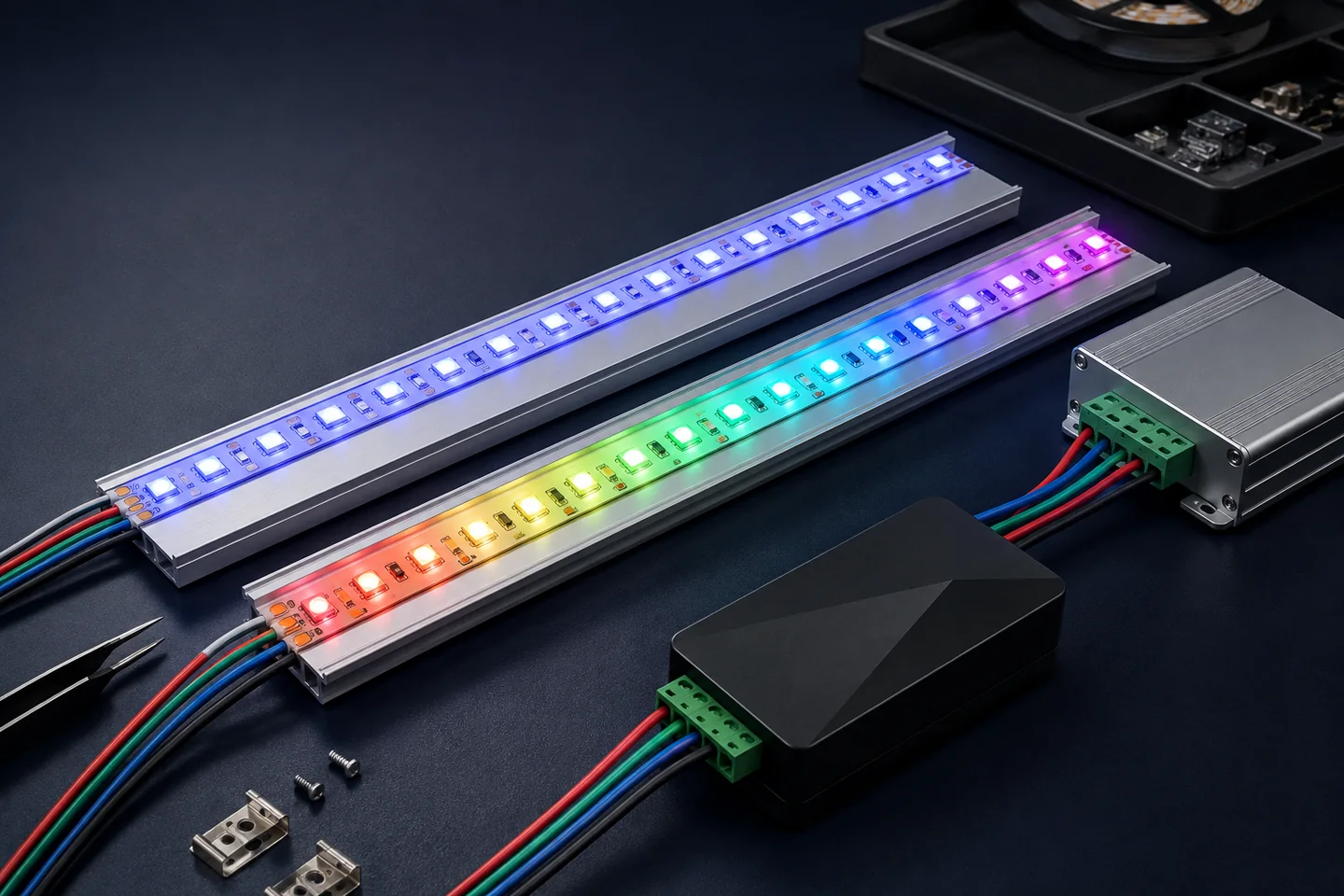
The short answer
Choose a conventional RGB LED strip when an entire circuit can show the same color and simple, repeatable control is more important than animation. Choose an addressable strip when the design needs multiple colors, chases, gradients or individually controlled pixel groups along one run.
The addressable option is not automatically better. It adds an IC and data system, so the buyer must control protocol, pixel grouping, data direction, controller capacity, signal distribution, programming, spare parts and commissioning. For a hotel cove that changes as one zone, conventional RGB may be easier to install and maintain. For a media facade or animated sign, addressable strip may be necessary.
How conventional and addressable RGB strips differ
A conventional constant-voltage RGB strip normally has shared power and separate red, green and blue channels. The controller adjusts those channels for the connected section, so the whole section follows the same color command.
An addressable strip adds control ICs. Data travels through the strip, and each IC controls one pixel or a defined group of LEDs. The exact grouping depends on the model. “60 LEDs/m” does not tell you whether there are 60 controllable pixels per meter.
| Decision point | Conventional RGB | Addressable RGB |
|---|---|---|
| Color along one controlled section | One mixed color at a time | Multiple pixel colors or zones |
| Typical effect | Static color, fade, whole-zone change | Chase, gradient, animation, mapped effects |
| Control wiring | Power plus RGB channels | Power plus model-specific data and reference conductors |
| Compatibility check | Voltage, common polarity, channel current | Voltage, IC/protocol, data direction, timing, grouping and controller |
| Commissioning | Set channels and scenes | Address/map pixels, load effects and test signal integrity |
| Replacement risk | Match voltage, channels and construction | Also match IC, protocol, color order and pixel grouping |
The connector shape does not prove compatibility. Two addressable strips can have the same number of conductors and still use different ICs, data timing, channel order or voltage.
Choose by the effect the client will approve
Write the effect before choosing hardware. Useful questions include:
- Must several colors appear simultaneously on one strip?
- Is the effect a simple chase or a pixel-mapped animation?
- What is the smallest controllable visual segment?
- Will the effect synchronize across separate runs or fixtures?
- What frame rate and transition smoothness does the client expect?
- Who creates and updates the content after handover?
- What should happen if the controller or data line fails?
For retail shelves, back bars, coves and hospitality accents where one zone changes together, conventional RGB can reduce programming and spare-part complexity. For signage, entertainment, themed spaces and dynamic architectural details, addressable strip gives more creative control—but only when the control designer defines the pixel map and system limits.
Do not approve a system from a still photograph. Request a video or physical mock-up showing the exact effect, speed, brightness and dimming behavior. Fast camera footage can also reveal artifacts that are not obvious in a supplier’s edited demonstration.
Specify the controller and protocol with the strip
For conventional RGB, verify strip voltage, common-anode or common-cathode arrangement, maximum current per channel, total controller load, dimming method and amplifier requirements. One controller output may need multiple protected power branches even when all branches follow the same color command.
For addressable strip, record:
- IC or protocol designation;
- supply voltage and data logic requirements;
- one-wire, clocked-data or other interface;
- data input and output direction;
- LEDs per IC and pixels per meter;
- color-channel order;
- controller pixel and port capacity;
- maximum recommended data distance and signal-conditioning plan;
- addressing or mapping method;
- behavior after one pixel or IC fails.
Do not use “DMX” as a generic synonym for all digital strip. ANSI E1.11 DMX512-A is a defined control-data standard; ESTA’s current published standards list identifies ANSI E1.11-2024 as the current edition. Many pixel strips instead use manufacturer-specific serial protocols and need a gateway or pixel controller between the show-control network and the strip.
If the project uses a building-lighting protocol, define the whole chain. The DALI Alliance, for example, lists tunable-white and RGBWAF as distinct color-control types under DALI-2 DT8 color control. A protocol at the building level does not automatically match the electrical interface of the strip.
Plan power and data as separate engineering tasks
Both strip types need a voltage-drop and current plan. Addressable strip also needs a data plan. A larger power supply does not repair a weak data signal, and a clean data signal does not correct low voltage at the far end.
Calculate each power branch from the actual maximum scene. For RGB systems, full mixed output can load several channels simultaneously. For addressable systems, a test pattern with many pixels at high output may draw more current than a typical animation. Do not size the supply only from the effect shown in a sales video.
Confirm:
- maximum watts per meter or per pixel group for the exact model;
- accepted voltage drop and feed-point spacing;
- cable size, connector current rating and branch protection;
- common reference or grounding arrangement required by the controller manufacturer;
- data cable type, route and separation from interference sources;
- controller location, enclosure and environmental protection;
- access for reset, replacement and programming.
Our guide to connecting multiple LED strips explains why parallel branches and feed points should be planned rather than extending one output indefinitely.
Approve the sample as a control system
The sample should contain the production-intent strip, controller, power supply, gateway where applicable, cable, connector and programmed effect. A loose strip powered by the supplier’s demonstration controller does not prove compatibility with the project system.
During approval, test:
- every required static color and white mix;
- low-level dimming and fade behavior;
- the longest and fastest planned animation;
- restart behavior after power interruption;
- appearance from the real viewing distance;
- color order at the first and last pixel;
- signal behavior at the proposed data length;
- temperature and voltage at representative full load;
- replacement of one strip segment without remapping the whole installation;
- saved program, controller configuration and file handover.
For bulk inspection, keep a known-good controller and test program. Verify the first and last controllable group, data direction, channel order and a full-load pattern. Label reels by model, IC/protocol, voltage and batch so similar-looking stock is not mixed.
RGB strip RFQ checklist
Send these details before requesting a price:
- conventional RGB or addressable effect requirement;
- effect storyboard, video reference or pixel map;
- voltage, total length and length of each branch;
- LED density and required pixels per meter;
- IC/protocol and controller where already specified;
- color order, data direction and connector pinout;
- indoor/outdoor zone and required IP construction;
- maximum scene, feed points and cable distances;
- programming, commissioning and handover responsibility;
- spare controller, gateway and strip-segment policy;
- sample acceptance test and bulk inspection method.
The current RGB and Magic LED Strip range includes conventional and addressable constructions. Availability and compatibility vary by exact model. Attach the effect and wiring requirements to the quotation request so the strip, controller and power design can be reviewed together.
Catalog & Sourcing Note
This article is prepared from our current product catalog and B2B specification workflow. Electrical, waterproofing and installation requirements vary by model and market, so confirm the final specification and approved sample before ordering.
Discuss Your Specification