The best strip changes with the hotel detail
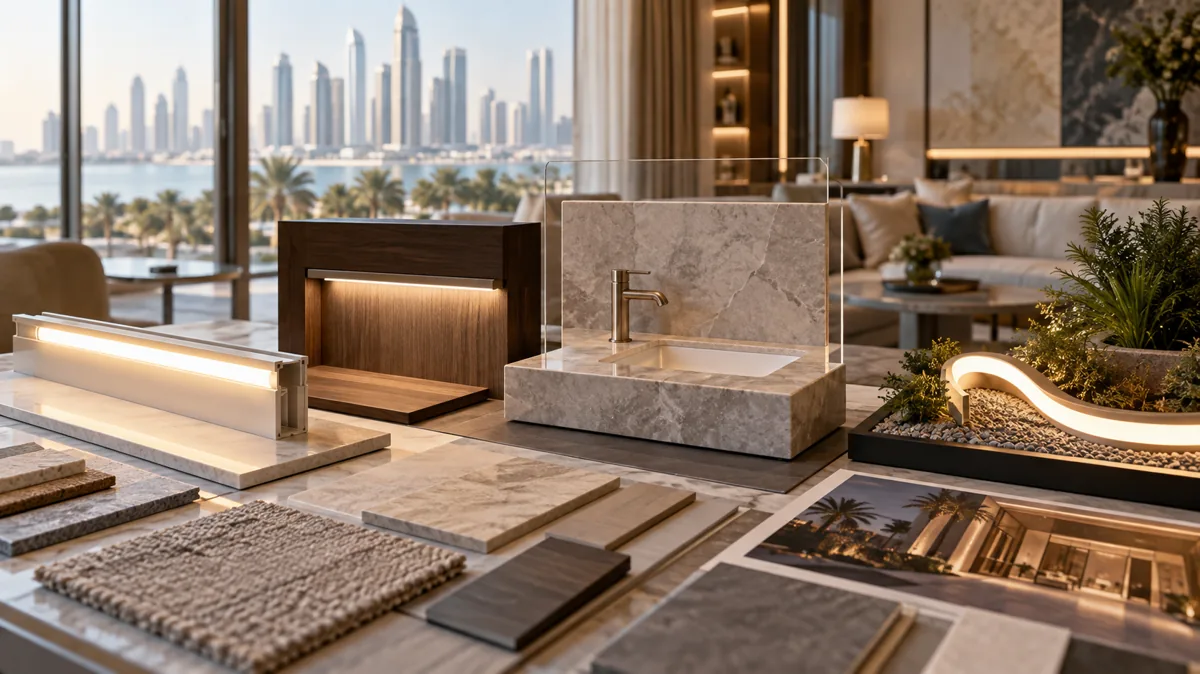
For a GCC hotel project, there is no useful single “best LED strip.” A low-voltage CRI95 COB strip in a suitable profile is a strong starting sample for a shallow interior cove. Narrow COB can fit fine joinery. A high-CRI SMD model is worth comparing where food, fabric or timber color matters. Protected constructions belong in exposed or wet details only after the complete termination and mounting system is reviewed.
The consultant’s required illuminance, color quality, dimming and installation rules take precedence over a catalog description. Mock up the actual material, profile and driver before approving a bulk order.
Why Dubai and Riyadh cannot use one generic hotel detail
An air-conditioned guestroom cove, a semi-open arrival canopy and a sun-exposed entrance are different thermal and environmental locations, even within one hotel. Saudi Arabia’s National Center for Meteorology describes summer maximum temperatures commonly in the 35–45°C range nationally and notes differences between coastal and inland regions. That is climate context, not a permitted operating-temperature rating for any LED model. UAE project teams should likewise use the actual site and enclosure design rather than assuming a Dubai indoor rating carries over to an external feature.
Heat is not the only issue. A cool interior adjoining a humid outdoor area can create condensation at poorly detailed entries. Dust, cleaning methods, direct sun, access panels and the way a ceiling or facade is drained can decide whether a protected strip survives. The IEC 60529 IP-code standard classifies ingress protection of enclosures; an IP label does not establish UV resistance, allowable ambient temperature or a field-cut joint’s protection.
For Saudi and UAE buyers, a separate market-entry and project-submittal review is also needed for the exact imported model and sales route. Our strip quotation covers the written product specification; no market-entry approval is included by default. The importer and project consultant must identify required tests, documents and responsible parties before ordering. See the Saudi project page and UAE importer page for the destination-specific enquiry questions.
Six configurations to sample by hotel zone
1. Shallow lobby or corridor cove: 8mm CRI95 COB in an aluminum profile
The COB 8mm 320LED CRI95 model lists DC12/24V, 8mm PCB and 12W/m. A DC24V sample is a reasonable first comparison when feeds are dispersed through a ceiling; the engineer still needs to calculate the actual branches. Review warm CCT, visible dots, diffuser transmission, driver access and heat at the finished profile. A long reception cove with no driver access is a maintenance problem, however attractive the sample looks.
2. Tight headboard or millwork recess: narrow 3mm CRI90 COB
The 3mm CRI90 COB model lists DC12/24V and 7W/m. Its narrow PCB can help where the recess will not accept a conventional 8mm strip. The trade-off is less room for a wide adhesive contact and profile choice. Test the exact furniture finish, cable turn and cleanability. The 3mm figure is PCB width, not a promise that the complete installed channel will fit a 3mm slot.
3. Finish-sensitive restaurant or suite detail: high-CRI SMD in a diffused channel
The SMD2835 8mm CRI98 model lists DC12/24V and 10W/m. It is a comparison sample where timber, fabric, food or artwork color needs evaluation. CRI alone does not settle saturation or the appearance of a specific finish; approve lit samples against the actual materials and ask for the project’s required color-quality values. A diffuser may be needed to avoid visible points.
4. Vanity or splash-adjacent detail: protected strip plus a drawn joint
For locations the consultant identifies as wet or splash-exposed, an IP68-listed DC12/24V COB model is a product example to inspect. Its catalog CRI is 80 and power is 10W/m; do not substitute it for a high-CRI makeup-lighting requirement without a visual mock-up. Keep the power supply and connections in approved locations. A field cut, adhesive, channel and cable entry are not IP68 merely because the uncut strip model has that listing.
5. Semi-open entrance accent: protected 24V SMD with maintainable feeds
The DC24V IP68 SMD model lists 8W/m and CRI80. It can be evaluated as one strip candidate, not as an approved entrance assembly. A shaded canopy and a fully sunlit facade demand different ambient and material checks. Verify the exact sheath, UV exposure, termination, mounting and drain path. Give the facilities team a replaceable section and reachable feed location.
6. Visible contour or decorative feature: neon flex with a measured bend
For a visible line around a reception feature, use the neon-flex range only after fixing profile dimensions, bending direction, cut unit and cable exit. A DC12V 6×12mm 5m kit exists in the catalog, but its listed IP construction needs confirmation for the selected version. Do not place an indoor decorative kit outdoors based on a styled photograph. Prototype the tightest turn and the mounting clips.
What each shortlist solves—and what it does not
| Hotel zone | First sample | Main approval question |
|---|---|---|
| Lobby/corridor cove | 8mm CRI95 COB, profiled | Is the line uniform and serviceable after the real diffuser? |
| Fine joinery | 3mm CRI90 COB | Does the recess fit the entire assembly and cable bend? |
| Restaurant/finish display | CRI98 SMD, diffused | Do materials look right under the required CCT and controls? |
| Vanity splash zone | Protected COB construction | Are cuts, driver position and entries approved as a system? |
| Semi-open entrance | Protected 24V SMD | Do sun, heat, dust and access conditions match the model and detail? |
| Visible feature outline | Neon flex | Is the bend direction, cut unit and mounted light line correct? |
These are not interchangeable substitutions. The first three are interior-lighting comparisons; the last three require installation and environmental review beyond the reel label.
Make the mock-up do real procurement work
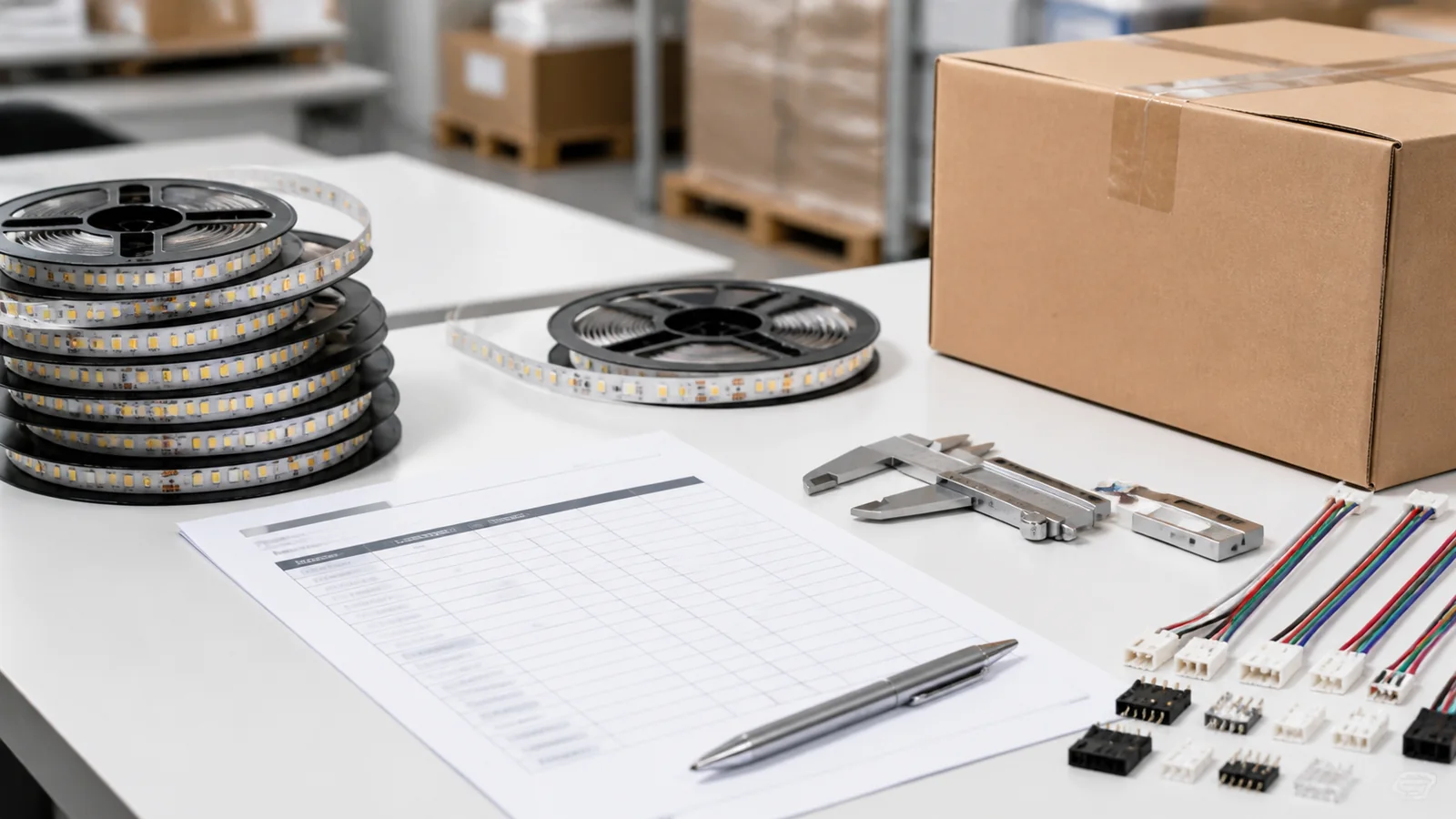
Build one production-intent section of each important detail: approved strip, profile, diffuser, finish, driver, control and joint. View it at normal guest distance, then inspect glare and color beside adjacent rooms. Record full-load power, branch voltage at both ends, visible output and assembly temperature after warm-up. For an exterior or vanity detail, inspect the finished seal and maintenance route too.
Attach the model-specific drawing and accepted sample reference to the purchase order. For replenishment, define how adjacent room batches will be matched; our color-consistency guide explains why an identical CCT label alone is insufficient. Keep the project’s technical acceptance documents separate from market-entry paperwork. We will only confirm what is available for the exact ordered model in writing.
A GCC hotel RFQ that can be answered accurately
Send the room and zone schedule, CCT and color-quality targets, profile drawings, diffuser material, linear meters by circuit, driver and dimming method, maximum ambient at each location, exposure and cleaning method, cable-entry drawing and replacement access. State whether the shipment is for UAE mainland, UAE re-export or Saudi import, and who will confirm local product-entry and project-submittal requirements.
Our standard MOQ is 3,000m; OEM review starts from 5,000m, subject to the chosen model and artwork scope. Samples and a written specification should come before a broad room rollout. You can send the zone schedule for a model-matched quote or use the GCC market hub to organize the first enquiry.
Catalog & Sourcing Note
This article is prepared from our current product catalog and B2B specification workflow. Electrical, waterproofing and installation requirements vary by model and market, so confirm the final specification and approved sample before ordering.
Discuss Your Specification