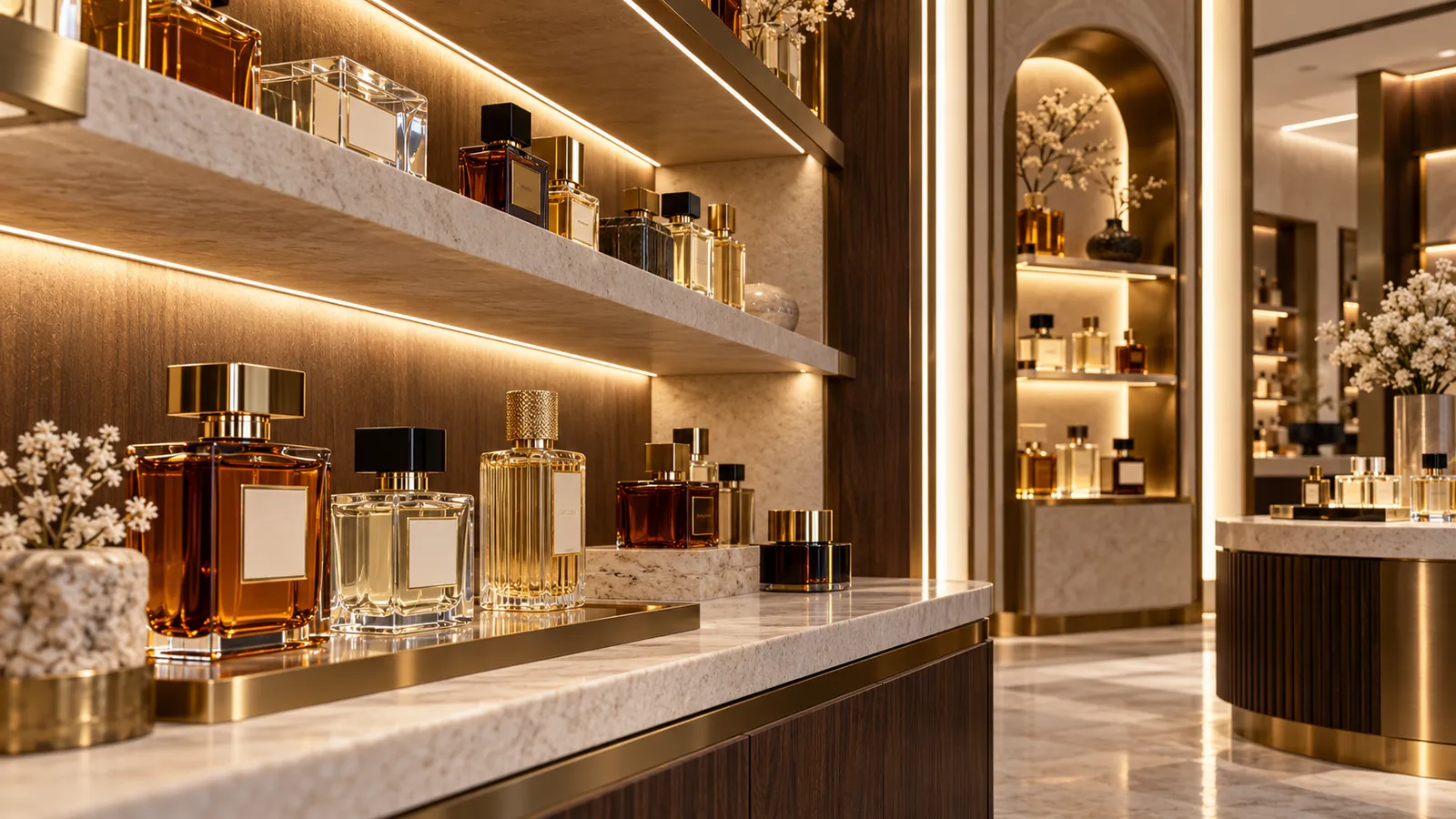
Concealed under-shelf lighting is a useful starting layout for dense perfume shelving. Paired vertical profiles suit taller bottle displays; a diffused back panel suits a feature bay where its brightness can be controlled. Choose the layout by testing label readability and reflections with the actual bottles before repeating it across a UAE or Saudi store.
Assess each fixture position for useful light on merchandise and control of reflected lines. It must also fit the joinery, allow service access and meet the merchandise owner’s exposure requirements. The five comparisons below use those common criteria as design judgments to test in a mock-up; they do not report measured performance rankings.
ERCO’s retail presentation guidance explains how uniform shelf lighting supports recognition of product details and how directional accent lighting emphasizes shape and shiny surfaces. Strip lighting can provide a shelf or architectural layer. Separate accent luminaires may still be needed to give bottles the desired highlights.
Compare the five layouts against the fixture
| Layout | Best starting application | Main limitation to check | Mock-up decision |
|---|---|---|---|
| Concealed under-shelf line | Repeated rows of boxed and bottled products | Tall bottles can shadow labels below | Read labels across a stocked shelf |
| Paired vertical profiles | Tall feature bays with mixed bottle heights | Reflected vertical lines on curved glass | Review reflections from customer positions |
| Diffused back panel | Selected feature bays and translucent bottles | Bright backgrounds can obscure front labels | Balance background and front illumination |
| Shielded tester-counter line | Counter edges and shallow tester displays | Glare, spills and cleaning access | Check seated and standing use |
| Recessed niche perimeter | A small feature group or architectural recess | A bright frame can dominate the merchandise | Compare product visibility with the frame dimmed |
1. Concealed under-shelf lighting for repeated rows
Place the profile beneath the shelf above and use the shelf edge or a designed shield to conceal the source. Adjust its setback and direction using the actual shelf depth. A line aimed behind the bottle may illuminate the background while leaving the front label dark.
Stock the sample shelf at its planned density. Include tall bottles and cartons beside shorter items. Check the lower row as well as the most visible eye-level shelf. Choose this layout when labels remain readable across the loaded bay and staff can reach the tape assembly for replacement.
2. Paired vertical profiles for tall feature bays
Vertical profiles at the sides of a bay provide another direction of light when shelf geometry restricts an overhead line. Conceal the emitting surfaces from normal viewing angles and test the left and right lines separately before operating both together.
Curved glass can reflect each profile as a bright stripe. Move the profile or adjust shielding if that stripe crosses a brand label. For mixed bottle heights, evaluate this layout once the joinery supplier has allowed space for the profile and its wiring route.
3. Diffused back panels for selected feature displays
A luminous background can emphasize the silhouette of a translucent bottle. It may also reduce label contrast if it is too bright relative to the front illumination. Provide independent control so the background can be adjusted during the merchandise review.
Use a full-depth sample of the proposed diffuser and backing arrangement. A bare tape sample cannot show whether the finished panel has visible bands or dark edges. The COB strip range offers tape candidates for evaluation; the finished optical result still depends on the complete assembly.
4. Shielded lines around tester counters
Place the concealed counter line according to its intended function. A low plinth glow can define the counter base, while a separately positioned line may illuminate a shallow tester shelf. Test both functions in the sample; one position may not serve both.
View the counter from standing and seated positions where seating is provided. Check reflections in polished stone and glass. Coordinate profiles, electrical enclosures and cleaning access with the fixture supplier, including the expected presence of spills. Keep the lighting assembly clear of loose blotters and stored packaging.
5. Recessed perimeter lighting for a feature niche
A concealed perimeter can separate a small product group from its surrounding joinery. Dim the perimeter during review to find whether the bottle remains the visual focus. If the front label still needs light, include a separately aimed source in the design.
Provide access to remove the profile and reach its connections. A sealed recess can look tidy yet be difficult to repair after the shop opens. Use the perimeter where its architectural effect supports the merchandising brief.
Review actual bottles under the complete lighting
Test clear, amber and opaque bottles, together with reflective caps and the intended packaging. Read small labels from the customer’s browsing positions. Review the complete bay under the store’s ambient and accent lighting; a dark-room tape demonstration will not reproduce that balance.
Compare available CCT and color-rendering options with the merchandise team. A single preferred CCT cannot be assumed for every bottle finish or store palette. Keep the approved combination consistent across repeated bays and record which tape variant was accepted.
Ask the merchandise owner to define any light-exposure or temperature restrictions. This shortlist does not establish a fragrance shelf life or a preservation limit. The UV and display-exposure guide explains why a low-UV claim alone cannot answer that question. Monitor the fixture’s thermal behavior separately from its appearance.
Prepare a fixture schedule that purchasing can use
Give each bay its own reference and record the approved lighting position, tape variant, profile, cover and control group. Include strip lengths, feed locations and access panels. Confirm the electrical load and the driver’s permitted operating conditions before the joinery is closed.
For repeat orders, keep the approved sample identity with the schedule. Reassess changes to the diffuser, bottle arrangement or shelf finish because these can change the visible result even when the tape remains the same.
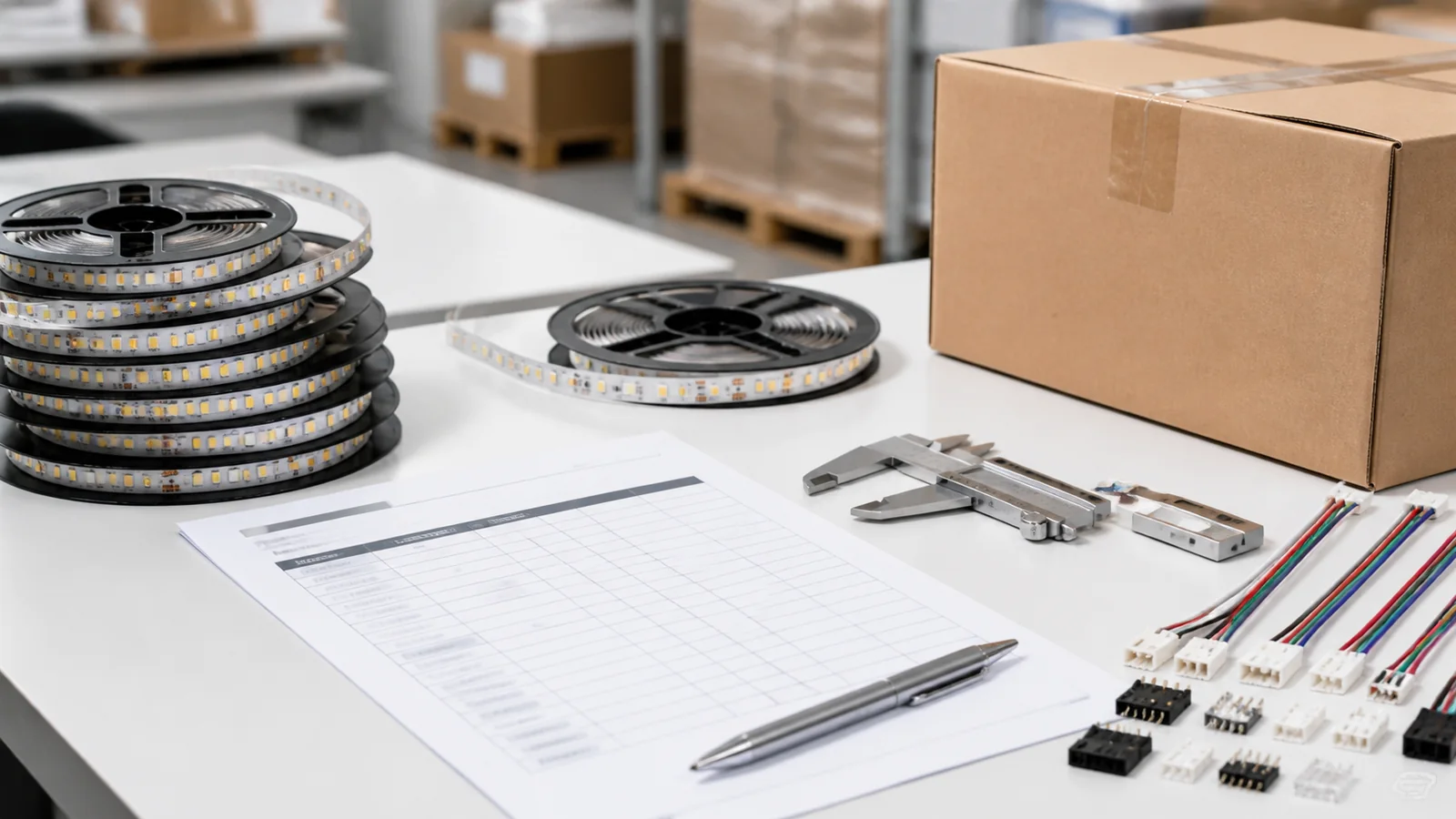
LEDStripStar’s current MOQ is 500 meters for standard products and 2,000 meters for custom products. The ordinary warranty is 2 years; confirm the applicable order terms. Discuss variant quantities when preparing the purchase schedule.
Send the shelf drawing and selected layout for a quotation. Include the mock-up observations and unresolved merchandise requirements so the proposed tape can be assessed against a defined fixture.
Catalog & Sourcing Note
This article is prepared from our current product catalog and B2B specification workflow. Electrical, waterproofing and installation requirements vary by model and market, so confirm the final specification and approved sample before ordering.
Discuss Your Specification