Begin with the surface, viewing angle and service route
For a GCC restaurant dining room, a warm-white DC24V COB strip in an aluminum profile is a sound first sample for coves, shelves and counters. The final choice depends on food presentation, finishes, viewing angle, dimming, cleaning and access. Exterior areas need their own products and installation details; copying the interior schedule and changing only the IP rating leaves major site conditions unresolved.
The seven configurations below form a practical shortlist for samples and design review. The lighting calculation and electrical drawings still govern the installed system.
Seven configurations to compare on a full-size mock-up
1. Dining-room cove: DC24V CRI95 COB in a deep profile
The 8mm 320LED CRI95 COB model lists DC12/24V, 12W/m and 3000K, 4000K and 6500K options. Start by sampling DC24V and the intended warm CCT behind the actual cove lip. Check the result beside timber, stone, upholstery and the general downlighting. Put drivers behind marked access panels.
2. Host counter or bar: concealed COB with a glare shield
Light the counter face or underside without exposing the source to seated guests. Coordinate the profile depth with the joinery drawing and leave room for cable exits. If the counter includes sinks, ice or cleaning water, the designer must review the strip, connections, driver and electrical location as one system.
3. Display shelf: narrow high-color-quality strip
The 3mm 400LED CRI90 COB model can be evaluated for narrow joinery. Place the source toward the front of a shelf to reduce back shadows, then shield it from the normal approach angle. Use short service sections so staff can replace one bay without dismantling the entire display.
4. Open-kitchen pass: profile-mounted strip away from heat and grease
Treat the pass as a task-lighting location with a demanding cleaning environment. Measure the mounting-surface temperature during service, document grease exposure and keep the driver away from the hot zone. A protected strip does not establish suitability for heat, steam, cleaning chemicals or food-area rules. The project consultant must approve the location and materials.
5. Restroom mirror: diffused light with location-specific electrical review
Use a profile or concealed edge that lights faces without a bright reflection in the mirror. Check CCT and color quality on the finished wall and countertop. The electrical designer must confirm the wet-area zone, driver position and allowed equipment. Field-cut joints need their own protection detail.
6. Sheltered terrace: protected low-voltage strip with drainage
The 8mm DC12/24V IP68 COB model is one catalog construction to review. Confirm the exact model against heat, humidity, cleaning, sun exposure and mounting conditions. Detail the profile, clips, cable entry, end seals and drainage so the system does not trap water.
7. Entrance or facade line: neon flex with planned feeds and mounting
Select a neon strip by voltage, cross-section and bending direction. Map every straight, curve, corner and feed on the elevation. Confirm cut unit, maximum supported run, attachment spacing and driver access before the facade contractor starts work.
Match each restaurant zone to its main approval question
| Zone | Starting configuration | Approval question |
|---|---|---|
| Dining cove | DC24V CRI95 COB | Does the cove hide the source and match the finishes? |
| Counter or bar | Shielded COB profile | Can guests see glare from seated positions? |
| Display shelf | Narrow CRI90 COB | Can one shelf bay be serviced independently? |
| Kitchen pass | Profile-mounted task strip | Are heat, grease and cleaning conditions documented? |
| Restroom mirror | Diffused high-color-quality strip | Is the electrical location approved? |
| Terrace | Protected low-voltage strip | Where can water enter or remain trapped? |
| Entrance or facade | Neon flex | Are bend direction, feeds and fixings shown on the elevation? |
Use the table to plan samples. The project specification remains the controlling document, and a restaurant can need different power, CCT and protection within the same zone because the mounting details differ.
Check indoor and outdoor boundary conditions in GCC projects
Saudi Arabia’s National Center for Meteorology describes hot summers and different coastal and inland conditions. A terrace profile in afternoon sun, a facade channel and an air-conditioned dining-room cove can have very different temperatures. Record the mounting-surface and enclosure temperature for each location.
At glazed entrances, humid outdoor air may meet cooled interior surfaces. Review cable entries, seals and drainage where the installation crosses that boundary. IP classification covers enclosure protection against ingress; it does not state operating temperature, UV resistance, chemical compatibility or the performance of a site-made joint. The IEC 60529 publication page defines the scope of the IP Code.
The importer, restaurant consultant and electrical designer must establish the destination and project requirements for the exact equipment. LEDStripStar’s standard quotation is based on the written product specification. Any additional testing or paperwork must be defined and agreed before the order.
Mock up one guest view and one service detail
Build a dining cove or shelf bay with the final finish, strip, profile, diffuser, driver and dimmer. View it from seated and standing positions, then check low-level dimming, color beside food and finishes, end-to-end brightness, heat and driver noise. Build the exterior termination with its real cable entry, end seal, profile and drainage path.
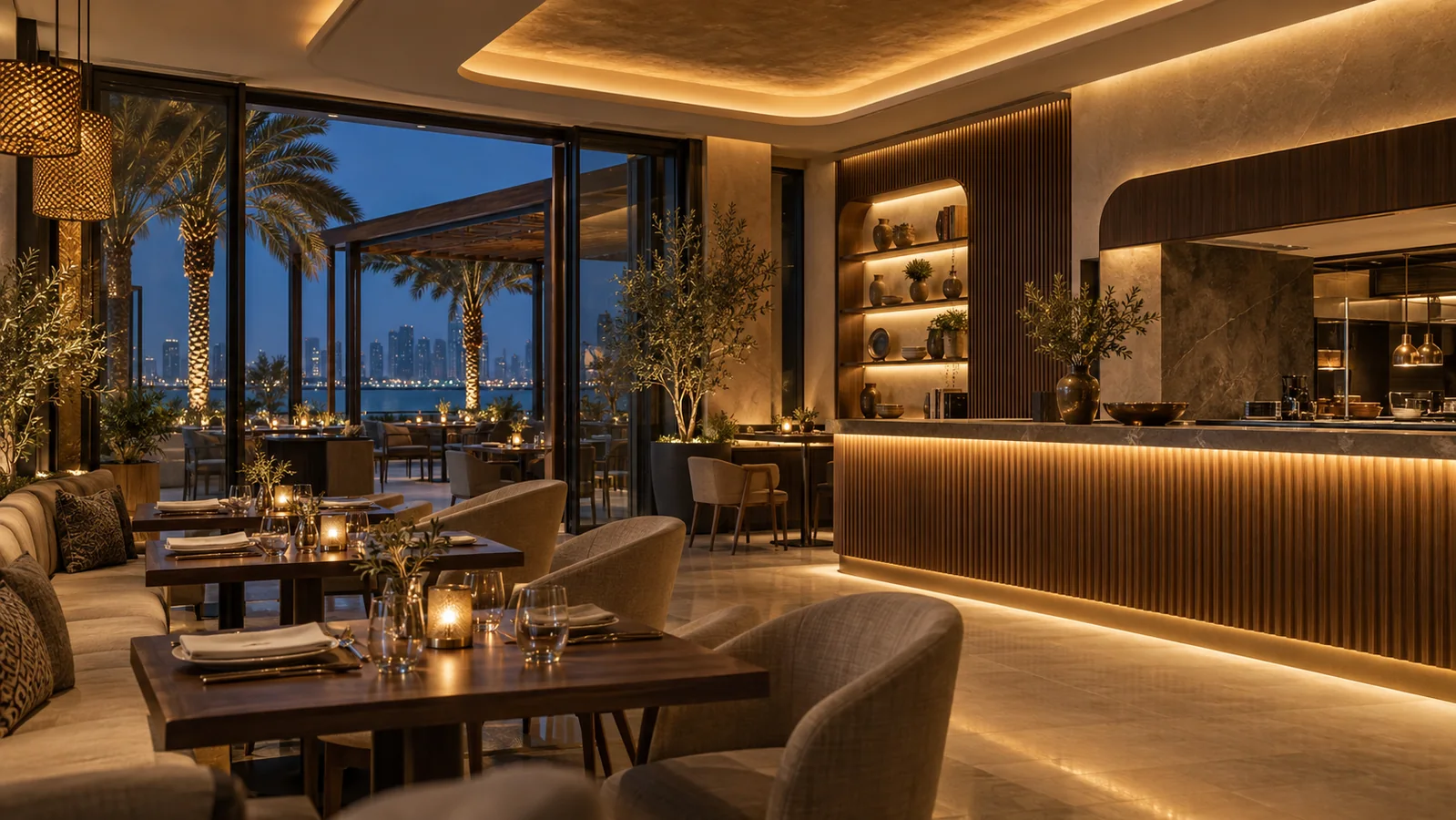
The header image is an architectural concept and does not document a completed restaurant project. Every visible detail still needs site-specific review.
Send reflected-ceiling plans, joinery sections, kitchen-pass details, wet-area zones, terrace plans and facade elevations through the quote request. List voltage, watts per meter, CCT, CRI, run lengths, feed locations, controls, mounting surface and exposure for every zone. The GCC market page helps organize destination and importer information before quotation.
Catalog & Sourcing Note
This article is prepared from our current product catalog and B2B specification workflow. Electrical, waterproofing and installation requirements vary by model and market, so confirm the final specification and approved sample before ordering.
Discuss Your Specification