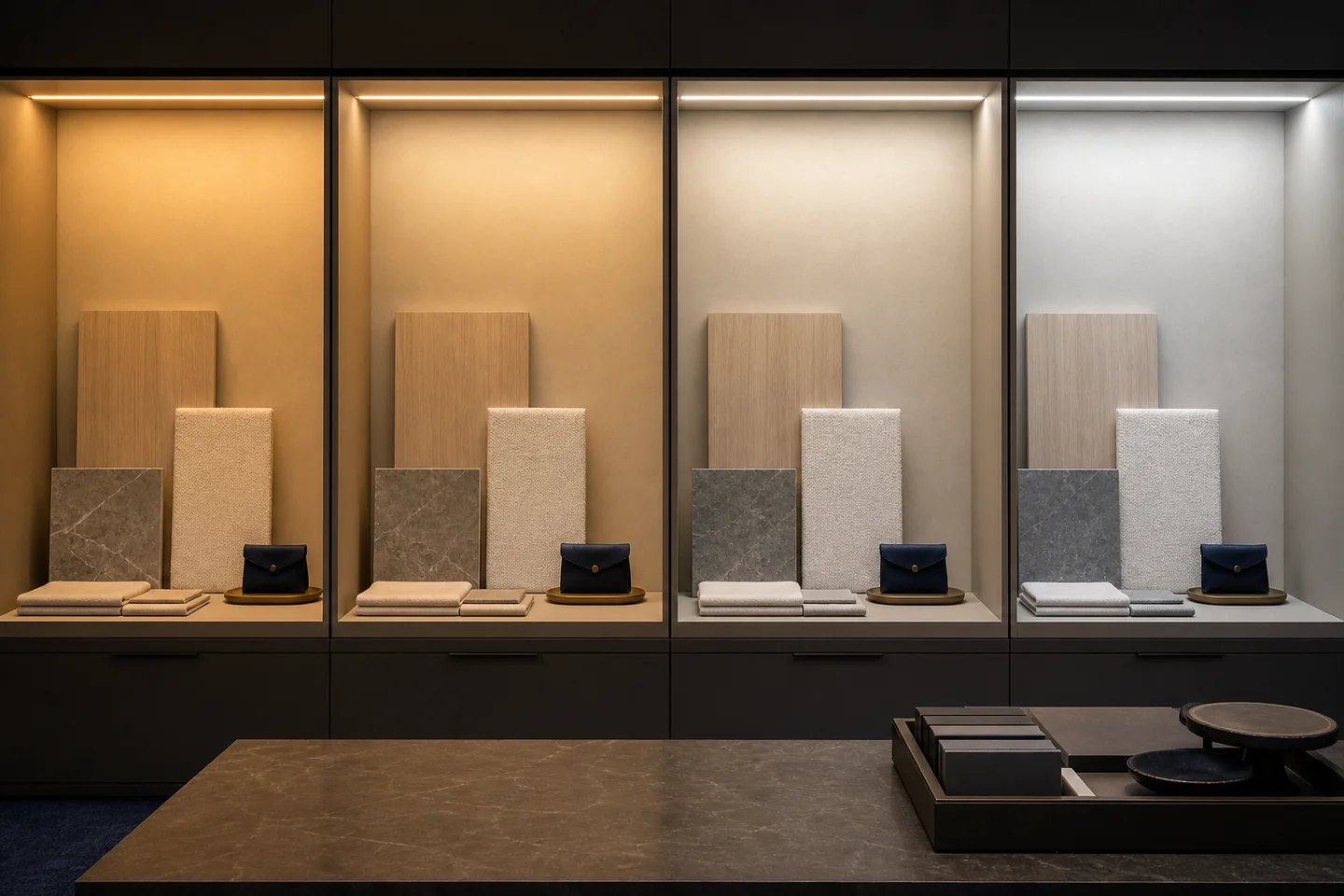
The short answer
Use 2700K for a distinctly warm, intimate appearance; 3000K for warm hospitality and residential-style commercial interiors; 4000K for a cleaner neutral appearance in offices, shops, kitchens and general retail; and 6500K only where a very cool daylight appearance is deliberately required. There is no universally “best” CCT.
Approve the choice on site with the actual wall, wood, stone, merchandise and diffuser. CCT describes the color appearance of the light, not brightness, color rendering, efficiency or quality. Two products carrying the same CCT label can still look different.
What color temperature actually describes
Correlated color temperature is expressed in kelvin. The CIE definition of CCT relates a light source’s chromaticity to the nearest point on the Planckian locus. In practical buying language, lower values usually look warmer and higher values look cooler.
That scale can be counterintuitive: a 2700K strip looks visually warmer than a 6500K strip even though its numerical value is lower.
Federal LED guidance published through the U.S. Department of Energy describes roughly 1800–2700K as warm and 4500–6500K as cool, while emphasizing that a higher or lower number does not mean better performance. It also notes that products with the same CCT may not appear identical. See the 2024 LED lighting and controls guidance.
2700K, 3000K, 4000K and 6500K compared
| CCT | Typical visual impression | Useful starting applications | Check before approval |
|---|---|---|---|
| 2700K | Warm, amber-leaning white | Restaurants, lounges, bedrooms, warm timber interiors | Whites may appear warmer; confirm fabrics and finishes |
| 3000K | Warm white with a cleaner feel | Hotel coves, lobbies, corridors, joinery and villas | Confirm consistency across rooms and dim levels |
| 4000K | Neutral to moderately cool white | Offices, modern kitchens, shelves and general retail | Check glare, merchandise appearance and nearby luminaires |
| 6500K | Very cool daylight appearance | Selected task, inspection or intentionally cool environments | Confirm the client requested it; avoid accidental mixing with warm sources |
These are starting points, not design rules. Illuminance, spectrum, interior colors, adaptation, daylight, age and culture can affect the final impression.
Choose CCT from the application and materials
Hotels, restaurants and lounges
2700K or 3000K is a common starting range when the design uses warm wood, brass, stone and soft furnishings. For a modern business hotel or conference area, 3500K or 4000K may fit the design better. Review our hotel lighting application page, but let the approved interior mock-up decide the final specification.
Retail shelves and supermarkets
4000K often provides a neutral baseline for general aisles and shelves. Product-specific displays may use another CCT or spectrum. Bakery, produce, fashion and jewelry should not be assigned one universal value; evaluate the actual merchandise, high-CRI requirement and surrounding ambient lighting. The supermarket lighting guide shows relevant strip options.
Cabinets, furniture and kitchens
3000K suits warm timber and traditional interiors, while 4000K often suits white, gray and contemporary finishes. If upper and lower cabinets are lit by different batches, a small CCT mismatch can become obvious because the lines are close together.
Offices and task areas
4000K is a practical starting point for many commercial workspaces, but CCT does not establish adequate task light or visual comfort. Check lux, glare, surface reflectance and the rest of the lighting system.
Outdoor and architectural work
The selected CCT must fit the design intent, local requirements and environmental context. Do not assume cooler light is automatically safer or brighter. Beam control, intensity, operating hours and the surrounding environment also matter.
CCT is not the same as color quality
Four separate questions belong in the specification:
- CCT: Does the light appear warm, neutral or cool?
- Duv or tint: Does it sit above or below the Planckian locus, affecting greenish or pinkish appearance?
- Color fidelity: How does the spectrum render objects, assessed with CRI and, where required, additional metrics?
- Color consistency: How closely do adjacent strips and repeat batches match?
The DOE’s LED basics guidance notes that CCT condenses color appearance with significant loss of information and distinguishes it from color fidelity. A “4000K high-CRI” request is therefore more useful than “white,” but it still needs tolerances and a sample.
For adjacent coves or shelves, define a color-tolerance method and batch controls. The SDCM and LED binning guide explains why nominal CCT alone cannot control visible differences.
How to approve CCT without creating a repeat-order problem
Request powered samples from the intended product construction and view them:
- inside the proposed aluminum profile and diffuser;
- against the real wall, ceiling, wood, fabric or merchandise;
- beside existing luminaires that will operate at the same time;
- at day and night conditions relevant to the project;
- at full output and required dim levels;
- after an agreed warm-up period;
- side by side, not hours apart from memory.
Record the sample model, CCT, measured chromaticity or tolerance data where required, CRI, driver, dimmer, profile and approval date. Seal a reference sample for production comparison.
If the project cannot decide between two fixed values, a tunable-white COB strip may be considered. It adds controller, wiring, channel-load and commissioning requirements, so it should not be specified only as a way to postpone a decision.
CCT checklist for the RFQ
- application and desired visual atmosphere;
- interior materials or merchandise being illuminated;
- fixed white, dim-to-warm or tunable-white requirement;
- target CCT and permitted tolerance;
- CRI and any additional color-fidelity requirement;
- profile, diffuser and viewing distance;
- dimming method and required dim range;
- adjacent lighting sources that must match;
- quantity by CCT and repeat-order needs;
- powered sample and retained-reference procedure.
Send these details through the quotation form. A useful supplier response should identify the exact model, available CCT options, control method and sample basis rather than treating every “warm white” strip as equivalent.
Catalog & Sourcing Note
This article is prepared from our current product catalog and B2B specification workflow. Electrical, waterproofing and installation requirements vary by model and market, so confirm the final specification and approved sample before ordering.
Discuss Your Specification