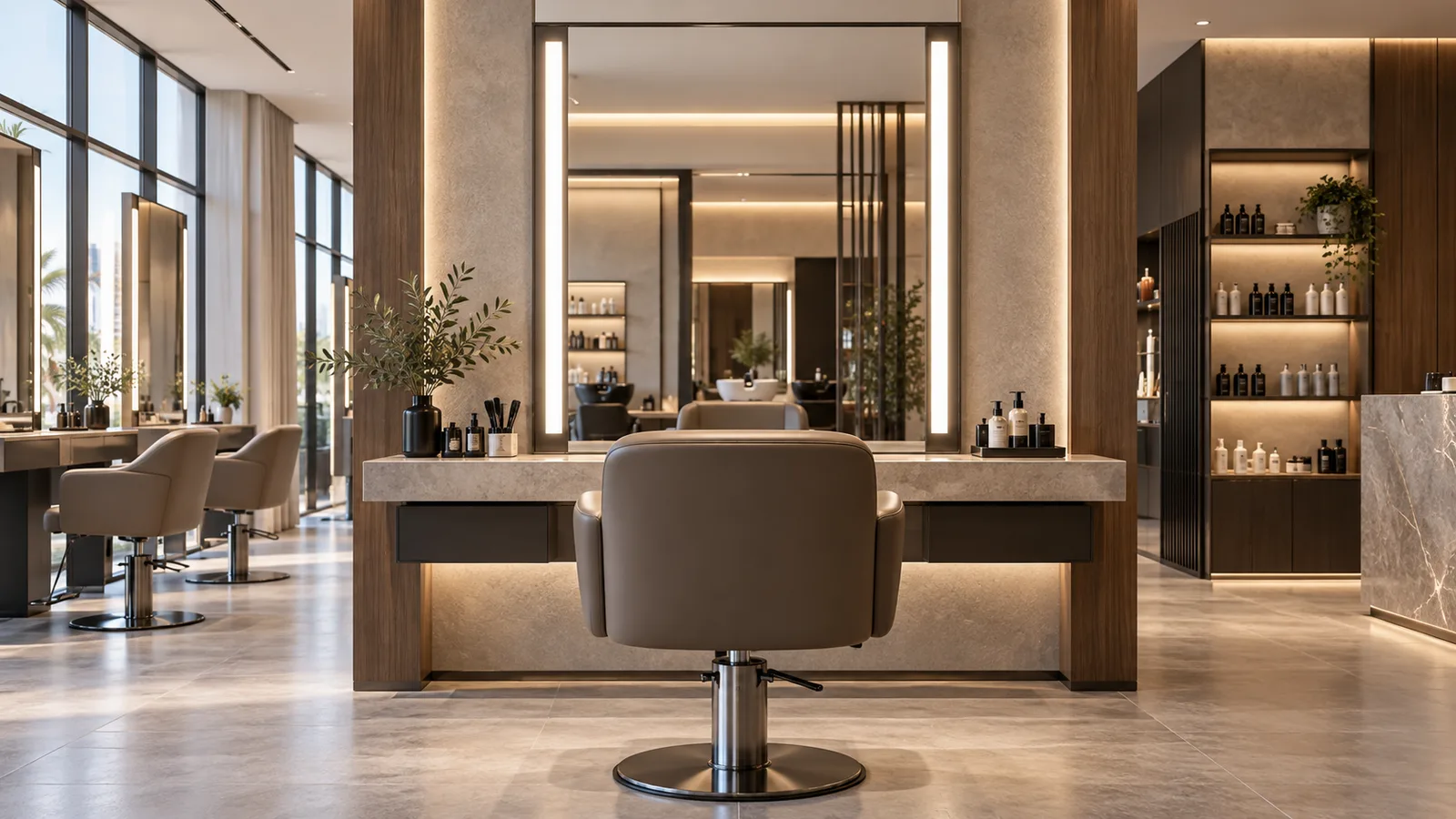
For a GCC hair salon, start with diffused mirror-side lighting for the client’s face and the working area. Add decorative or display lighting where it serves a separate purpose. A backlit mirror halo can look attractive without supplying enough useful forward light. Choose the layout around the task, mirror geometry, reflections and controls staff can operate consistently.
The five options below suit different parts of a UAE or Saudi salon fit-out. They are layout recommendations, not verified installations or a substitute for the project’s lighting design and local requirements.
Choose by the work being done at each station
Evaluate a layout against face and hair visibility, reflected glare, consistency during color assessment, maintainability and staff control. A supplier’s strip photograph does not show how the assembled profile will look in the mirror.
Kichler’s mirror-lighting guidance discusses side lighting for grooming and facial shadows from overhead light alone. That placement principle is useful when preparing a salon mock-up, but bathroom guidance is not a GCC salon standard. Check the actual chair, mirror and working positions.
| Layout | Main role | What to verify before approval |
|---|---|---|
| Diffused mirror-side lines | Forward light at the station | Facial shadows, hair visibility and direct/reflected glare |
| Backlit mirror halo | Decorative separation from the wall | Appearance with task lighting on and off |
| Concealed ambient cove | Background room lighting | Source concealment, wall finish and contribution at stations |
| Shielded retail-shelf lines | Product visibility | Label readability and reflections from packaging |
| Independently controlled consultation light | A defined white-light setting | Repeatable settings and appearance of actual samples |
Five layouts and where each helps
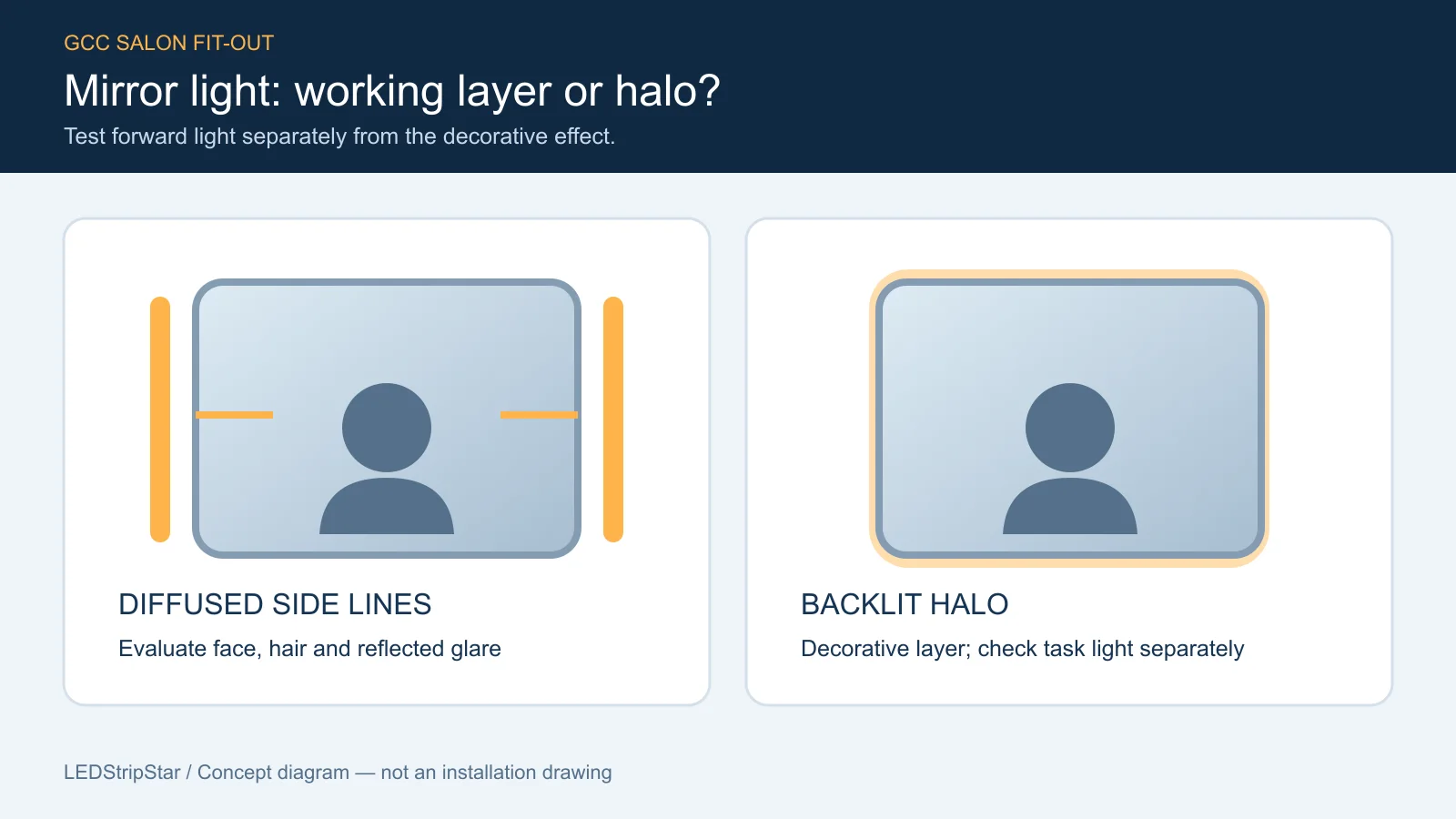
1. Diffused lines beside the mirror
Use forward-facing, shielded lines beside the mirror as a candidate for station lighting. Test them with a seated client and the stylist standing in normal working positions. Check whether the stylist’s body blocks the light and whether the diffuser appears uncomfortably bright in the mirror.
The 8mm CRI95 COB strip is a catalog source option for a sample. Its listed CRI is not proof that the completed station will render every hair color accurately. Assess real swatches and skin tones under the assembled lighting; the profile and diffuser also affect delivered light.
2. A separate backlit mirror halo
A concealed strip behind the mirror can soften its outline and illuminate the surrounding wall. Put it on a separate control when staff need to adjust decoration without changing the working light.
Check the halo against the actual wall color and spacing, since those conditions influence the visible effect. Approve it as a decorative layer. A photograph of a glowing mirror edge cannot establish how well the station lights the client.
3. A concealed ambient cove
Use a cove to establish background brightness where the room geometry permits concealed indirect light. Look for uneven wall illumination, visible source lines from seated positions and reflections in mirrors.
Ambient lighting may complement the station but does not automatically solve facial shadows or provide the required task light. Have the lighting designer check the complete room rather than specifying strip length as a proxy for performance. Leave access to power equipment and serviceable strip sections.
4. Shielded lighting inside retail displays
Place shelf lighting so customers can read labels without seeing a harsh source or a bright reflection in glossy bottles. Trial an occupied shelf, including the packaging actually sold, before copying the detail across the shop.
A 5mm CRI90 COB strip may help where internal profile space is restricted. PCB width does not establish the finished profile width or cooling suitability. Check the assembled channel using the profile selection guide.
5. A controlled white-light consultation zone
For comparisons under more than one white-light setting, specify a separate consultation zone with settings staff can repeat. Decide which setting is used for the salon’s normal color discussion. Otherwise, an accidentally changed scene can alter the conditions between appointments.
The tunable-white COB family lists a WW+W arrangement; its catalog entry does not establish exact endpoints for the selected order. Confirm those endpoints and the compatible controller before promising a particular range. Adjustable white tone cannot guarantee a match to every daylight condition or destination light source.
Approve a station that people can actually use
Build a representative mirror station with the intended source, profile, diffuser, controls and wall finish. Ask staff to inspect face shadows, hair visibility and glare from seated and standing positions. Check a range of real hair swatches under the agreed setting without treating the demonstration as a laboratory color measurement.
Review cleaning and product exposure with the selected materials. An indoor location alone does not establish suitability near splashes, sprays or cleaning chemicals. Confirm the construction and maintenance restrictions; do not infer chemical resistance from an IP label.
Also test startup after a supply interruption and label the controls. Record the accepted settings in the project handover, so later maintenance does not quietly change the consultation lighting.
Send a fit-out brief instead of asking only for “salon strip”
Include the station drawing, intended role of each lighting layer, selected voltage, sample color settings, profile detail and zone quantities in the enquiry. Ask the installation team to confirm access, controls and applicable local project requirements separately. With that brief, a source supplier can discuss the strip without implying that a reel alone is an approved salon lighting system.
Catalog & Sourcing Note
This article is prepared from our current product catalog and B2B specification workflow. Electrical, waterproofing and installation requirements vary by model and market, so confirm the final specification and approved sample before ordering.
Discuss Your Specification