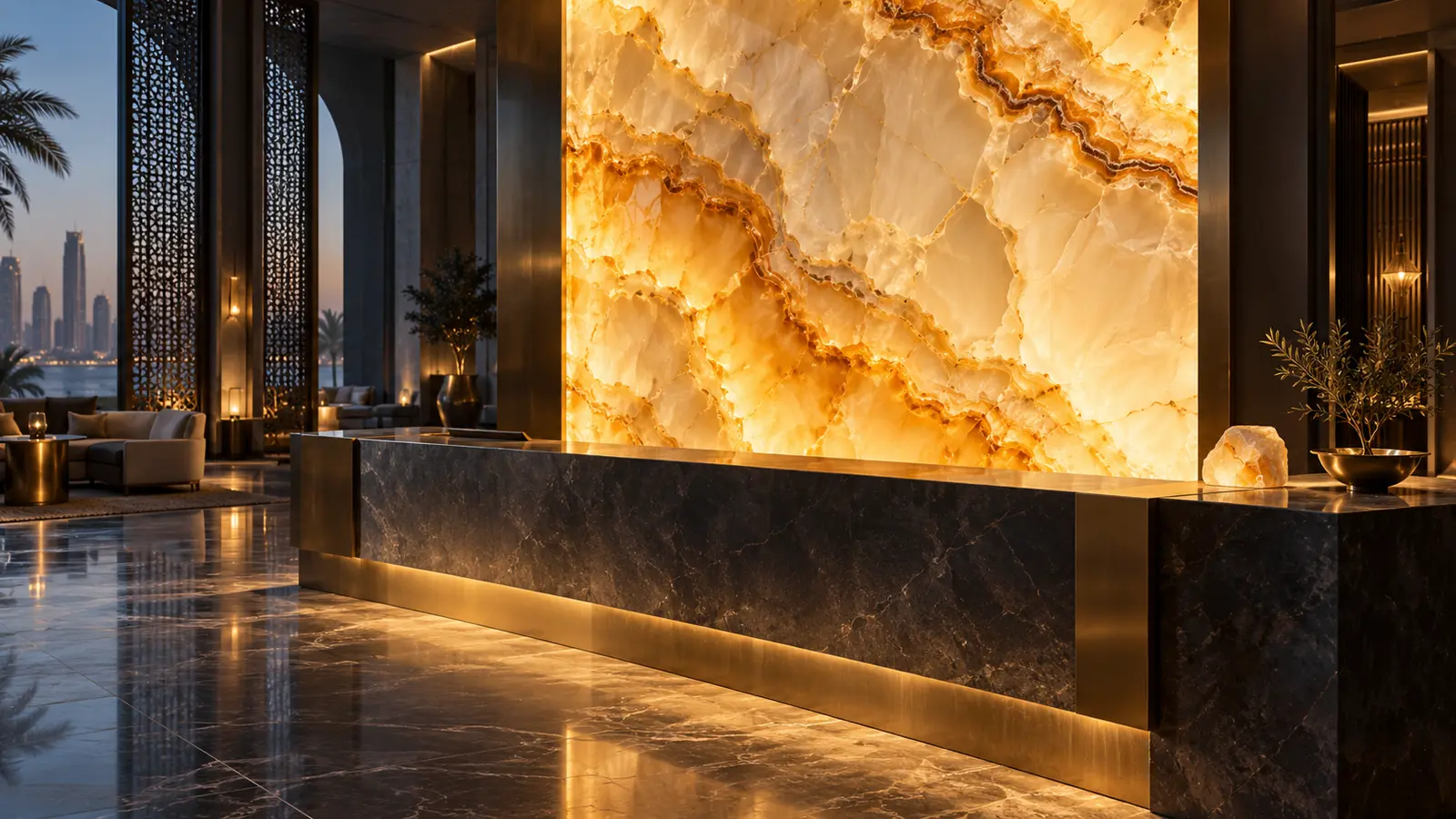
LED strip can backlight a translucent stone panel when the actual slab and completed construction transmit enough light and the source layout produces an acceptable appearance. For broad surfaces or shallow cavities, a purpose-designed light panel or LED sheet may be a better candidate than rows of tape. Approve a representative illuminated mockup before choosing the bulk source quantity.
For a GCC reception feature or bar front, obtain the actual material sample and section drawing before choosing power or strip spacing. Thickness, veining, backing and fabrication layers can affect the appearance, so the stone trade name alone is insufficient.
Review the slab together with its backing
Ask the stone fabricator to identify the slab, finished thickness, surface finish and all backing or reinforcement layers. Include mesh, resin, adhesive and the supporting construction where present. A loose offcut that transmits light may not represent the installed face after those layers are added.
Inspect both dense and more translucent areas of the proposed material. The design team should decide which natural variations it wants to retain and which light-source patterns it finds unacceptable. A bright vein surrounded by darker stone is a different issue from a repeated line matching every strip row.
Prime Light Boxes’ stone-backlighting product comparison gives different clearance recommendations for its backlit panels, acrylic light panels and flexible LED sheets. Source architecture changes the installation detail. Those recommendations apply to the supplier’s constructions, and cannot establish spacing for ordinary LEDStripStar tape or every stone slab.
Request an alternative surface-source proposal when the fabricator cannot provide enough cavity or access for the tape arrangement. LEDStripStar’s strip catalog does not establish that a complete stone panel, supporting structure or finished lighting box is included.
Compare source layout before adding power
Rows of tape form line sources whose visibility through the stone depends on the assembled optics, spacing and cavity. A COB strip can look continuous along its length yet produce visible bands across a panel. Inspect uniformity at the finished face rather than judging it from the bare strip.
Use the 8mm CRI95 COB family as a candidate for a white-light sample, with the exact voltage and white variant identified. Its catalog color-rendering and source-output fields do not describe the light emerging through the stone. Compare the intended white appearance using the actual slab.
| Detail in the proposed assembly | What to include in the mockup | Decision before ordering |
|---|---|---|
| Broad flat stone face | Representative source rows or a proposed light panel | Acceptable bands, bright regions and edge appearance |
| Shallow available cavity | The actual source-to-face distance and all layers | Whether a tape layout is feasible or another source is needed |
| Slab joint or frame | The real seam, backing and support position | Acceptable shadow and access detail |
| Veining or dense patch | Material representing the intended slab variation | Distinguish stone character from a source-layout defect |
| Cutout or return edge | The proposed source termination and structure | Appearance around the obstruction and edge |
| Service opening | A practical source and driver replacement route | Whether maintenance is possible without destructive removal |
For a tape layout, change one variable at a time during review. Compare row position, spacing, cavity depth or a suitable diffuser before increasing power. The diffusion guide explains why source spacing and optical distance matter. There is no universal row spacing that can be approved without the material and assembly.
Do not estimate face brightness by multiplying bare-strip lumens by a transmission percentage. That calculation leaves out the source distribution, reflections, supports and other optical layers. If the project requires numerical luminance or uniformity, agree a measurement method for the finished face and have the mockup assessed accordingly.
Include joints, heat management and replacement access
Build a representative bay containing a seam or support if the final installation has one. Use the intended backing, cavity lining, source mounting and dimming condition. A hand-held light behind a small offcut cannot approve a full feature with its structural shadows and edge conditions.
Review the panel from its normal viewing distance under the customer’s intended room-lighting conditions. Compare its off and on appearance. Photograph the agreed result using consistent exposure and white balance; those photographs document appearance, not measured brightness.
The fabricator must independently resolve the stone’s weight, support and permitted attachment method. Tape and its adhesive do not support a stone slab. Qualified personnel should design and install the electrical assembly, including its heat path, environmental protection and accessible power equipment. Keep the strip, backing and other materials within their stated operating limits.
Have the maintenance team review the replacement route before closing the panel. Identify which part can be opened, how a failed section is reached and where a driver can be isolated and replaced. If the design requires removal of bonded stone for routine servicing, resolve that cost and responsibility before approval. The driver maintenance guide covers the equipment-access side.
Freeze the approved slab reference and layers, cavity drawing, source layout, strip variant, drive condition and viewing criteria. Keep the acceptance sample and record its limitations, including that every slab may not look identical. Calculate strip quantity after the layout is approved.
Send the drawing and mockup requirement through the quotation form, using the COB range to identify possible strip constructions. Standard MOQ is 500 meters and custom MOQ is 2,000 meters. Ordinary warranty is 2 years. Confirm source suitability and the stone fabricator’s separate scope before placing the order.
Catalog & Sourcing Note
This article is prepared from our current product catalog and B2B specification workflow. Electrical, waterproofing and installation requirements vary by model and market, so confirm the final specification and approved sample before ordering.
Discuss Your Specification