Yes, with a battery and a properly controlled DC output.
A DC12V or DC24V LED strip can be supplied by a solar-charged battery system. A bare solar panel is normally the wrong thing to connect directly to constant-voltage LED tape: panel voltage and available power change with sun and load, while the strip needs a controlled supply within its model limits.
The strip is only one component. The system designer must select the panel, charge controller, battery, low-voltage disconnect, protection and, where needed, a regulated DC/DC output. We sell LED strip products; the presence of a strip in our catalog is not a claim that we supply or have tested a complete solar kit.
The arrangement below is useful for a remote sign, landscape accent or temporary site feature. It should not be copied as a final wiring diagram. Local electrical rules, battery chemistry, fire protection and outdoor enclosure details need a qualified designer.
Start with the energy path, not panel wattage
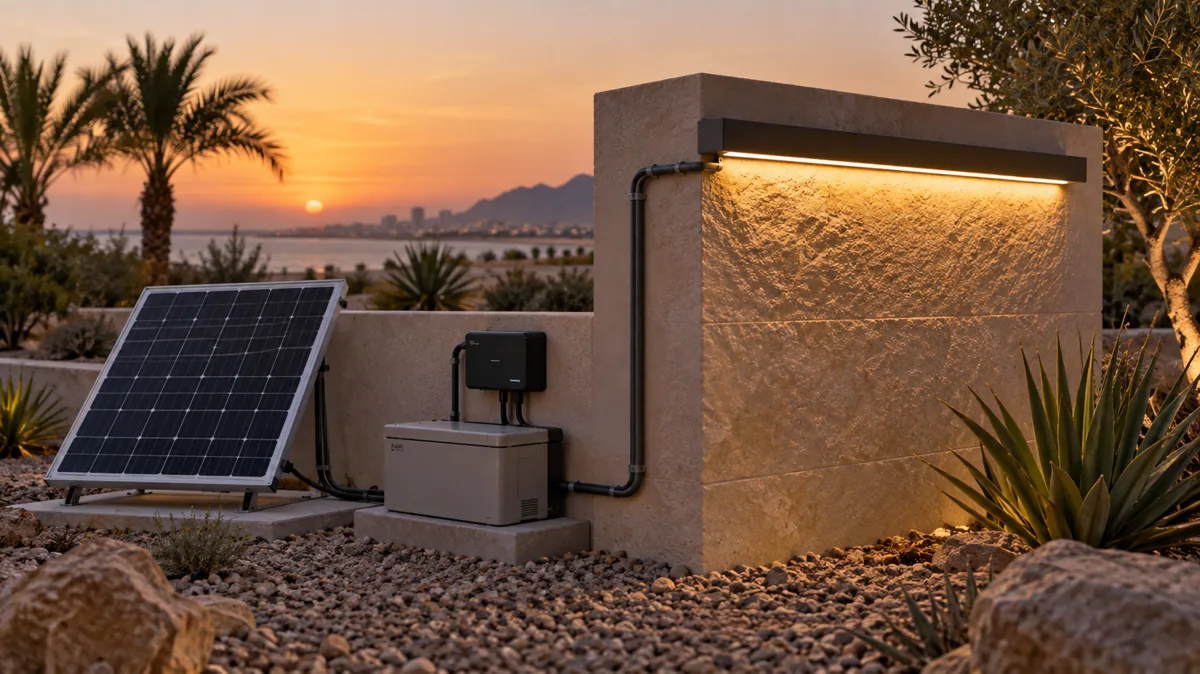
The usual path is PV panel → charge controller → battery → protected load output or regulated DC/DC supply → LED strip and compatible controls. The charge controller manages charging; it is not automatically a precision LED-strip power supply.
Some controllers include a lighting timer and a low-voltage disconnect. Victron’s MPPT manual describes a load output that disconnects when battery voltage becomes too low, and states that the output’s current rating depends on the controller model. Its configuration guide also covers streetlight timing. These features show what to check; they do not mean every controller output matches every LED strip.
Check battery-voltage variation through charging and discharge against the strip’s permitted input range. If those ranges do not align, specify a regulated output sized for the branch. Do not assume a “12V battery” holds exactly 12.0V all night.
Calculate the nightly load before sizing storage
Start from the ordered strip’s watts per meter and the lit length. Then add controller and DC/DC consumption where known. The first-pass arithmetic is:
Strip load (W) = listed W/m × installed meters
Nightly strip energy (Wh) = strip load (W) × operating hours
For a hypothetical 8W/m strip over 5m, operating six hours, that is 40W and 240Wh of strip energy. It is not a recommendation for a particular panel or battery. Storage must also account for conversion losses, allowable battery depth of discharge, cold or hot battery behavior, days of autonomy and aging. Solar production needs site-specific irradiance, panel orientation, shading, dirt and seasonal assumptions. A six-hour sign in Dubai is not sized from the same weather assumption as one in Riyadh or an indoor atrium.
To estimate a powered run, use the voltage-drop guide. A battery that holds adequate energy can still leave the far end dim if the cable, PCB or feed plan is inadequate. Split long strips into branches and confirm current limits at each controller output, terminal and connector.
Choose a strip voltage only after choosing the system
Our low-voltage range contains DC12V and DC24V models. At the same nominal wattage, a 24V branch draws less current than a 12V branch; that can make cable loss easier to manage. It does not tell you which battery configuration is cheaper or safer, and it does not override cut-length or controller requirements.
For a shaded indoor accent, start with the finished light level, CCT and operating schedule. For an exposed sign, review the strip and every cable entry, joint and enclosure. Our DC24V IP68 SMD model is an example of a listed protected strip construction, not an IP68 claim for a field-built solar assembly. A solar panel in the same photograph does not make the LED section waterproof or UV-qualified.
If dimming or dusk-to-dawn control is required, test the exact controller with the chosen LED strip at low battery voltage and at the lowest dimming level. A timer can reduce nightly energy, but its switching behavior and load-output rating still need to be checked.
Test the nights that matter
Build a small sample with the intended strip, driver or DC/DC stage, controller and feed cable. Record strip voltage at start-up, during charging, under full load and near low-voltage disconnect. Check visible output at the far end, controller temperature, restart after disconnect and the effect of dimming. For an outdoor mock-up, include the actual profile, seal and cable entry.
The image above is a concept illustration, not a test or customer project. Do not use it to infer a cable size, battery capacity or panel rating.
Send two separate specifications
For the strip quotation, provide required voltage, watts or target light level, CCT, lit length, cut units, mounting detail and exposure. For the solar designer, provide the same load plus location, operating hours, autonomy target, shading, panel area, battery chemistry, enclosure temperature and maintenance plan. Identify who owns the interface between the regulated DC output and the strip.
You can request a model-matched strip quote with the project load information. Ask the solar-system integrator to approve the final panel, battery and protection design; an LED-strip quotation alone cannot establish that the system will run through a cloudy night.
Catalog & Sourcing Note
This article is prepared from our current product catalog and B2B specification workflow. Electrical, waterproofing and installation requirements vary by model and market, so confirm the final specification and approved sample before ordering.
Discuss Your Specification