Yes, when both feeds belong to the same output
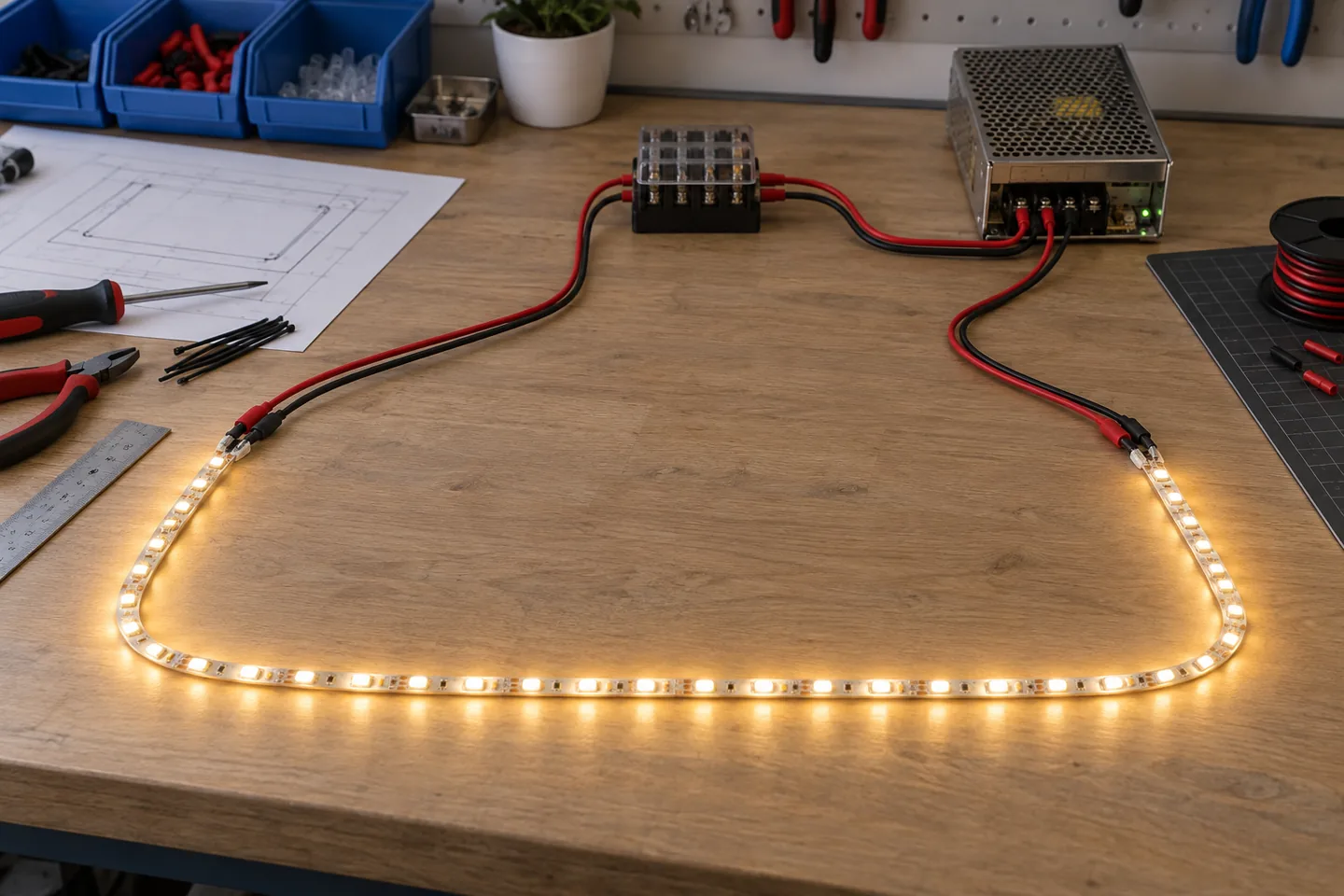
A compatible constant-voltage LED strip can be powered from both ends. Connect both feed cables to the same power-supply output, or to the same controller output for a dimmed or color-changing strip. Match every conductor and keep the polarity correct at both ends.
Dual-end feeding can reduce the visible brightness difference between the beginning and end of a run. It does not increase the strip’s voltage rating, make an undersized power supply acceptable or guarantee that current divides equally. The strip, supply, controller, cable and connectors still need a complete current and voltage-drop calculation.
Do not connect one independent power supply to each end unless the exact power supplies and system design explicitly permit their outputs to operate together. Many LED power supplies do not share current when paralleled.
The correct dual-end topology
For a single-color two-wire strip, the basic arrangement is:
- One constant-voltage supply feeds a protected distribution point.
- One cable leaves that point for the near end of the strip.
- A second cable leaves the same point for the far end.
- Positive connects to positive and negative connects to negative at both ends.
- Each cable, connector and distribution terminal is rated for the current it may carry.
Lutron’s tape-light wiring application note describes a dual-ended option as feeding both ends of one continuous tape run. In electrical terms, it behaves like two shorter tape sections connected in parallel. Its drawings and length limits apply to the specified Lutron system, not to every LED strip. The useful design principle is to shorten the current path through the tape and keep both feeds on one controlled output.
A center feed is another option when the supply can be located near the middle. It creates two shorter runs without routing a return cable to the far end. The better layout is the one that produces acceptable voltage and brightness at every point while keeping joints accessible.
What dual-end power can and cannot solve
Voltage drops across feed cables, connectors and the copper tracks on the strip. A long, narrow or high-power strip may look bright near the feed and dimmer at the remote end. Feeding from both ends shortens the longest path through the PCB, so the far end no longer depends on current travelling through the whole strip.
Consider an 8m, 24V strip rated at 10W/m. Its nominal strip load is 80W, or about 3.33A before controller losses and design allowance. A dual-end feed does not let the buyer specify two 1.67A cables automatically. Current sharing depends on the resistance of each cable route, connection and half of the strip. Size and protect the branches from measured or conservatively calculated current, not an assumed perfect split.
Dual-end feeding also cannot repair:
- a 12V strip connected to a 24V supply;
- a controller with insufficient channel current;
- a connector with high contact resistance;
- damaged or undersized PCB copper;
- a strip run that exceeds the manufacturer’s permitted construction;
- thermal problems caused by the mounting detail.
If the strip still has a sharp brightness change at one joint, inspect that joint. A gradual fall along the run points more strongly toward voltage drop.
White, tunable-white, RGB and addressable strips need different checks
Single-color strip
Both ends use the same positive and negative output. Confirm conductor size, fuse or branch protection, terminal capacity and polarity before energizing.
Tunable-white and RGB strip
Every output channel must return to the matching channel at the other end. A common-positive RGB strip, for example, needs the common conductor and each color channel kept in the same order. Both feed cables must be connected after the same controller. Feeding one end before the controller and the other after it bypasses the control path and can damage equipment.
Addressable strip
Power injection and data routing are separate design questions. A project may feed power at more than one point while data still follows the direction printed on the strip. Maintain the required ground reference and follow the controller and pixel-chip instructions. Do not apply a second data signal from the far end just because power is present there.
Mains-voltage strip
This article is for low-voltage constant-voltage tape. Mains-voltage products have model-specific rectifiers, cut lengths, connectors, maximum runs and protection requirements. A qualified professional must use the instructions supplied for the exact product.
Verify the layout on a full-length sample
Build the sample with the proposed reel, supply, controller, cable lengths and connectors. Short bench leads can hide a problem that appears after installation.
- Record the supply voltage with no strip connected.
- Connect the planned run and operate the worst-case steady scene at full output.
- After the agreed warm-up period, measure voltage at the near end, middle and far end without exposing live conductors carelessly.
- Measure input current to the distribution branches with suitable equipment.
- Compare brightness or illuminance at repeatable positions. Use the same meter geometry and ambient condition each time.
- Check each terminal and connector for discoloration, odor, softening or abnormal temperature.
- Repeat at representative dimming levels and color combinations.
- Isolate power and inspect polarity labels, strain relief and branch identification.
Approval should record the actual sample configuration and acceptance limits. A photograph of an evenly lit strip is not enough when camera exposure can hide brightness variation.
Four mistakes that create avoidable risk
Joining two ordinary power supplies at opposite ends
The outputs can fight each other when their voltages differ. MEAN WELL’s LED power-supply FAQ says its LED supplies do not have parallel current sharing and recommends a larger supply or separate LED sections instead. Follow the documentation for the exact supply. If two supplies serve separate zones, keep their output circuits separated as required by the design.
Forgetting the controller rating
The power supply may have enough watts while one controller channel is overloaded. Calculate total and per-channel current, then check terminal and connector ratings.
Using the reel length as the powered-run limit
A 10m or 20m supply length describes how material is supplied. It does not prove that one end, or even two ends, can power that distance under every condition. PCB width, copper weight, watts per meter, voltage and allowable variation all matter.
Hiding the far-end joint
Dual-end wiring adds a termination that must remain inspectable. Plan cable access before the ceiling, cabinet or sign is closed.
What to send with the RFQ
Include:
- exact strip model and operating voltage;
- power per meter and length of each continuous run;
- single color, tunable white, RGB or addressable control type;
- proposed supply and controller models;
- one-way cable length and conductor size for both feeds;
- connector and terminal ratings;
- drawing showing the distribution point and both terminations;
- installation surface, profile and ambient conditions;
- acceptable voltage, brightness and color variation;
- sample test method and required records;
- destination and buyer-specified electrical requirements.
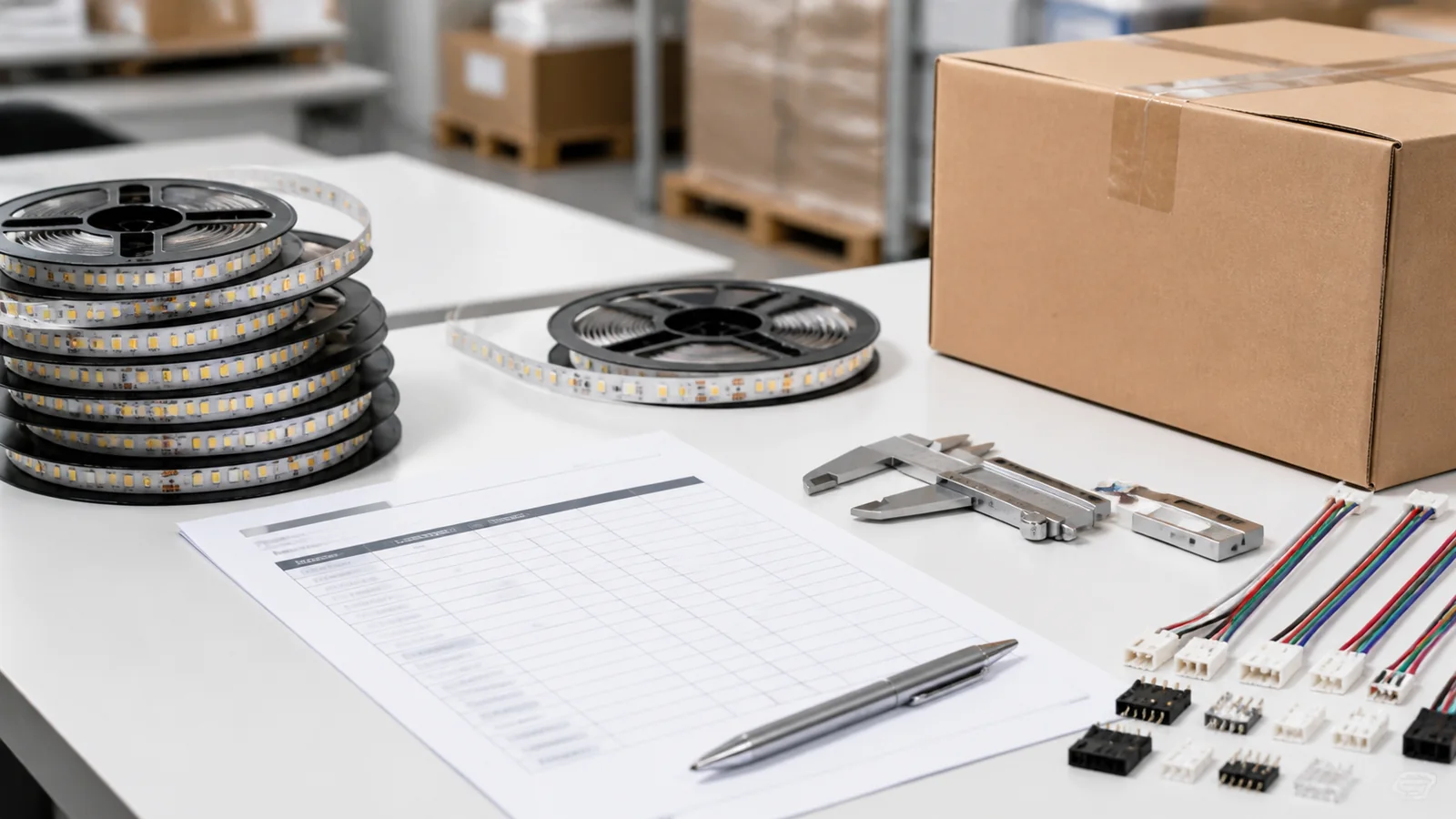
The DC24V 20m no-drop model is a useful catalog reference for long-run discussions, but its listed supply length is not a substitute for a feed drawing and full-length test. Send the proposed run through the quote form so the electrical layout can be reviewed with the exact strip option.
Catalog & Sourcing Note
This article is prepared from our current product catalog and B2B specification workflow. Electrical, waterproofing and installation requirements vary by model and market, so confirm the final specification and approved sample before ordering.
Discuss Your Specification