The short answer
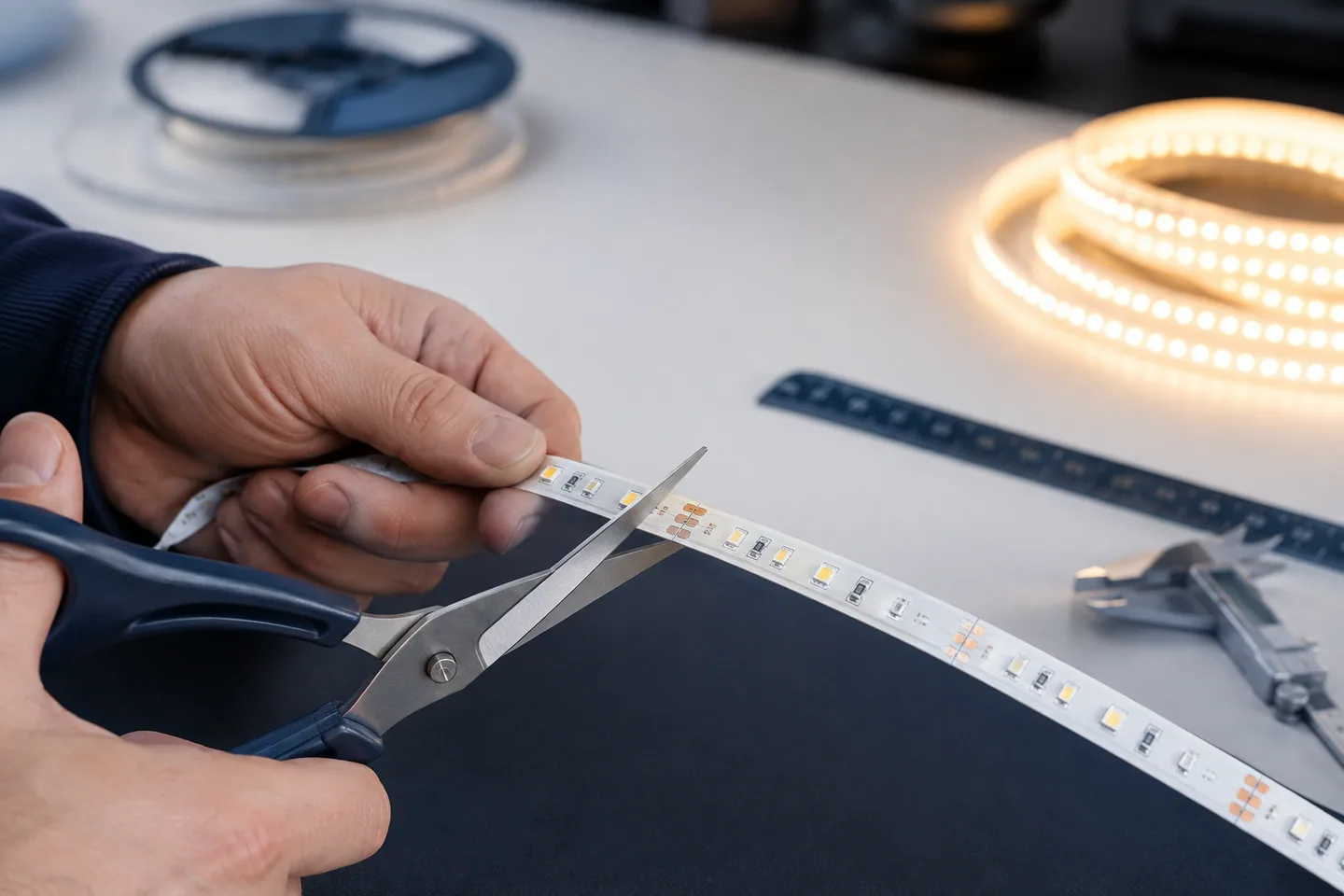
Most LED strip lights can be shortened, but only at the cut marks designed into that exact model. Disconnect power, find the printed line or scissor symbol beside the copper pads, and make a clean square cut through that line. Cutting between marked points usually breaks one circuit segment.
Do not assume every strip is cuttable or that every offcut can be reused. The answer changes with the circuit, connector system and protective jacket. Outdoor and mains-voltage products need their model-specific cutting and termination procedure.
For a bulk order, the more useful question is not simply “Can it be cut?” It is: What is the cutting interval, what usable length will each location require, and who will terminate the cut ends?
Where can you cut an LED strip?
A flexible strip is made from repeated electrical segments. The permitted cut line sits at the boundary between segments, commonly near exposed copper pads. The artwork may include a line, scissors symbol or both.
Philips Hue’s cutting guide explains the same underlying rule for its cuttable models: use the designated line so the circuit remains complete. LEDVANCE installation instructions also call for straight cuts in designated areas and warn against folding or twisting the strip.
Before cutting:
- Identify the exact strip model and voltage.
- Isolate the power supply and prevent accidental reconnection.
- Confirm which printed mark is the cut line, not merely a component reference.
- Check whether the copper pads must be divided through their center.
- Support the strip flat and use a sharp, clean tool.
- Inspect the cut for torn copper, damaged components and loose jacket material.
If markings are missing, unclear or hidden by an opaque jacket, stop and obtain the model drawing or work instruction. Guessing from LED spacing is unreliable.
Why the cutting interval matters
The cutting interval is the smallest length that can be removed while leaving a complete working segment. It comes from the circuit design, not from the reel length.
Suppose a shelf opening is 983 mm and the selected strip cuts every 50 mm. The nearest usable lengths are normally 950 mm or 1,000 mm. A 1,000 mm piece may not fit, so the lighted length becomes 950 mm and the designer must accept a 33 mm unlit remainder. A shorter cutting interval can reduce that gap.
This affects more than appearance:
- repeated cabinet bays may need identical illuminated lengths;
- signage letters and display cases may have very short sections;
- copper-pad size influences connector and soldering space;
- more cuts create more joints, labor and inspection points;
- custom factory lengths must still land on valid circuit boundaries.
Do not infer the interval from “120 LEDs/m.” Two strips with the same LED density can use different series-parallel layouts. Ask for the interval in millimeters and verify it on the approval sample.
For close-tolerance layouts, compare a free-cut COB strip or one-LED-cut SMD strip with the standard model. “Free-cut” is still a model-specific construction; confirm the permitted cutting method before production.
Can you reuse the cut-off piece?
Often yes, if the offcut contains complete segments and has usable connection pads. It still needs the correct polarity, conductor count, connector or soldered lead, strain relief and insulation.
Reuse depends on five checks:
| Check | Why it matters |
|---|---|
| Copper pads remain accessible | The new lead or connector needs a sound contact area |
| Connector matches PCB width | An 8 mm connector is not automatically suitable for a 10 mm strip |
| Contact count and pad order match | Single-color, tunable-white and RGB strips use different circuits |
| Current rating is adequate | A connector that fits can still be undersized electrically |
| The cut end can be protected | The joint must suit touch, dust and moisture exposure |
Solderless connectors can speed field work, but fit must be tested with the actual PCB, coating and pad layout. Soldering gives more geometric flexibility but requires controlled heat, clean wetting and strain relief. See the LED strip soldering guide for inspection points.
Some proprietary products do not permit offcut reuse, or only support it with a matched accessory. The rule for one model should not be generalized to another.
Waterproof and mains-voltage strips need a different plan
Cutting a protected strip opens its coating, tube or silicone jacket. The remaining circuit may work electrically, but the new end no longer has the untouched construction. It needs the specified end cap, cable entry, sealing material, curing process and strain relief.
Do not describe a field-cut piece with the same IP rating unless the completed termination has evidence for that construction and the project accepts it. The waterproof connection guide explains how to specify and inspect the finished joint.
Mains-voltage strip introduces higher shock and fire consequences, longer cut units and model-matched rectifiers or end fittings. Do not cut, energize or improvise a termination without the manufacturer’s instructions. A qualified installer must follow the electrical rules that apply at the destination.
Plan cut lengths before a bulk order
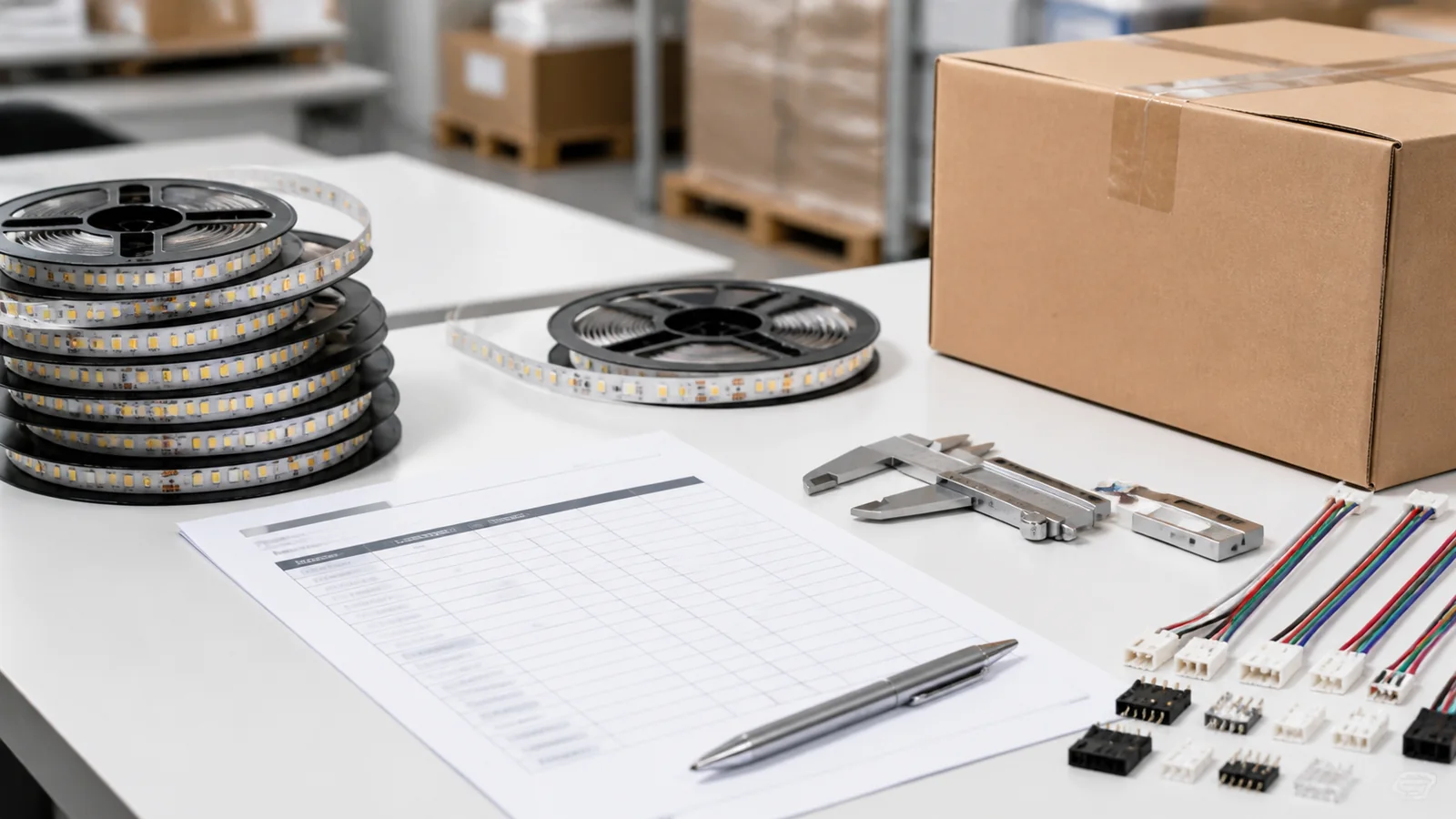
For projects with repeated furniture, shelves or signs, create a cut schedule rather than ordering only total meters.
| Field | Example format |
|---|---|
| Location ID | Cabinet A-01 |
| Finished lighted length | 950 mm |
| Quantity | 24 pieces |
| Lead position | Left entry |
| Lead length | Buyer-defined |
| Connector type | Bare lead / plug / solderless |
| End treatment | Open dry end / specified sealed termination |
| Label | Location ID and model |
Then reconcile the schedule to reel yield. A 5 m reel does not necessarily produce five usable 1 m assemblies after allowing for cut increments, damaged ends, leads and production handling. Agree whether the supplier delivers full reels, factory-cut assemblies or both.
Approve one production-intent sample with the final strip, lead, connector and end treatment. Measure the lit length, not only the physical length. Keep a photo and sample ID with the purchase order.
Cutting questions to put in the RFQ
- Is this exact model cuttable, and where is the permitted line?
- What is the cutting interval in millimeters?
- Does the cut unit change between 12V and 24V versions?
- Can both sides of a correct cut be reused?
- What PCB width, pad layout and connector type apply?
- What is the maximum planned powered length after cutting?
- Which factory lead directions and lead lengths are available?
- How are dry, damp and outdoor cut ends treated?
- Will the supplier provide reels, cut pieces or finished assemblies?
- What sample and inspection method will confirm the production order?
Send the location schedule through the quotation form. A precise schedule lets the supplier quote usable assemblies and labor instead of estimating from total meters alone.
Catalog & Sourcing Note
This article is prepared from our current product catalog and B2B specification workflow. Electrical, waterproofing and installation requirements vary by model and market, so confirm the final specification and approved sample before ordering.
Discuss Your Specification