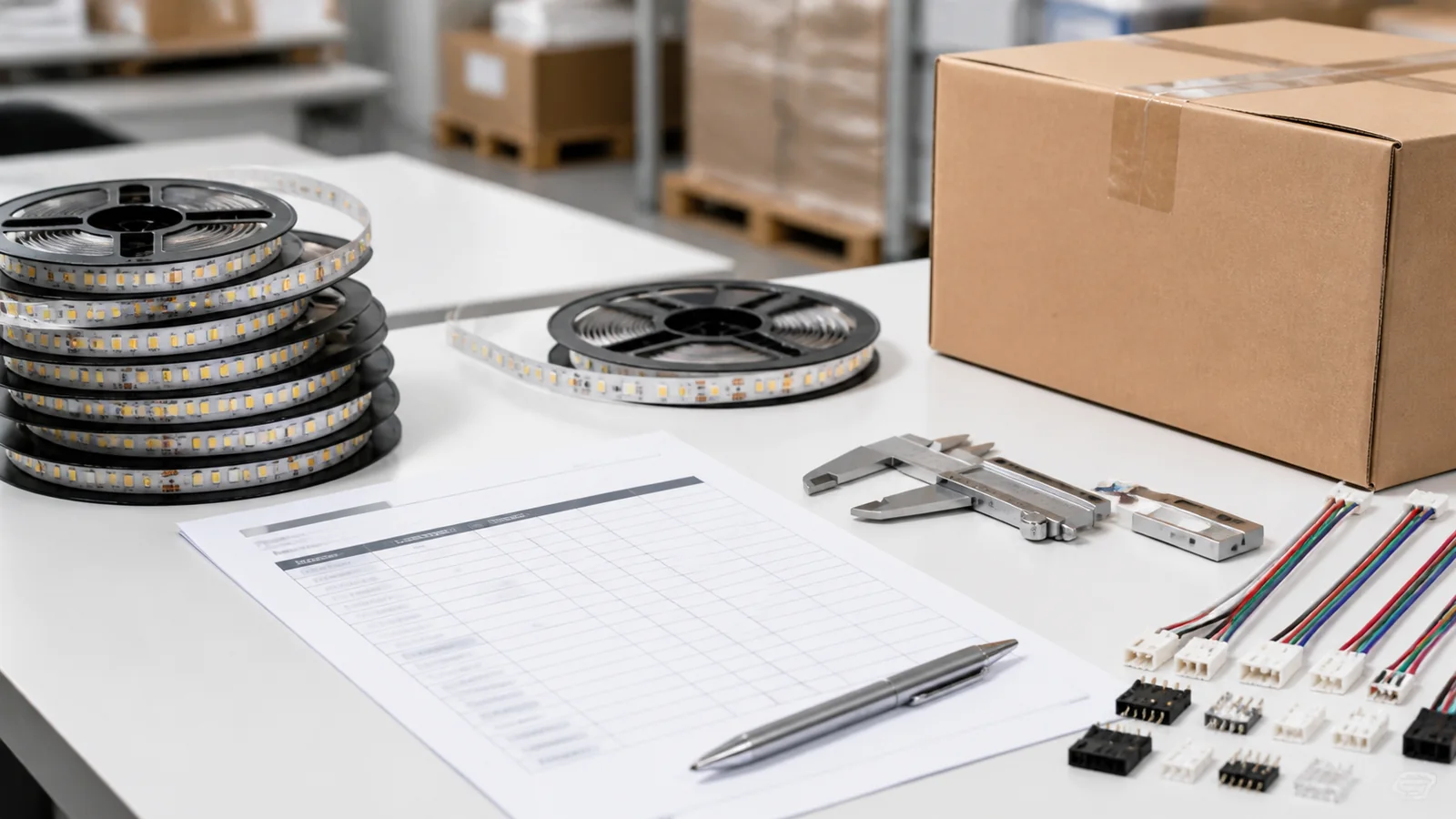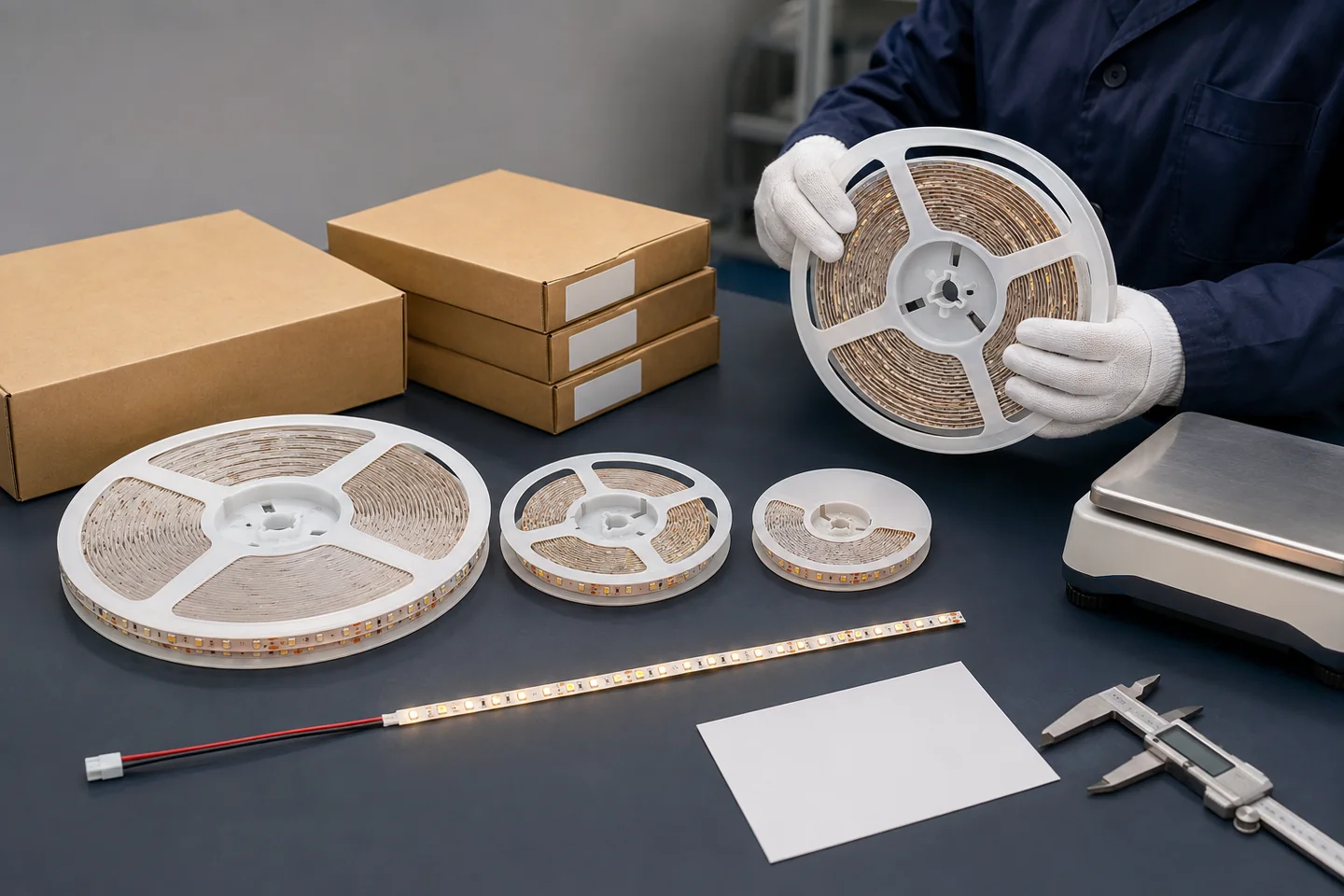
The short answer
Choose LED strip reel length from the buyer’s installation modules, cut interval, handling method, powered-run design and packing limits. Do not treat a 50m or 100m supply reel as proof that the whole reel can be powered from one end. Reel length describes how the product is supplied; maximum powered length is an electrical limit that must be confirmed for the exact model.
Standard reels are usually simpler for distributors that hold inventory and cut locally. Factory-cut sets can reduce site work when every segment has a controlled length, cable and connector. The best option is the one that lowers total installation risk, not automatically the longest reel.
Separate four different length specifications
A clear purchase order distinguishes four values:
| Length term | What it controls | Typical mistake |
|---|---|---|
| Supply or reel length | How much strip is wound and packed on one reel | Assuming the whole reel is one powered circuit |
| Maximum powered length | How far the exact model may be powered within accepted electrical limits | Copying a limit from a different voltage or wattage |
| Cutting interval | Where the PCB or finished product may be divided | Requesting a finished length that falls between cut marks |
| Finished set length | Delivered segment including its agreed tolerance, cable and termination | Measuring only the lit section when the project needs overall length |
Write all four into the specification where they apply. This prevents a supplier, installer and electrical designer from using the word “length” to mean different things.
Our product pages show the available supply/reel length for each model. The catalog currently includes short set and reel formats as well as longer supply rolls, depending on the product family. Those values must remain tied to the specific model rather than generalized across COB, SMD, neon, silicone and AC strip.
When to use standard reels or factory-cut lengths
Standard reels suit flexible local stock
A distributor that sells many small jobs may prefer standard reels because one stock item can serve several applications. Local cutting also reduces the need to forecast every finished length in advance. The buyer still needs the correct cutting instructions, compatible connectors and a method for resealing protected constructions.
Standard reels are also easier when final site dimensions are uncertain. The trade-off is more installer labor, more leftover pieces and greater variation in field-made joints.
Factory-cut sets suit repeatable project modules
Factory-cut sets make sense for cabinets, retail fixtures, hotel rooms, signs or other repeated assemblies where dimensions are stable. Cables, connectors, end caps and labels can be applied under a controlled process, then checked before packing.
Before ordering sets, define whether the length means PCB length, illuminated length or overall assembly length. A cable exit, end cap or connector changes the installed envelope. Protected strip also needs a model-specific sealing process at every cut end.
Long reels suit logistics only when the product system supports them
A longer reel can reduce reel changes and packing pieces, but it is heavier to handle and can trap more heat if powered while coiled. It may require a larger reel, stronger carton and a different unwinding method. The electrical design may still divide that supply reel into shorter powered sections.
Never energize a tightly wound reel for normal operation. Test and commission it in the installed configuration, using the feed plan for the exact model.
Calculate reels from modules, not only total meters
Start with a cut list. Group required segments by finished length, cable direction, color or CCT, connector and installation zone. Then calculate how many valid segments fit within one supply reel while respecting the cutting interval and allowed tolerance.
For example, a project may need many identical shelf sections plus several longer perimeter sections. Combining the totals and dividing by one reel length hides the offcuts created by each cutting pattern. Calculate yield for each segment group, then add agreed spare sets for installation damage and future maintenance.
The calculation should include:
- number of installation locations;
- finished length per location and tolerance;
- cutting interval of the selected model;
- expected offcut from each reel or production panel;
- cable and connector configuration;
- commissioning spares and maintenance stock;
- whether partial reels may be delivered and how they are labeled.
Do not choose the electrical feed arrangement from this packing calculation. Use the exact strip voltage, watts per meter, cable resistance, connector rating and accepted voltage drop. The voltage-drop calculation guide shows how to plan powered sections and feed points separately.
Match the reel to packing and receiving
Approve the reel outside diameter, core, winding direction and tail restraint. Strip wound too tightly can be stressed; strip wound loosely can telescope or rub in transit. Cable leads and connectors need pockets or protection so they are not crushed against the reel flange.
Each reel or finished set label should identify the agreed model, voltage, color or CCT, length, quantity unit and batch or lot reference. When a carton contains mixed lengths, the carton label and packing list should make the mix easy to count without opening every bag.
For marketplace or retail programs, agree who supplies the barcode and item number. Label claims must match the supplied construction, ratings and approved artwork. The detailed wholesale packaging guide covers inner bags, retail boxes, cartons and shipping marks.
Carton approval should consider actual packed weight and dimensions after the reel, accessories and protective material are finalized. Do not estimate a new long-reel carton only by multiplying a short-reel weight; the reel and protection format may change.
Approve a packed sample and length inspection plan
Ask for a production-intent sample in the proposed reel or set format. Check that it unwinds without kinks, the strip surface is not marked, connectors remain protected and labels can be read without removing the product.
Length inspection should define the measurement reference and tolerance. For custom sets, confirm whether the cable and connector are included in the overall measurement. For reels, agree how the supplier verifies length and how partial reels are identified.
A useful pre-shipment check includes:
- model and batch identity;
- reel or finished-set length against the purchase order;
- cutting interval and cut position;
- cable length, exit direction and connector;
- polarity, continuity and functional sample test;
- seal and strain relief where the construction is protected;
- winding, reel condition, label and bag closure;
- carton quantity and packing-list reconciliation.
Do not unwind and repack every reel without a defined reason; unnecessary handling can introduce damage. Use an agreed sampling plan, record exceptions, and isolate any mismatched lot for review.
What to put in the reel-length RFQ
Send these details with the enquiry:
- exact product model or required voltage, power, PCB width, CCT/color and IP construction;
- standard reel or factory-cut set;
- supply length per reel and required finished lengths;
- cutting interval and length tolerance;
- maximum powered length or feed-point plan to be confirmed separately;
- cable length, conductor count, entry direction and connector;
- reel size, winding direction, bag, label and carton requirements;
- quantities by length and required spare sets;
- destination, receiving unit and barcode ownership;
- sample approval and pre-shipment length checks.
If the project has a cut list, attach it to the quotation request instead of sending only a total-meter quantity. The supplier can then review model compatibility, material yield, termination count and packing format before confirming the order.
Catalog & Sourcing Note
This article is prepared from our current product catalog and B2B specification workflow. Electrical, waterproofing and installation requirements vary by model and market, so confirm the final specification and approved sample before ordering.
Discuss Your Specification