The short answer
To verify LED strip lumen output, require a report and sample that identify the exact model, CCT, CRI option, input voltage, measured power, sample length, stabilization condition and test method. Compare lumens per meter only after those conditions match. Then use the approved sample and an agreed production tolerance to inspect the bulk order.
A bare claim such as “1,200 lm/m” is not enough. It may describe a short laboratory sample, a different color temperature, nominal rather than measured power, or LED package data instead of the finished strip. Ask what was actually measured.
First define what the lumen claim means
The quotation, specification sheet and test report should use the same product identity. Record:
- model code and revision;
- LED package or COB construction;
- CCT or color option;
- CRI requirement and any additional color-quality metric required by the project;
- PCB width, LED density and IP construction;
- rated voltage and watts per meter;
- reported lumens per meter and efficacy;
- whether the value is typical, minimum, initial or maintained;
- measurement tolerance or uncertainty.
Do not compare a high-CRI warm-white strip with a lower-CRI cool-white strip as if wattage were the only variable. LED spectrum, operating current, optical protection and temperature can change output. A silicone cover, coating, diffuser or aluminum profile may also change the delivered light even when the PCB is unchanged.
If the supplier gives efficacy in lumens per watt, check whether the denominator is the measured strip power or a rounded catalog rating. Recalculate it from values in the same report:
Efficacy (lm/W) = measured luminous flux (lm) ÷ measured electrical power (W)
For a tested section longer or shorter than one meter, confirm how the result was normalized. Cut units, feed cables and end effects can make a very short sample unrepresentative of a production reel.
Control the test conditions before comparing suppliers
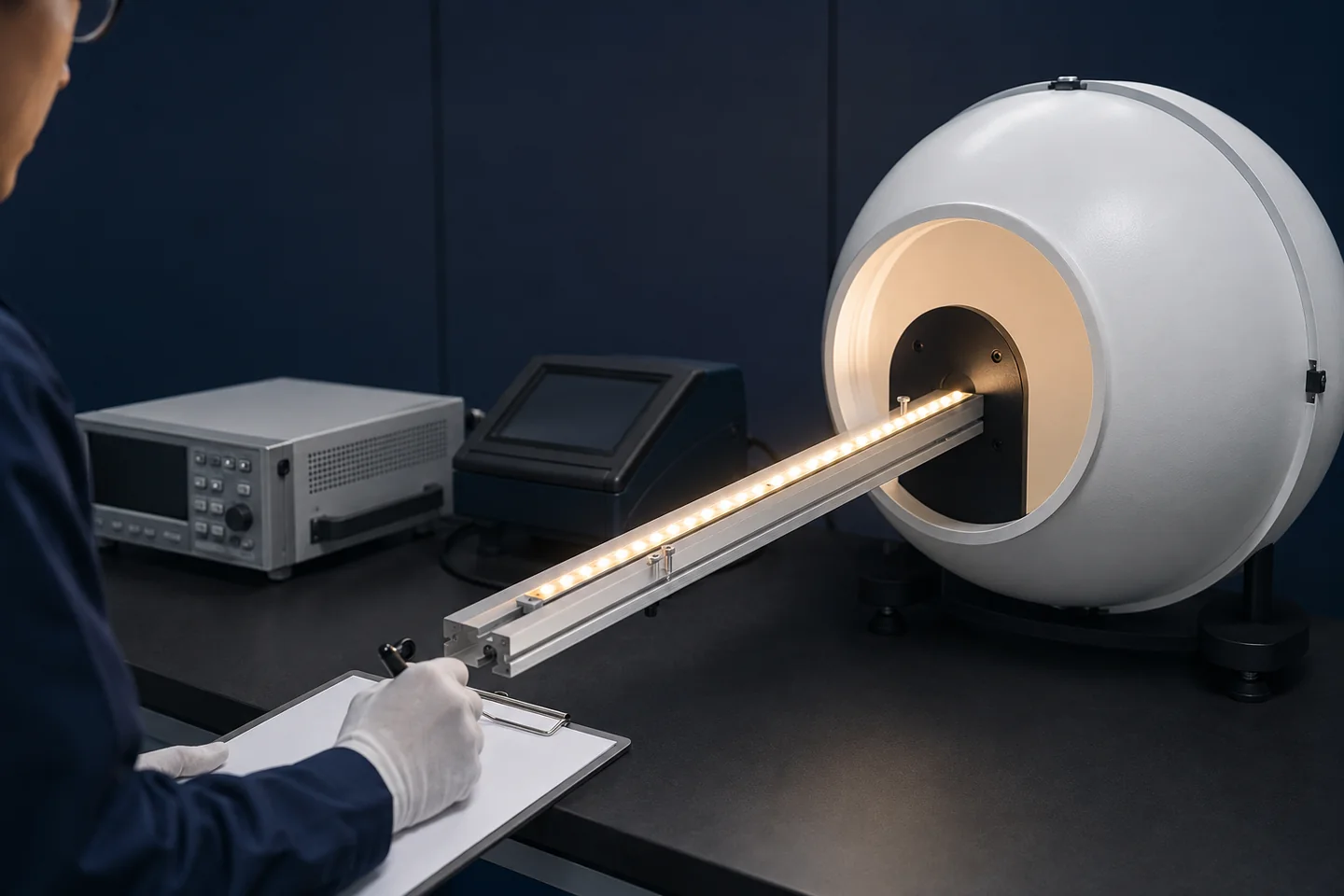
The Illuminating Engineering Society’s ANSI/IES LM-79-24 describes procedures and precautions for reproducible measurements of total luminous flux, electrical power, efficacy, color quantities and spectrum for solid-state lighting products under standard conditions. It is written for complete SSL products, so a buyer should still confirm how the laboratory treated the specific flexible strip sample and power equipment.
The CIE’s S 025 test method likewise emphasizes normalized measuring conditions and reporting for LED devices. The useful procurement principle is simple: two numbers are comparable only when the samples and conditions are defined consistently.
Ask the laboratory or supplier to state:
- test equipment and calibration or traceability information;
- sphere or goniophotometer configuration;
- sample length and mounting arrangement;
- power supply or driver used and its settings;
- electrical values measured at the sample;
- ambient and sample temperature conditions;
- stabilization method and measurement time;
- CCT, chromaticity and CRI reported with flux;
- measurement uncertainty;
- report date, laboratory and sample identification.
Do not specify a laboratory standard merely as a badge. Decide whether the test setup represents the product you are purchasing and whether the report contains enough information to reproduce the comparison.
How to read a lumen test report
Start with the identification page. The model on the report should match the quotation and sample label. If a family of models is listed, find the exact differences covered by the tested sample. A report for an IP20 construction does not automatically prove the same output after silicone extrusion.
Then reconcile the electrical and optical values:
| Report item | Buyer question |
|---|---|
| Input voltage and current | Were they measured at the strip, and do they match the quoted operating condition? |
| Measured power | Does it agree with the stated watts per meter after normalization? |
| Total luminous flux | Is it the complete test sample or a calculated per-meter value? |
| Luminous efficacy | Was it calculated from measured values in the same test? |
| CCT and chromaticity | Is this the color option you will order? |
| CRI and special indices | Do they meet the project requirement, and are they from the same spectrum? |
| Uncertainty | Is the promised production limit large enough to distinguish a real pass or fail? |
Check the spectral and color pages instead of reading only the lumen headline. The CIE notes that color-quality evaluation is more complex than one general CRI value; its 2025 position statement recommends reporting the CIE General Colour Fidelity Index alongside CRI during a transition where relevant. A buyer need not demand every metric for every job, but retail, hospitality, museum and color-critical projects may need more than Ra alone.
Build a useful sample comparison
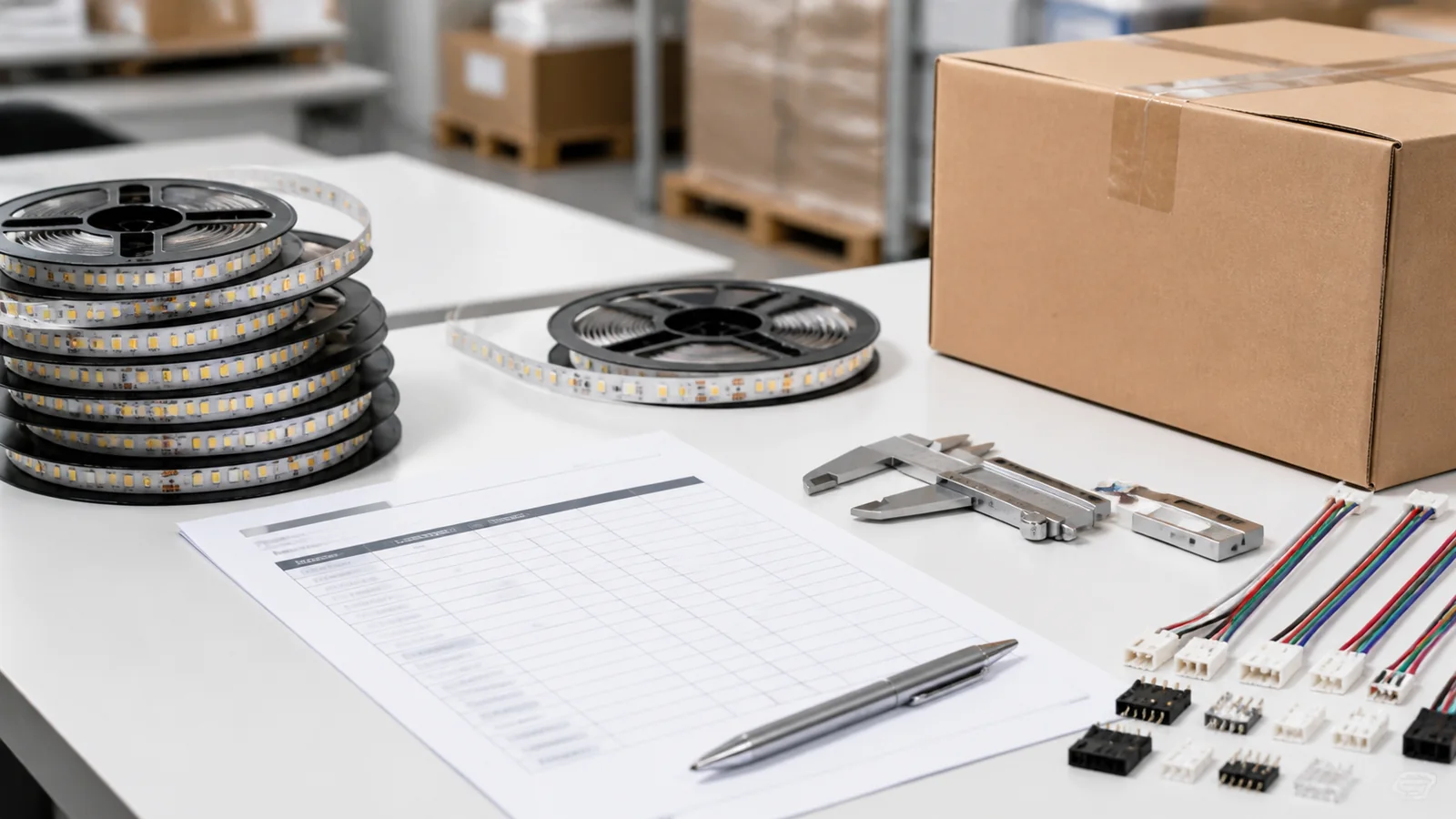
Request the same CCT, CRI, voltage, power class and protection construction from each shortlisted supplier. Mount equal lengths on the intended aluminum profile or a controlled test surface. Use the same regulated supply and cable arrangement, and let samples reach a stable condition before recording electrical and optical results.
Visual comparison still matters, but it answers different questions. Inspect:
- brightness and uniformity at the intended dimming level;
- visible color difference between pieces and along a reel;
- dark zones at cut points, joints and connectors;
- dot visibility through the intended diffuser;
- color shift when the strip warms;
- start-to-end appearance over the planned powered run.
Do not use a phone lux application as proof of lumens per meter. It may help identify a large relative difference when geometry and settings remain fixed, but it is not a substitute for a calibrated flux measurement. A lux meter measures illuminance at a point; lumens describe total luminous flux. The mounting distance and beam distribution affect lux readings.
Our guide to LED strip brightness explains how lumens, lux, profile losses and installation geometry answer different design questions.
Turn the approved result into a production limit
A typical value alone gives the inspection team no pass/fail rule. Agree a minimum output or allowable deviation, plus the voltage, temperature, stabilization and sample length used for the check. The limit must account for measurement uncertainty and realistic production variation without becoming meaningless.
The pre-shipment plan should specify:
- how reels or finished sets are sampled;
- whether testing is destructive or non-destructive;
- the reference equipment and setup;
- measured power and flux acceptance limits;
- CCT, chromaticity and color-consistency limits;
- disposition for a failed sample or lot;
- whether replacement, sorting or investigation is required;
- records retained with the batch.
Keep one signed production-intent sample. If the LED package, resistor layout, PCB copper, coating, silicone, adhesive or power loading changes, review whether the old photometric result remains relevant. A matching label is not enough if the construction changed.
Lumen verification checklist for an RFQ
Include these items in the enquiry:
- application and required delivered light, not only lumens per meter;
- exact CCT, CRI and color-tolerance requirement;
- voltage, watts per meter, PCB width and LED density;
- IP construction and intended profile or diffuser;
- required typical and/or minimum luminous flux;
- acceptable power and lumen tolerance;
- required report, test method and laboratory information;
- sample length, mounting and stabilization conditions;
- bulk inspection method and sampling plan;
- model-change notification requirement.
Send the application drawing and target values through the quotation form. We can identify which model-specific data are available and which points need sample verification before the specification is frozen.
Catalog & Sourcing Note
This article is prepared from our current product catalog and B2B specification workflow. Electrical, waterproofing and installation requirements vary by model and market, so confirm the final specification and approved sample before ordering.
Discuss Your Specification