Trace every reel back to an identifiable production lot
A useful traceability system lets a buyer start with one reel and find its purchase order, product model, production lot, packing carton, inspection record and approved specification. The label does not need a complex database, but the code must remain unique enough to isolate affected stock when a problem appears.
Decide the level before the labels are printed. A simple wholesale order may only need lot-level traceability. A customer assembling kits or supplying several project sites may need reel-level serial numbers and a record of which reels entered each carton.
Match data collection to the cost of a failure
IPC-1782 describes manufacturing and supply-chain traceability as a risk-based agreement between user and supplier. Its published scope covers products, processes, assemblies, parts and components, with different levels of traceability. The IPC overview is useful when a buyer needs a formal framework.
For ordinary commercial LED strip, start with the questions the system must answer. Can the warehouse separate one suspect PCB or LED bin? Can it identify which cartons went to a customer? Can the supplier retrieve the related inspection record? Collecting data that nobody can search or use adds work without narrowing a recall.
Define what creates a new lot. Common triggers include a different PCB batch, LED bin, phosphor or encapsulation batch, assembly date or production line. The exact triggers depend on the product and the risks agreed for the order. Put the definition in the traceability specification because suppliers may group production differently.
Use the same identity through reel, bag and carton
Each reel label should carry the buyer or supplier model code, voltage, color or CCT, reel length, lot code and quantity unit. Add production date or date code when required. For RGB, tunable-white or addressable products, include the control type or channel description needed to prevent warehouse mixing.
The bag and inner box should repeat the reel identity. The master carton label should add reel quantity, total meters, carton sequence, gross and net weight if required, and shipping marks. If mixed lots are allowed in one carton, list the lot and quantity breakdown. If mixed lots are prohibited, state that rule explicitly.
A barcode or QR code should encode a stable identifier while the label keeps its human-readable fields. Receiving staff still need to identify voltage, color and quantity when a scanner is unavailable. Before production, test the code size, contrast and placement on the real reel and carton surfaces.
The packaging specification guide covers label placement and packing levels in more detail.
A lot code becomes useful when records use it
Inspection reports should list the same product and lot codes printed on the shipped reels. Link the approved sample revision, purchase order, production quantity, sampled quantity and test date. If the factory records CCT, electrical or appearance checks, the record should identify which lot those readings represent.
Keep a retained sample with its original label. The retention period should cover the commercial warranty and the time needed for shipping, sale and complaint handling. Store it under conditions that do not damage the adhesive, silicone or label.
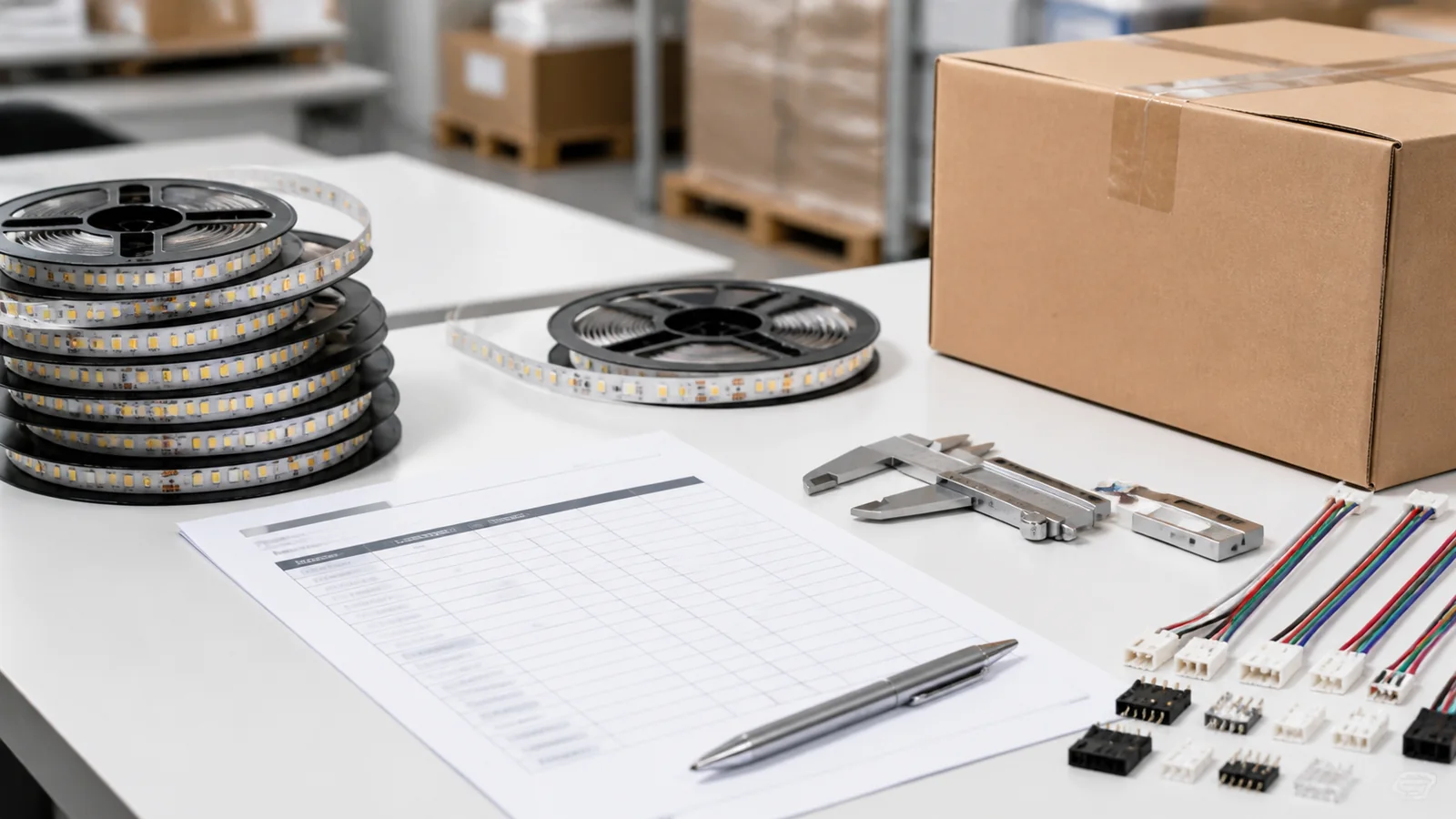
Photographs help when they show the actual label, reel face, strip appearance and carton mark for the inspected lot. Generic factory photographs have no traceability value. The generated header image is an explanatory warehouse concept and does not document a real shipment.
Test whether the chain works at receiving
Select reels from different carton positions. Scan or record their codes and ask the supplier to return the linked model, production lot and inspection record. Compare voltage, CCT or color, reel length and visible construction against the purchase order.
Then perform a reverse lookup. Choose one production lot from the supplier’s packing list and identify every carton containing it. A system that can only search from carton to lot may still leave the buyer unable to isolate all affected stock.
Record warehouse splits. When a master carton is opened and reels move to separate orders or project sites, the buyer’s inventory system must preserve the original reel or lot code. Relabeling with a new customer item number should not remove the production identity.
Define the fields before requesting a quote
Send the model-code format, lot definition, reel fields, carton fields, barcode type, carton sequence rule, mixed-lot policy, packing-list format, retained-sample requirement and record-retention period. Provide artwork or a label example for private-label orders.
State whether the buyer requires lot-level or reel-level traceability and which documents must carry the code. Extra labels, serialized codes and data files affect production and packing work, so they need agreement before order confirmation.
Attach the label schedule to the wholesale quote request. For OEM work, review the final model code and packaging through the OEM service process after the technical specification is stable.
Catalog & Sourcing Note
This article is prepared from our current product catalog and B2B specification workflow. Electrical, waterproofing and installation requirements vary by model and market, so confirm the final specification and approved sample before ordering.
Discuss Your Specification