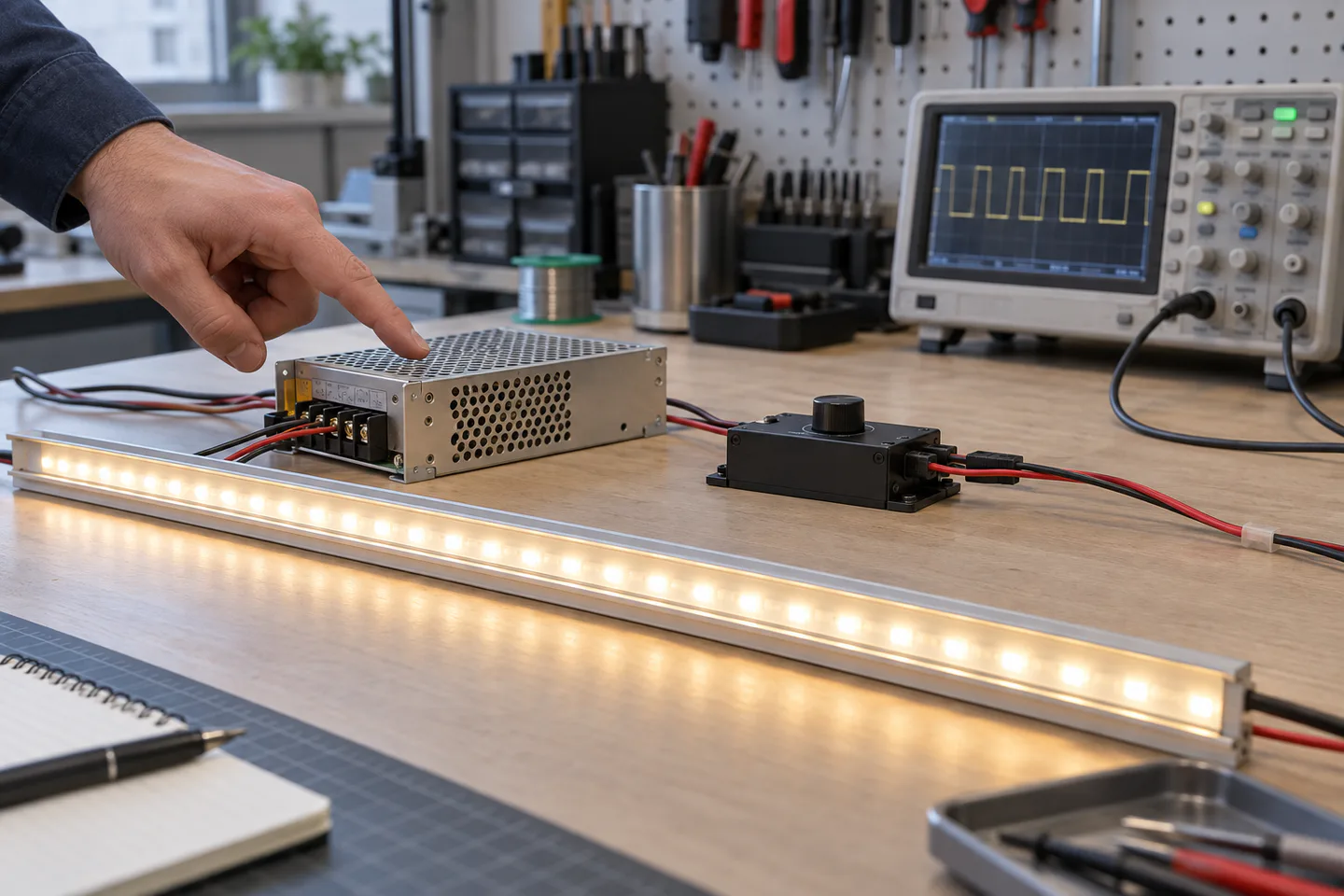
The load and control method are exciting an audible vibration
When an LED strip system buzzes only at certain dimming levels, the sound often comes from a power-supply or controller component vibrating under a changing electrical waveform. Pulse-width modulation can alter the current pattern seen by the supply. Magnetics, capacitors, circuit boards or the enclosure can then turn a small vibration into an audible hum or whine.
That does not prove the unit is unsafe, and it does not make the noise acceptable. First locate the sound. Then check compatibility, loading, temperature and output stability. Replace equipment that smells hot, shows damage, flickers badly, cycles on and off, or cannot maintain the specified DC output.
Locate the sound before changing parts
A finished strip system has several possible sound sources: the AC/DC power supply, a separate PWM controller, the strip itself, a loose metal cover, an aluminum profile or even adjacent building material acting as a sounding board.
Test in a quiet room without pressing on energized equipment. Listen at full output, 75%, 50%, 25% and the lowest stable level. Record whether pitch or volume changes. A cardboard listening tube can help locate a source without touching it, provided it stays clear of terminals and ventilation openings.
If the supply is inside a cabinet or ceiling void, compare the sound with the same unit resting safely in its intended test position before installation. A hollow panel can amplify a minor vibration. Do this only with proper guarding, ventilation and strain relief; an open-frame supply is not a loose tabletop appliance.
Why PWM and driver behavior matter
Many constant-voltage strips are dimmed by rapidly switching their DC current. The duty cycle changes the average light output while the supply and controller still handle current pulses. The exact response depends on PWM frequency, controller design, cable impedance, strip load and the power supply’s control loop.
MEAN WELL’s LED power-supply technical Q&A notes that PWM driving can produce high-frequency audible noise. This is a general mechanism, not a diagnosis of every buzzing installation. A sound that appears only with one controller/supply pairing is strong reason to test compatibility rather than adding random components.
The DOE’s flicker research summary also explains that the waveform delivered to LEDs depends on driver loading, dimming level and the waveform from the control. Audible noise and visible flicker are different outcomes, but both can change across the dimming range.
A controlled diagnostic test
Use the exact production-intent components and change one variable at a time.
- Confirm that strip voltage matches the power-supply and controller voltage.
- Calculate the connected strip load from the agreed watts per meter and installed length. Include all branches on the controller.
- Measure DC voltage and current with suitable instruments at full output and representative dimming levels.
- Record noise location, distance, background condition and dimming percentage.
- Check ventilation, case temperature and whether the unit is mounted as its manufacturer requires.
- Have a competent technician test the supply with the strip directly at steady output, then test the controller/supply combination. Do not bypass controls on a mains-voltage strip.
- Substitute one known-compatible supply or controller of the correct rating. Keep the rest of the system unchanged.
- Repeat after the system has reached a stable operating temperature.
An oversized wattage label alone does not settle compatibility. Very light loading can also produce unusual control behavior on some supplies. Use the manufacturer’s stated load range, derating curve and dimming instructions for the exact model.
Noise that should stop the test
Disconnect the system through its normal safe means and quarantine the equipment if buzzing is accompanied by any of these signs:
- burnt odor, discoloration, melted insulation or smoke;
- repeated restarting or protection cycling;
- unstable output voltage or severe visible flicker;
- loose terminals, arcing marks or damaged conductors;
- enclosure temperature outside the supplier’s stated conditions;
- a sudden change from previously quiet operation.
Do not open, pot, glue or squeeze a power supply to silence it. That can obstruct cooling, damage insulation or hide a failing component. A return or model change is usually more controlled than a field modification with no approved procedure.
Write a noise test that a supplier can repeat
“Silent” is difficult to inspect unless the order defines the setup. For hotel rooms, display cabinets, studios and bedrooms, add an audible-noise check to the approved sample.
State the background condition, listener distance, mounting surface, enclosure or cabinet, strip length, input voltage, warm-up time and dimming points. Test every relevant color combination on RGB or tunable-white systems because channel loading changes with the scene. Keep a short audio recording as supporting evidence, but pair it with the written setup; a phone recording can exaggerate automatic gain and does not replace an agreed limit.
If quiet operation is commercially important, test at least two production-intent samples. One unusually quiet unit does not describe batch variation.
Information to send before requesting a quiet system
Include:
- strip voltage, watts per meter, length and branch layout;
- fixed white, tunable white, RGB or addressable channel arrangement;
- power-supply and controller model numbers;
- mains input range and installation location;
- expected ambient temperature and ventilation;
- dimming method, frequency where available and required dimming range;
- mounting surface, enclosure and distance from occupants;
- operating hours and switching frequency;
- acceptable noise test setup;
- sample quantity and replacement procedure for noisy units.
Review the dimming compatibility guide before choosing the control chain. You can send the proposed components through the quote form; the strip specification should be confirmed together with the driver and controller assumptions.
Catalog & Sourcing Note
This article is prepared from our current product catalog and B2B specification workflow. Electrical, waterproofing and installation requirements vary by model and market, so confirm the final specification and approved sample before ordering.
Discuss Your Specification