Match the strip to the way the sign makes light
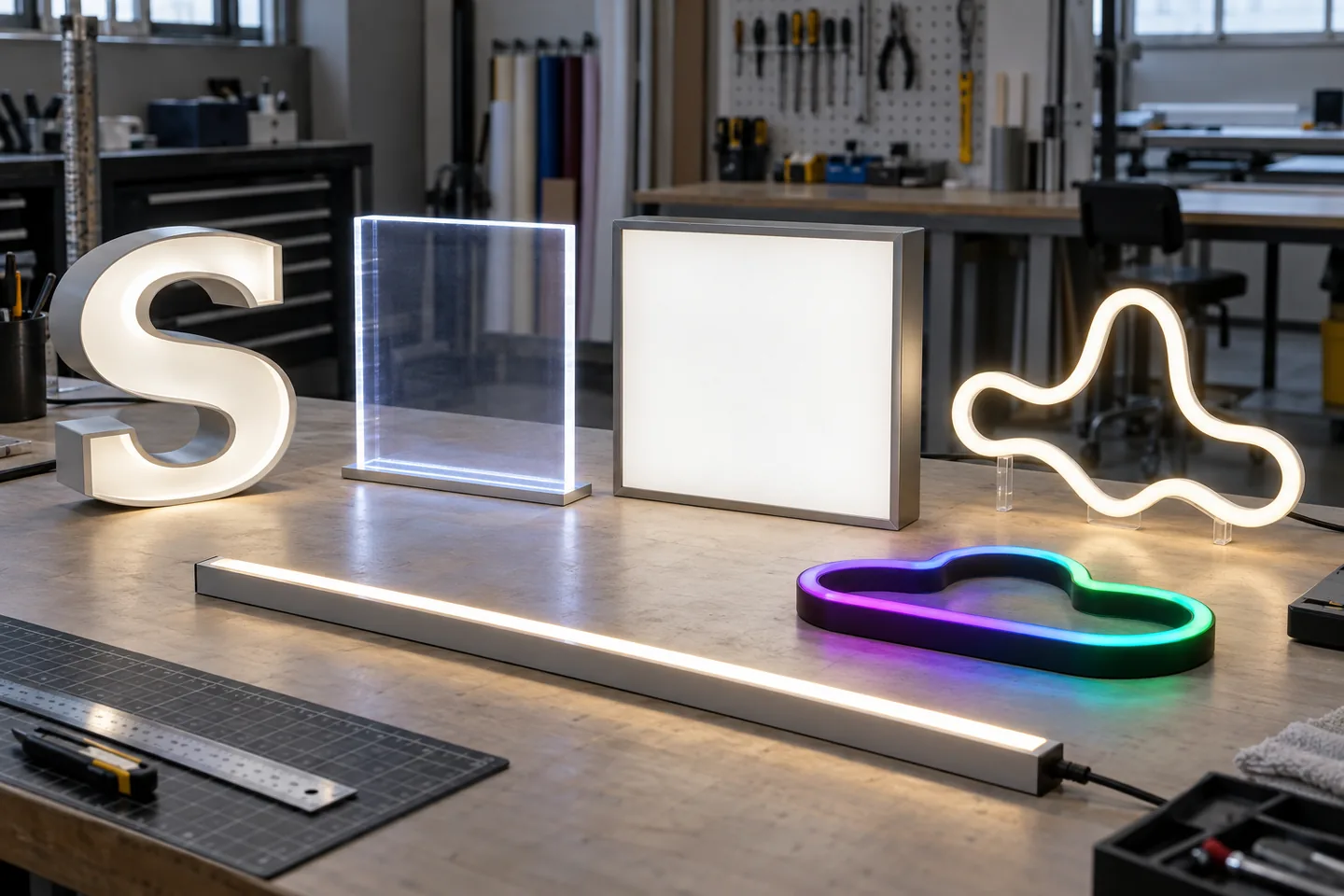
A shallow channel letter, a 1.5m lightbox, an edge-lit acrylic panel and an animated outline place different demands on cut length, source spacing, bending direction, control and service access. The sign section should be drawn before the strip is chosen.
For a static indoor sign with little diffusion depth, begin by testing a low-voltage COB strip or a closely spaced SMD strip. Use a flexible silicone or neon profile for a visible outline. Addressable RGB belongs in signs that genuinely need moving effects and can accommodate the controller, power injection and programming work.
The six configurations below are starting points for prototypes. Catalog figures describe the strip model, not the completed sign. Face luminance, uniformity and viewing quality must be measured on the actual enclosure, surface and graphic.
Compare the sign before comparing LED count
Record these details first:
- Is the sign face-lit, halo-lit, edge-lit, internally illuminated or an exposed outline?
- What are the return depth, letter stroke width and distance from LEDs to the diffuser or face?
- What is the face material, color, transmission and printed coverage?
- What is the smallest letter, corner radius and available cut length?
- Will the sign show one white color, static RGB or animated pixels?
- How will an installer reach strips, connectors, controllers and drivers after the sign is mounted?
- Is the installation indoors, outdoors, washed, exposed to sun or subject to condensation?
The International Sign Association’s design and placement guidance separates external illumination, internal illumination and illuminated elements such as exposed LEDs or neon-style tubing. It also notes that illumination affects color appearance and that local brightness limits may apply. That is a useful reason to approve the finished sign at day and night conditions instead of buying by strip lumen output alone.
Six configurations to prototype
1. Narrow COB strip for slim channel letters
Use this configuration for narrow strokes and shallow letter returns where an 8mm or 10mm PCB is difficult to route.
The 3mm COB 400 LED/m strip is listed at DC12/24V, 7W/m, 500lm/m and CRI 90. Its narrow PCB can fit tighter sign details, but the prototype still needs the actual cutting interval and bend path. Do not crease the PCB around a corner or bridge a sharp metal edge.
Test whether the lower nominal output is enough for the face material and viewing environment. A slim letter may need less light than a deep, dark or heavily printed face.
2. One-LED-cut SMD strip for short letter segments
It suits small letters, repeated strokes and kit production where unused length creates visible gaps.
The 8mm SMD2835 one-LED-cut strip lists DC12/24V, 10W/m, 1000lm/m and CRI 80. Short cutting flexibility can help a fabricator place light closer to stroke ends. Confirm the exact cut marks on the production sample and decide whether each short piece will be soldered or connected by a purpose-made lead.
Many small segments create many joints. Include pull checks, polarity marking and a repeatable wire-routing template in production inspection.
3. High-output SMD strip for a deeper lightbox prototype
Start here for internally illuminated panels where spacing and face transmission require more output.
The 10mm SMD2835 240 LED/m strip is listed at DC12/24V, 18W/m, 1800lm/m and CRI 80. Treat it as a high-load candidate. The sign needs a thermal path, sufficient driver capacity and a feed plan that holds voltage across the full layout.
More lumens do not guarantee a better lightbox. A bright line placed too close to the face can produce stripes while the areas between rows stay dim. Compare row spacing, setback and diffuser layers on a full-size section.
4. Standard 8mm COB for shallow continuous lines
This configuration fits slim indoor lightboxes, halo details and reflective sign interiors where individual points remain visible.
The 8mm COB 320 LED/m CRI80 strip lists DC12/24V, 10W/m and 900lm/m, with 3000K, 4000K, 6500K and blue catalog options. A continuous phosphor surface can reduce source spotting, although face uniformity still depends on setback and material.
Approve color using the real acrylic, vinyl or painted return. A white strip can shift when it passes through a tinted face.
5. Silicone or neon flex for exposed outlines
Use silicone or neon flex for visible contours, script shapes and architectural sign borders where the light source is part of the graphic.
The 7x15mm DC5V RGB Magic neon flex kit is a 5m catalog option for color-changing outlines. The profile dimensions and bending direction decide which curves are possible. Obtain the cut interval, minimum bend radius, cable exit and end treatment before drawing the final shape.
For a static outdoor outline, the 10x10mm IP68 flexible silicone strip is listed at DC12/24V, 10W/m and a 100m supply length. That supply length is not a permitted single electrical run. The finished sign still needs planned feed points, supports, drainage and sealed terminations.
6. Addressable RGB strip for animated signs
Addressable RGB suits entertainment, events and feature signs that require programmed movement instead of a fixed brand color.
The DC24V SMD5050 RGB Magic strip lists 60 LEDs/m, 12W/m and a 10m supply length. Before selecting it, define the pixel grouping, control protocol, data direction, maximum frame or effect requirement and behavior after power restoration.
Animated signs add controller configuration, data wiring and more complex fault diagnosis. Keep data and power diagrams with the sign. If the customer only needs one static color, a simpler circuit may be easier to commission and maintain.
Quick comparison
| Configuration | Strongest use case | Main prototype question | Service burden |
|---|---|---|---|
| 3mm narrow COB | Slim channel-letter strokes | Does it fit and turn without PCB stress? | Medium |
| One-LED-cut SMD | Short repeated segments | Can every joint be made consistently? | High |
| 240 LED/m SMD | Deeper or demanding lightbox | Are heat, row spacing and voltage controlled? | Medium |
| 8mm COB | Shallow continuous white line | Is the face uniform at the available setback? | Low to medium |
| Silicone or neon flex | Exposed outline | Does the profile bend and seal as drawn? | Medium |
| Addressable RGB | Animated feature sign | Are power, data and programming documented? | High |
This table compares design fit, not finished-sign brightness. The same strip can look different behind another face, at another depth or with another row spacing.
Approve a sign section, not a loose reel
Build the most difficult part of the sign at production scale. For channel letters, include the narrowest stroke, tightest corner and longest continuous section. For a lightbox, include the final face, printed layer, internal finish and planned LED spacing.
Evaluate:
- day and night appearance at the intended viewing distance;
- bright spots, dark bands and color shift across the face;
- voltage at the first and last feed points under full load;
- driver, strip, connector and enclosure temperatures after warm-up;
- color and brightness at the approved dimming setting;
- cable shadows and visible hardware;
- start-up, dimming and power-restoration behavior;
- access for replacing one failed segment or driver;
- water path, drainage and termination condition where relevant.
Use locked camera settings only as a supporting record. The acceptance decision should use agreed meter readings and direct observation because automatic exposure can make two different samples look similar.
Turn the prototype into the RFQ
Specify:
- sign type, overall dimensions, stroke width and return depth;
- face, diffuser, vinyl and internal reflective materials;
- LED model, voltage, power, color and cut interval;
- strip spacing and distance to the sign face;
- profile or mounting method;
- driver and controller arrangement;
- feed points, cable sizes and connector method;
- static, tunable, RGB or addressable behavior;
- indoor or outdoor environment and cleaning exposure;
- replacement access and spare-part requirement;
- sample dimensions and measurable acceptance limits;
- destination and buyer-defined market-entry requirements.
Send the section drawing through the sign-lighting quote form. We can compare it with the current COB, SMD, neon flex and RGB catalog options, then state where a proposed model differs from the approved prototype.
Catalog & Sourcing Note
This article is prepared from our current product catalog and B2B specification workflow. Electrical, waterproofing and installation requirements vary by model and market, so confirm the final specification and approved sample before ordering.
Discuss Your Specification