Continuous operation is possible after a system-level check
LED strip lights can run 24 hours a day when the complete installation is designed for that schedule. The buyer needs to approve the strip, mounting profile, branch wiring, driver, dimming method, ambient temperature and access for replacement as one system.
Continuous operation raises the accumulated heat exposure of the LEDs, flexible PCB and driver. The U.S. Department of Energy’s LED lifetime and reliability fact sheet explains that LED system performance depends on the interaction of its components and that thermal management affects package life. Service-life approval should cover the installed system as well as the LED chip’s claimed hour rating.
For a hotel corridor, supermarket shelf, security desk or industrial indicator that will remain on through the night, write the operating schedule into the request for quotation. A supplier cannot assess continuous operation if the inquiry only lists voltage, color temperature and meters.
Calculate each run and branch from the approved model
Start with the model’s measured or declared watts per meter and the actual installed length:
connected load (W) = strip power (W/m) × installed length (m)
For example, 20 meters of a 12W/m strip represents 240W of connected strip load before allowing for conversion losses or any model-specific design margin. Do not place that length on one feed without checking the model’s supported run, conductor size and voltage drop. Divide the layout into branches that the approved strip and wiring can support.
The COB 8mm 320LED CRI95 catalog model is listed at DC12/24V and 12W/m. Those values help size a proposal. Maximum run and continuous-use approval still depend on the final voltage, feed spacing, PCB construction and mounting detail confirmed for the order.
Measure voltage at the first and last powered sections under full load. A branch that is already near its lower acceptable voltage during commissioning has little tolerance for warm cables, loose terminals or supply variation. The power supply and voltage-drop guide shows how to include cable length and current in that check.
Treat the installed temperature as an acceptance value
The same strip can run at different temperatures on bare wood, inside a shallow profile, in a ventilated aluminum channel or in a sealed cabinet. An aluminum profile can spread heat when the flexible PCB makes sound contact with it. It cannot remove heat effectively if the profile is undersized, covered with insulation or enclosed without a heat path.
Record three temperatures during the mock-up:
- room or enclosure air near the installation;
- the strip/profile temperature at the warmest section;
- the driver case temperature at its maker’s specified measurement point, when applicable.
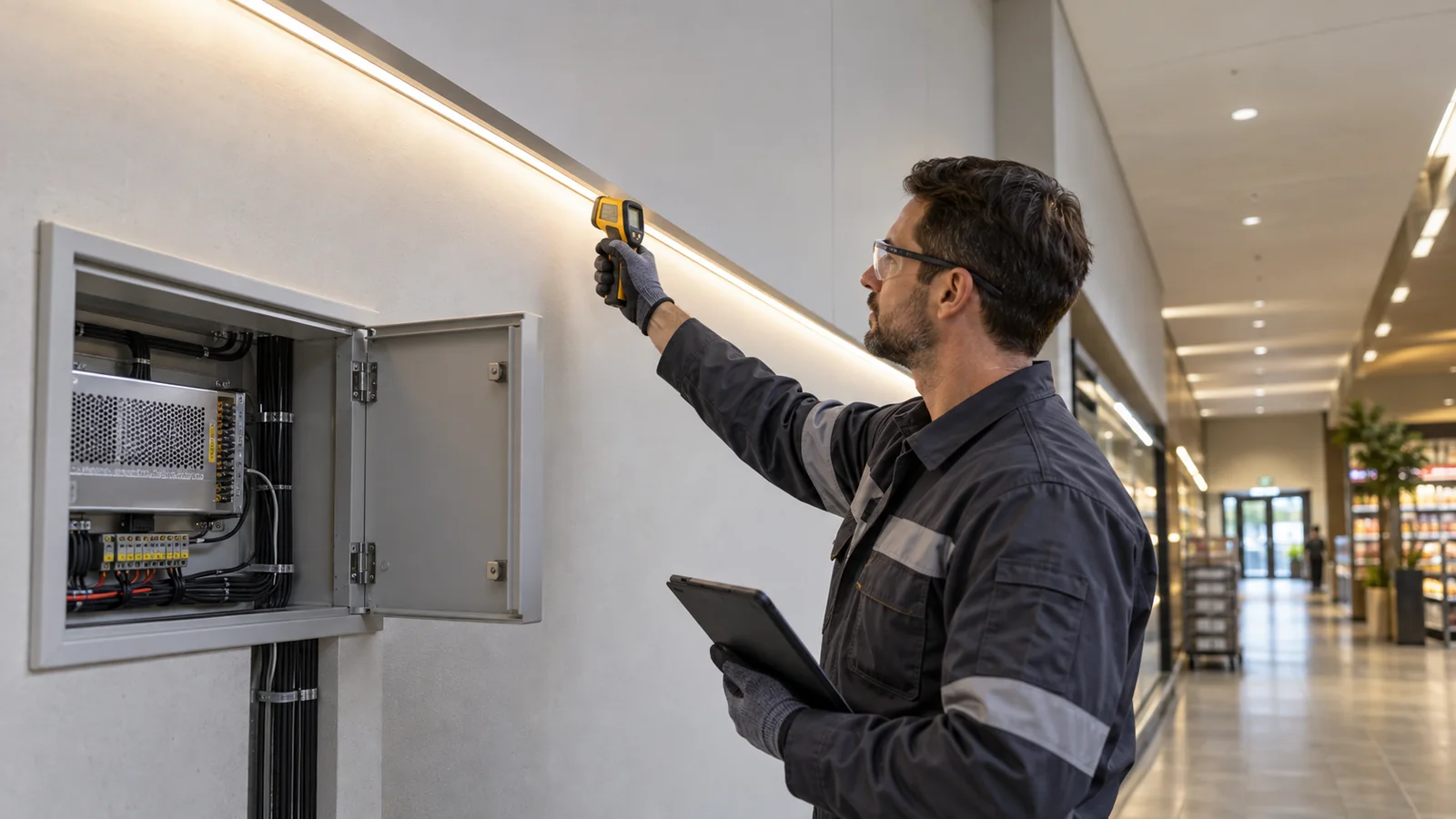
Use the strip and driver limits stated for the exact models. A general surface reading cannot establish LED junction temperature unless the product documentation gives a validated relationship. A handheld infrared thermometer also depends on surface emissivity and aiming, so use the same method and marked locations for comparisons.
The DOE’s luminaire lifetime guidance notes that driver electronics and their operating temperature can be major reliability concerns. The strip may remain lit while light output, color or driver stability has already moved outside the project’s acceptable range.
Approve the power supply at the real ambient temperature
Choose a constant-voltage supply that matches the strip voltage and can carry the calculated branch load under the installation conditions. Read its load-versus-temperature curve instead of applying one universal spare-capacity percentage. Some supplies can deliver their full nameplate output only within part of the ambient range or in a defined mounting orientation.
MEAN WELL’s power supply application guidance tells designers to check the model’s derating curve and consider operating temperature. It also notes that mounting orientation can affect heat behavior for some fanless supplies. The same principle applies regardless of driver brand: approve the exact data sheet and install the unit with the required ventilation and clearances.
Check the low-voltage side as carefully as the mains input. Terminal current, conductor size, branch fusing where required, connector rating and cable entry all need to match the circuit. Place the driver where future staff can inspect or replace it without removing finished joinery.
Run the mock-up through its worst credible condition
A five-minute lighting check will find reversed polarity and dead segments. It will not show the stabilized temperature of a profile or driver. Build the test with the proposed strip, profile, diffuser, driver, cable lengths and enclosure. Operate it long enough for temperatures and electrical readings to stabilize under the highest expected ambient condition that can be reproduced safely.
Record:
- input and output voltage at the driver;
- current or power for each loaded branch;
- voltage at the far end of each representative run;
- strip/profile and driver temperatures at marked points;
- light output or illuminance at an agreed reference point;
- visible color difference, dark segments, flicker, noise or odor;
- performance at every required dimming level.
Repeat the check after switching cycles if the installation uses occupancy schedules or daily shutdowns. A continuously energized driver and a driver switched several times per day face different service conditions. The acceptance record should identify which schedule was tested.
Plan replacement before the ceiling or display is closed
Continuous-use projects should divide long layouts into serviceable sections. Keep drivers outside hot sealed cavities, label each circuit and leave enough cable access to test a branch without pulling on the strip. If color matching matters, retain spare strip from the approved production batch and store it under suitable conditions.
The maintenance file should list the strip model, voltage, watts per meter, profile, driver, dimmer, branch lengths, feed locations and commissioning readings. Add the accepted replacement procedure and the person responsible for isolating mains power. The driver maintenance guide gives a layout method for accessible replacement.
When requesting a 24/7 installation, send LEDStripStar the operating schedule, ambient range, run plan, mounting section and control method through the quotation form. Available construction and all final technical details are confirmed by model before ordering. Any special test or documentation requirement must be agreed in advance.
The header image is an editorial concept showing a maintenance inspection. It is not a test record for a product or project.
Catalog & Sourcing Note
This article is prepared from our current product catalog and B2B specification workflow. Electrical, waterproofing and installation requirements vary by model and market, so confirm the final specification and approved sample before ordering.
Discuss Your Specification