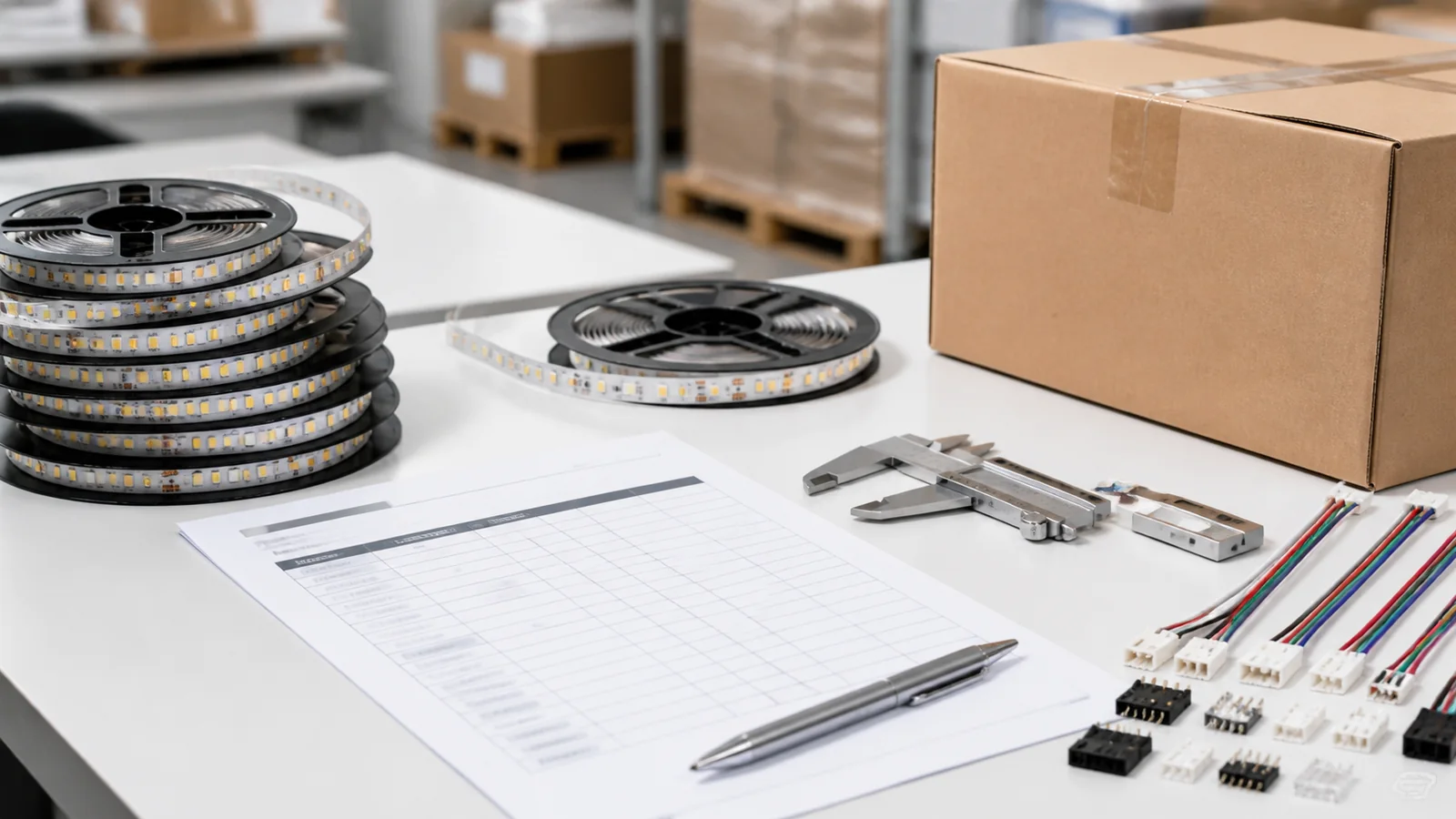
Factory soldered joins can be part of an LED strip reel’s intended construction. Their presence alone does not prove that a reel is defective or that the joins are acceptable for your project. Confirm the exact model’s construction, then judge the electrical function, mechanical fit and visible result against the agreed sample and order requirements.
A reel advertised as one continuous length may contain joined PCB sections. If your project needs a joint-free finished piece, write that requirement explicitly and obtain confirmation before ordering. Do not infer it from reel length or a product photograph.
Separate reel length from joint-free construction
Ask whether “continuous” means one supplied length, one electrically connected assembly, or no board-to-board joins. These describe different requirements. A factory join may sit inside a reel even though the customer receives one length with no loose pieces.
Flexfire’s IP20 Grip Connector guide describes pre-soldered manufacturing joins and instructs users not to attach its connector at those joints. The spacing and connector instruction belong to that product system. They are not a specification for every LED strip, or evidence of the joint construction in LEDStripStar’s catalog.
Our 8mm CRI95 COB listing lists 5M/10M supply lengths. Those values do not specify joint count, spacing or a joint-free guarantee. Request the construction details for the exact order. The reel-length guide covers the separate packing and cut-list decisions.
Inspect what the join changes in the installation
Start with an unpowered sample, keeping its reel label and batch identity. Check both faces without pulling or bending the join to see whether it breaks. Destructive tests require a separately agreed method and sacrificial samples.
| Check | What the buyer needs to establish |
|---|---|
| Location | Does the join fall at a finished end, connector position, tight curve or visible focal point? |
| Physical clearance | Does the joint sit correctly in the actual channel with its cover and mounting arrangement? |
| Visible condition | Are there loose sections, lifted pads, obvious cracks, damaged coating or unintended bridges between contacts? |
| Light-line appearance | Does the join create an unacceptable dark gap or color change through the intended diffuser? |
| Protected construction | Is the joint enclosure or coating consistent with the agreed construction and exposure? |
Appearance alone cannot establish electrical reliability. A joint that lights on a bench may still sit poorly in the production profile. Fit the representative sample into the intended channel without forcing the cover or pressing the soldered area against conductive metal.
For a functional check, use a correctly rated supply and the approved wiring arrangement. Fully unwind the sample length, support it and isolate power before connection changes. Keep mains equipment closed and mains work with a qualified installer. Check the whole finished run at its intended output, then inspect the join’s visible effect from the project viewing positions.
If a section flickers, loses light or shows signs of damage, disconnect it and record the symptom. Do not repeatedly flex a powered join, press it with a metal tool or bypass protection to make it work. The troubleshooting guide can help separate a strip problem from supply or connection issues.
Do not install a solderless connector on an existing join unless the connector manufacturer explicitly allows that construction. Pad geometry, solder thickness and cover clearance all matter. Follow the exact strip’s cut markings and connection instructions rather than cutting through a join by eye.
Agree the requirement before comparing quotes
For a visible architectural line, ask the supplier to show a representative join in the finished profile. For factory-cut assemblies, identify any locations where a join would interfere with the connector, mounting clip or bend. If joins are prohibited in specified finished pieces, obtain written confirmation that those lengths can be supplied that way.
A useful order note includes:
- Exact strip model, voltage variant, construction and supplied length.
- Whether board-to-board joins are permitted, with any count or location limits agreed for that order.
- Finished cut lengths and areas that must remain clear for termination or installation.
- Approved joint appearance through the actual profile and diffuser.
- Functional inspection method, sampling plan and treatment of nonconforming reels.
- Identity of the reference sample and any agreed destructive-test procedure.
Do not invent a universal allowable gap, joint count or pull strength. Those limits need the product drawing, application and an agreed acceptance method. A field-cut waterproof assembly also needs its own sealing review; a label on the reel does not establish the condition of a modified joint. See the connection sealing guide.
Preserve evidence before repairing a disputed reel
Separate the affected reel, photograph the joint and label, and record the position along the supplied length. Note how many reels were checked and how many showed the same condition. Keep unchecked stock separate from confirmed affected quantities.
Compare the observation with the purchase order and reference sample. A permitted factory join and an unapproved field repair require different discussions. If the documents do not define the construction, ask for clarification without describing every joined reel as scrap.
Before cutting out or resoldering a disputed join, agree the inspection and resolution steps with the supplier. Altering it may remove the evidence needed to determine what happened. Use the fault-documentation checklist and include the original specification with your enquiry.
Catalog & Sourcing Note
This article is prepared from our current product catalog and B2B specification workflow. Electrical, waterproofing and installation requirements vary by model and market, so confirm the final specification and approved sample before ordering.
Discuss Your Specification