Most 12V and 24V LED strips use a constant-voltage power supply
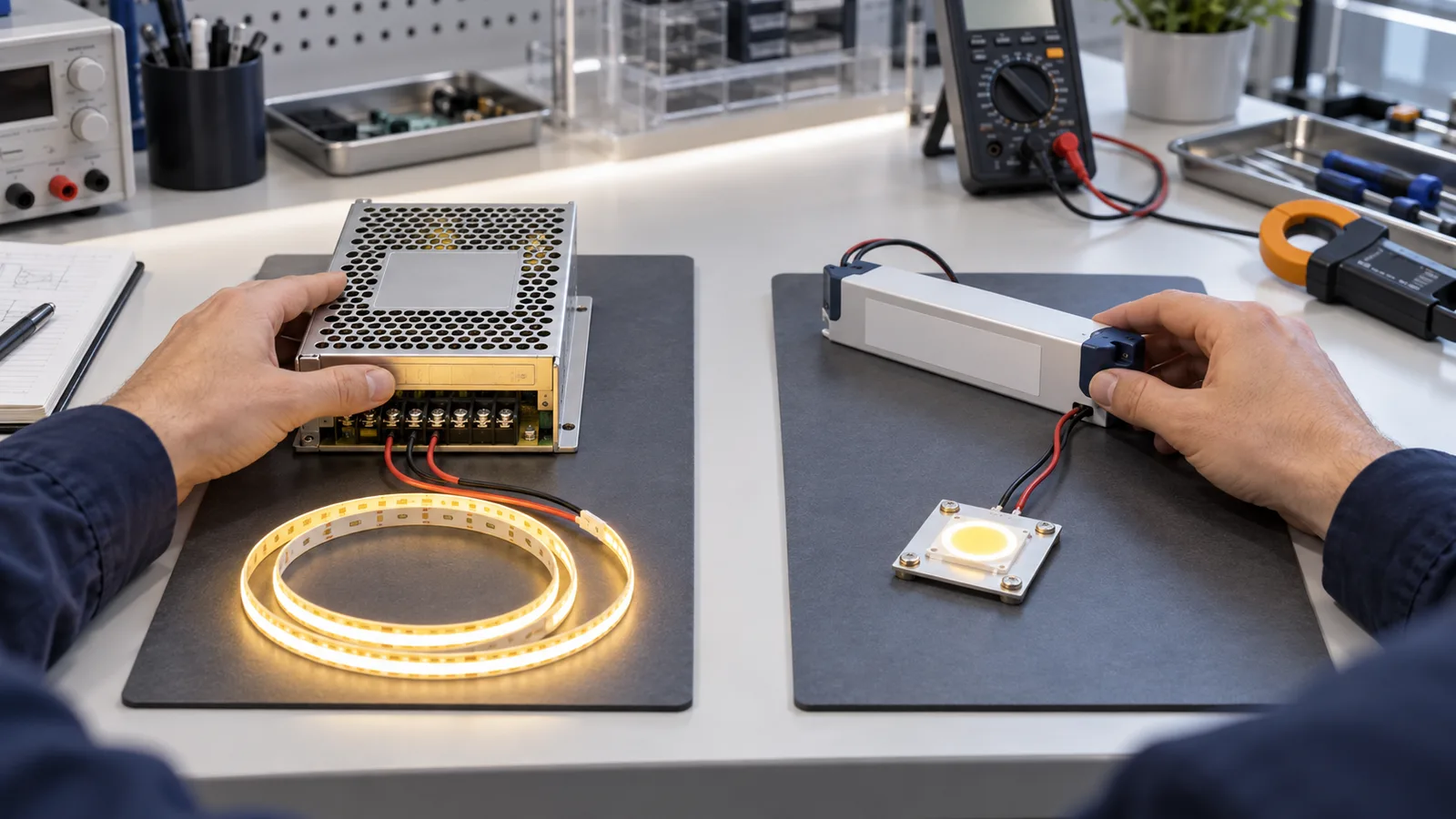
The words “LED driver” and “LED power supply” are often used for the same box in quotations, but the output behavior matters more than the name. A conventional 12V or 24V flexible LED strip normally needs a constant-voltage output that matches its rated voltage. A bare LED module designed for regulated current may need a constant-current driver instead.
Never choose from wattage alone. Match the output mode, output voltage or current range, total load, ambient conditions and dimming method. A 24V constant-voltage strip must not be connected to a constant-current driver simply because both devices carry a suitable wattage number.
AC220V strip is outside this low-voltage arrangement. It uses product-specific input accessories and must be selected, terminated and installed for its own construction.
Constant voltage and constant current regulate different quantities
| Item | Constant-voltage supply | Constant-current driver |
|---|---|---|
| Regulated output | Voltage, such as 12V DC or 24V DC | Current, such as a stated milliamp range |
| Common load | Flexible strip with onboard current-limiting components | LED module or luminaire designed around a defined drive current |
| Buyer must match | Strip voltage and total watts or amps | Required drive current and permitted output-voltage range |
| Typical marking | 24V DC, maximum output current and rated watts | Output current plus a voltage operating window |
| Common selection error | Correct watts but wrong voltage | Correct watts but current or voltage window does not suit the LED load |
A constant-voltage supply holds the specified output voltage while the connected branches draw current according to their design and length. This is the usual arrangement for the low-voltage strip models in our catalog.
A constant-current driver regulates current and adjusts its output voltage within a stated operating window. MEAN WELL’s LED driver application FAQ illustrates this with an LED load whose forward voltage and required current are calculated before the driver is selected. That example describes a constant-current LED design, so its calculation should not be copied onto a 24V constant-voltage strip.
The safe buying rule is simple: obtain the strip’s required input first, then select power equipment that provides that output mode.
Read the complete output specification
For a constant-voltage strip supply, record:
- AC input range and frequency;
- DC output voltage;
- rated output current;
- rated output power;
- permitted loading and temperature conditions;
- enclosure and installation environment;
- dimming type, if any;
- number and type of output terminals;
- installation, spacing and ventilation instructions.
For a constant-current driver, record the regulated current and its allowed output-voltage range. The connected LED load must sit inside that range during operation. Also check whether the current is fixed, selectable or programmable.
Do not identify output mode from enclosure shape. Metal-case, plastic-case and compact in-profile units can exist in several electrical formats. Check the label and the manufacturer’s datasheet for the exact model code.
The LEDVANCE strip system wiring guide shows a 220 to 240V AC input feeding a driver with a 24V SELV output for the illustrated LED strip system. It also shows a controller after the driver for dynamic strip types. The diagram is useful for system order, while the exact ratings still come from the selected components.
Size the supply from the connected branch load
For constant-voltage strip, start with:
Strip load (W) = watts per meter (W/m) × powered length (m)
Then calculate nominal current:
Current (A) = strip load (W) ÷ rated voltage (V)
Suppose a 24V strip is rated at 10W/m and one power zone contains 8m. The nominal strip load is 80W and the current is about 3.33A. Apply the power-supply manufacturer’s loading and derating guidance before selecting the final rating. Check controller, terminal, connector and cable ratings against the current they carry.
Do not treat one large wattage figure as permission to make one long strip run. Power-supply capacity and voltage drop are separate checks. A supply may have enough total watts while the far end of a long branch receives inadequate voltage. Divide the installation into feed sections according to the exact strip, cable route and measured result.
For several branches:
- Calculate each branch load and current.
- Add the branches assigned to the same supply.
- Apply the supply maker’s loading and temperature guidance.
- Confirm each terminal and distribution path.
- Calculate voltage drop on the longest cable route.
- Measure the representative branch under full load.
The power-supply and voltage-drop guide covers the full calculation. Use the LED strip wiring guide to turn it into a branch drawing.
Match the dimming method across the complete chain
“Dimmable” does not define one universal interface. A strip system may be controlled on the AC input side of a compatible supply, through a control input on the supply, or by a low-voltage PWM controller placed between a constant-voltage supply and the strip.
Before ordering, state the control method in plain terms and by protocol where applicable. Examples include phase-cut input, 0/1-10V, DALI, DMX or low-voltage PWM. Confirm the following items together:
- wall control or building-control output;
- power-supply dimming input;
- controller supply voltage;
- controller total and per-channel current;
- strip channel arrangement;
- required minimum dim level;
- switching and standby behavior;
- cable route between control points.
A non-dimming supply can still feed some low-voltage PWM controllers because the controller varies the strip output after the supply. That arrangement depends on the exact controller and supply. Conversely, a dimmable supply does not guarantee compatibility with every wall dimmer or building-control system.
For color-changing strip, the controller normally sits between the constant-voltage supply and the load. Keep the supply voltage identical across the controller input and strip input, and verify channel order. Our controller selection guide explains channel and protocol matching.
Specify the power equipment in the RFQ
Provide these details for each lighting zone:
- strip model, rated voltage and watts per meter;
- meters connected to each power supply;
- number and length of branches;
- cable distance to the farthest branch;
- indoor, enclosed, damp or exposed location;
- expected ambient temperature and ventilation condition;
- controller type and per-channel load;
- required dimming or building-control protocol;
- input voltage and plug, terminal or hardwired connection requirement;
- installation space and access for replacement;
- required sample and loaded system test;
- labeling and packing by zone or circuit.
Ask the quotation to identify the exact power-supply model and its output mode. Do not accept “matching driver” as the full specification. If the project needs particular documents or tests, define them before quotation and confirm what is available for the proposed model.
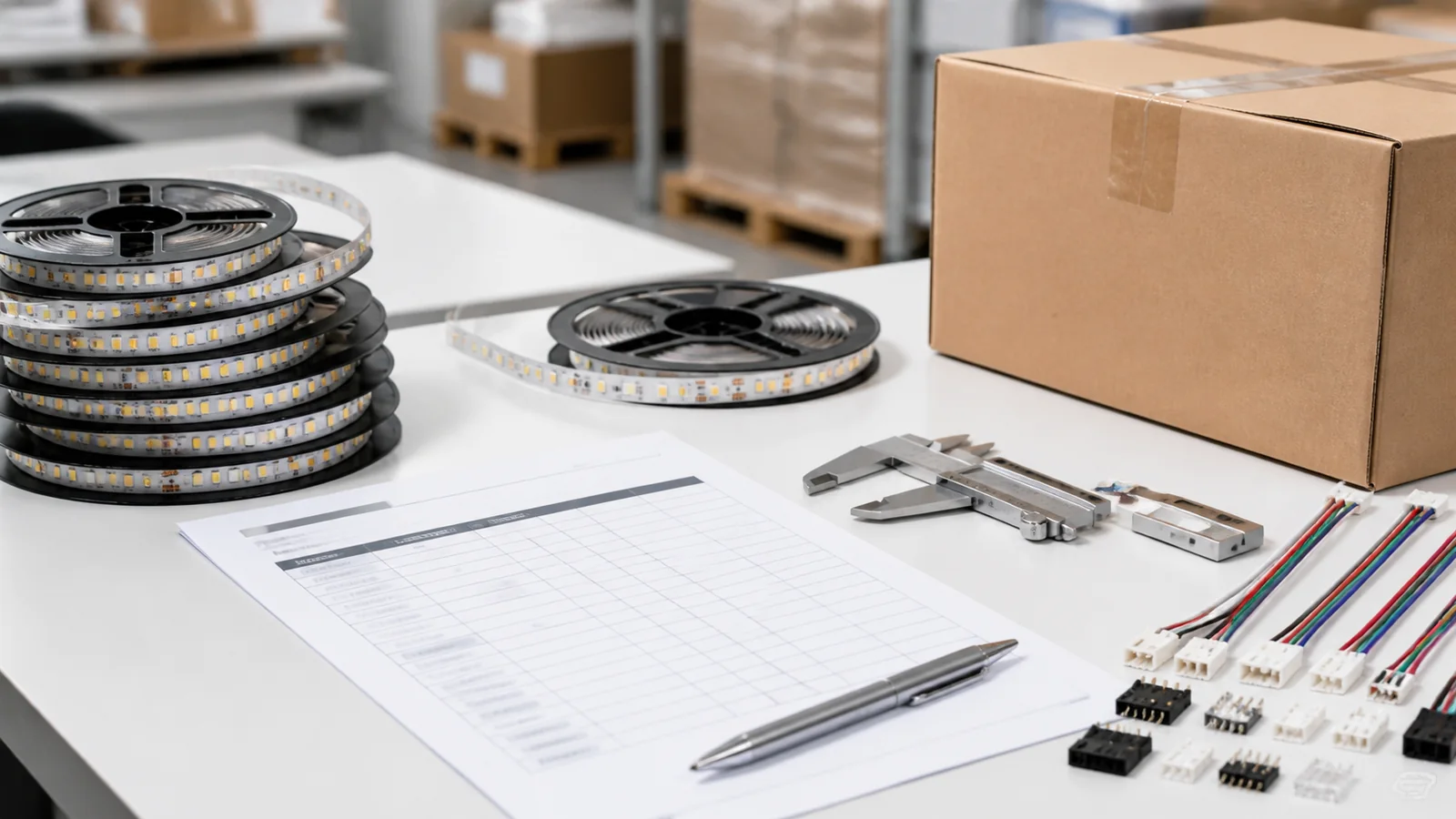
Test a production-representative strip, supply, controller and cable together. Measure voltage at the supply and at the far end, operate the controls through their full range, and inspect temperatures under the intended installation conditions. For wholesale orders, submit the power-zone schedule through the quote form. Standard MOQ is 500m, and final component compatibility must be confirmed before production.
Catalog & Sourcing Note
This article is prepared from our current product catalog and B2B specification workflow. Electrical, waterproofing and installation requirements vary by model and market, so confirm the final specification and approved sample before ordering.
Discuss Your Specification