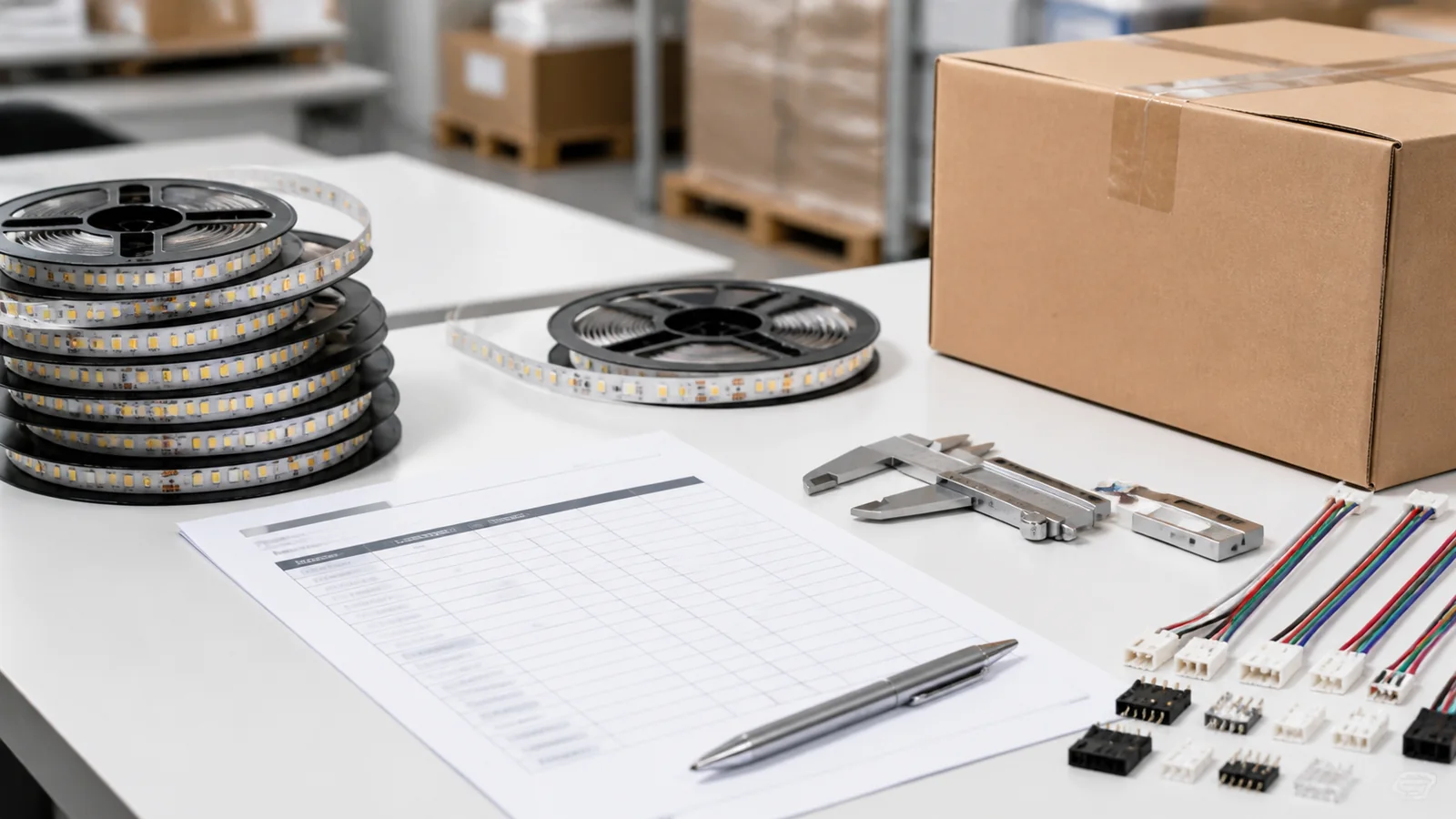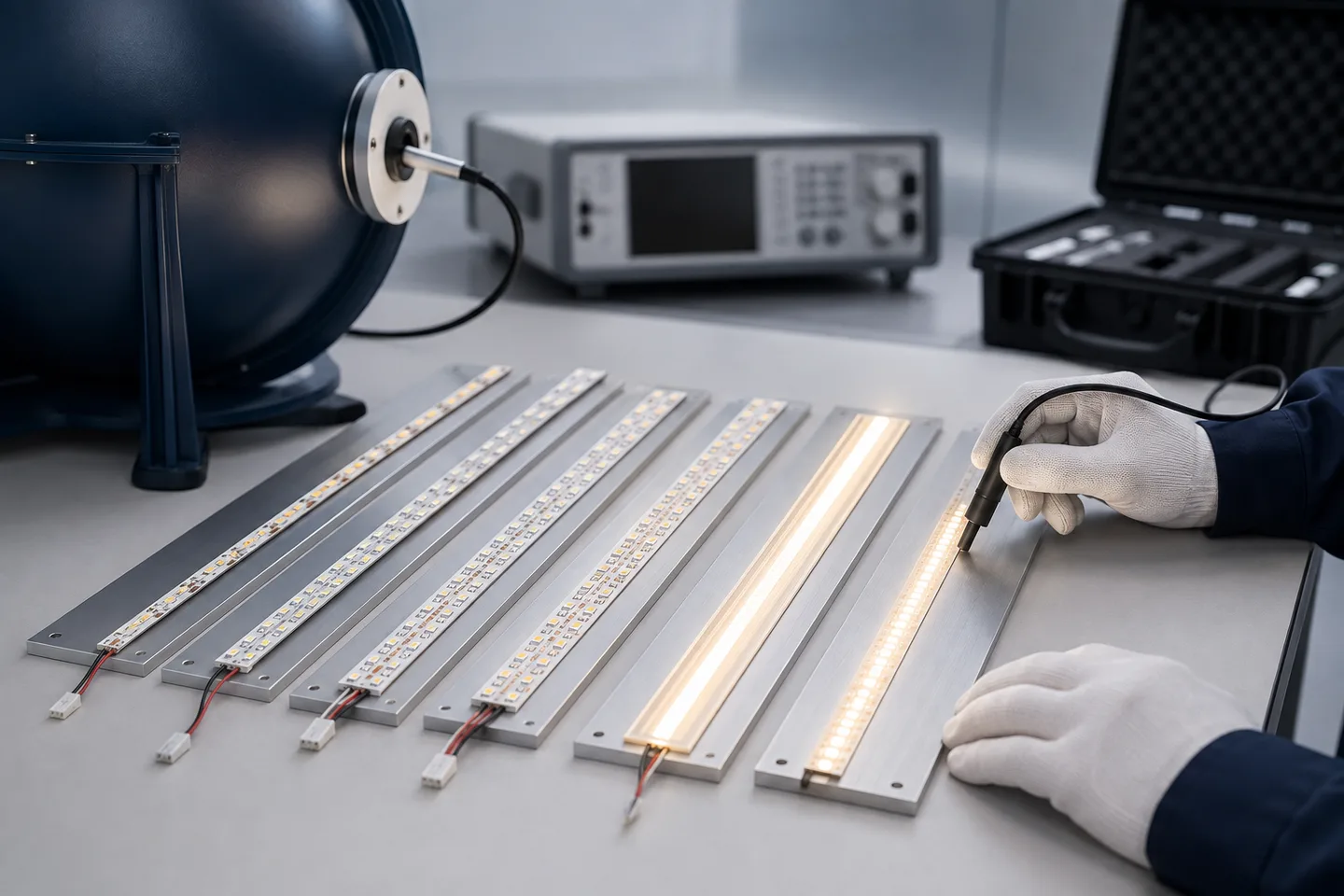
Direct answer: start with lm/W, but do not stop there
Based on the power and lumen fields in LEDStripStar’s catalog on September 8, 2026, several white-light strips calculate to 100 listed lumens per watt (lm/W). They include selected SMD2835 and FCOB configurations. That is a tie at the catalog-field level, not proof that every sample delivers the same result in an installation.
The most energy-efficient choice for a buyer is the strip system that delivers the required light and color at the target surface with the lowest measured input power. Driver loss, dimming, voltage drop, profile and diffuser losses, temperature, CCT and color-rendering requirements can change the result.
The calculations use current website catalog fields rather than laboratory results for a finished installation. Verify the exact ordered model and complete system on samples before a bulk decision.
How this comparison was calculated
For each model:
listed strip efficacy (lm/W) = listed luminous flux per meter ÷ listed power per meter
Example: a strip listed at 1,000lm/m and 10W/m calculates to 100lm/W.
This ratio is useful only when the numerator and denominator describe the same operating condition. A fair comparison needs the same selected voltage, CCT, CRI, sample length, stabilization time and measurement configuration. A bare-strip lumen value cannot be compared directly with light measured after a diffuser.
The U.S. Department of Energy’s LED basics distinguishes source efficacy from complete-luminaire efficacy and notes that the power supply and fixture design affect energy use. DOE’s metrics and test-method overview also explains why defined optical and electrical measurements matter when products are compared.
Six efficient catalog configurations worth comparing
The table groups comparable starting points by use case, because efficiency only matters when the configuration can deliver the required result.
| Configuration | Current catalog fields | Calculated listed efficacy | Why shortlist it | Main tradeoff to test |
|---|---|---|---|---|
| SMD2835 8mm 120 LED/m, one-LED-cut | 10W/m; 1,000lm/m | 100lm/W | Short cut modules for signs, shelves and fitted details | More joints and feed planning in segmented layouts |
| SMD2835 8mm 180 LED/m | 16W/m; 1,600lm/m | 100lm/W | Higher listed output on an 8mm PCB | Heat and voltage drop at the intended run length |
| SMD2835 10mm 240 LED/m | 18W/m; 1,800lm/m | 100lm/W | High listed output with dense SMD layout | Profile fit, thermal condition and supply capacity |
| SMD2835 12mm 240 LED/m, two-row | 18W/m; 1,800lm/m | 100lm/W | Wider two-row format where profile space allows | Wider channel, connector and bend constraints |
| FCOB 8mm 240 LED/m | 12W/m; 1,200lm/m | 100lm/W | Continuous-looking light in shallow details | Confirm delivered output through the chosen diffuser |
| SMD2835 8mm 120 LED/m, CRI98 | 10W/m; 900lm/m | 90lm/W | Higher listed color-rendering option for retail/material review | Lower calculated efficacy than the 100lm/W group |
Why include a 90lm/W model in a “most efficient” shortlist? Because efficiency is not the only specification. A buyer who needs high color fidelity should compare the energy cost of meeting that visual requirement, not select a lower-CRI strip and discover after installation that the merchandise looks wrong.
Another current option, the 5mm SMD2835 120 LED/m AC220V strip, also calculates to 100lm/W from its 12W/m and 1,200lm/m catalog fields. It is not in the main six because a mains-voltage strip requires a different safety, cutting, insulation and market-acceptance review from low-voltage tape. Do not treat equal lm/W as interchangeability.
The strip with the highest listed lm/W may not use the least energy
Driver losses
To compare a complete system, measure power at the AC input, not only the nominal DC strip load. Driver efficiency changes with model, load and operating condition. Oversizing a supply excessively can place the normal load outside its best operating region; undersizing creates a different reliability problem.
Diffuser and profile losses
A deeper profile or more transmissive diffuser may deliver more usable light than a visually opaque combination, but glare and dot visibility also matter. Compare assembled samples at the same target plane.
Voltage drop
A long strip can draw power while producing uneven light because the far end receives less voltage. Divide long layouts into designed branches and measure the feed and far end under load. The voltage-drop guide shows how cable, current and feed length interact.
CCT and color quality
Cooler and lower-color-rendering variants may produce more listed lumens per watt than warmer or higher-color-fidelity variants. Lock the required CCT and color performance before comparing efficacy.
Controls and operating schedule
A slightly lower-efficacy strip that is correctly dimmed, scheduled or controlled by occupancy can consume less annual energy than a higher-efficacy strip left at full output. Controls must match the strip voltage and channel type, and the comparison should include standby power where it is material.
Sample test plan for an efficiency claim
Ask for two or more samples of the exact proposed model and order option. Record the label and construction, then use one written method for every candidate:
- select one CCT, CRI, voltage and production configuration;
- define sample length, feed arrangement and any profile/diffuser;
- operate samples until readings stabilize under the same ambient condition;
- measure DC voltage at the strip and electrical power;
- measure light output with a suitable photometric setup;
- repeat at the longest proposed branch or a representative assembly;
- calculate strip efficacy and complete-system efficacy separately;
- compare color, temperature, voltage drop and visual uniformity;
- retain an approved sample and signed measurement record;
- repeat the agreed checks on production batches.
Do not accept a screenshot containing only a lumen number. The report or record should identify the tested model, sample configuration, CCT, electrical input, instrument, date and operator. The lumen-output verification guide provides a fuller buyer checklist.
Choose efficiency in the context of the application
| Buyer need | Start with | Verify before ordering |
|---|---|---|
| Maximum light from a narrow profile | 8mm 180 LED/m SMD | Profile temperature, far-end voltage and assembled output |
| Dense high-output linear light | 10mm or 12mm 240 LED/m SMD | Channel width, driver loading and diffusion |
| Continuous-looking cove or shelf light | 8mm 240 LED/m FCOB | Dot visibility, diffuser loss and run uniformity |
| Very short repeatable cut modules | 8mm one-LED-cut SMD | Cut interval, joint method and labor per assembly |
| High-fidelity retail/material display | 8mm CRI98 SMD | Color performance on the actual merchandise and energy tradeoff |
| Long mains-voltage run | Review separately from low-voltage tape | Electrical design, insulation, cut rules and requirements at the destination |
For an RFQ, state the delivered-light target, CCT, color requirement, operating hours, branch lengths, dimming method, profile and diffuser. Then ask every supplier to quote and test against the same schedule. That makes “most efficient” a measurable purchasing requirement instead of a marketing label.
Catalog & Sourcing Note
This article is prepared from our current product catalog and B2B specification workflow. Electrical, waterproofing and installation requirements vary by model and market, so confirm the final specification and approved sample before ordering.
Discuss Your Specification