The short answer
Choose SMD 2835 when the project mainly needs efficient, repeatable white linear light and the available strip design meets the required brightness, color quality and thermal conditions. Choose SMD 5050 when the larger multi-die package is needed for RGB, RGBW or other multi-channel effects. But the package code alone does not determine which strip is brighter, more efficient or longer lasting.
For a purchasing decision, compare the complete strip: LED supplier and bin, LEDs per meter, drive current, watts and lumens per meter, PCB width and copper, voltage, CRI and color tolerance, IP construction, controller, profile and warranty conditions.
What do 2835 and 5050 mean?
The package name commonly describes the nominal LED footprint: approximately 2.8 × 3.5mm for 2835 and 5.0 × 5.0mm for 5050. It identifies a package platform, not a finished-light specification.
Different manufacturers can build packages of the same nominal size with different chips, phosphors, frames, thermal paths, rated currents and color bins. The U.S. Department of Energy’s solid-state lighting manufacturing report lists 2835 and 5050 among several package platforms and shows that package class, materials, chip type and performance factors vary. A buyer therefore needs the exact package and strip data, not just “2835” or “5050” on a quotation.
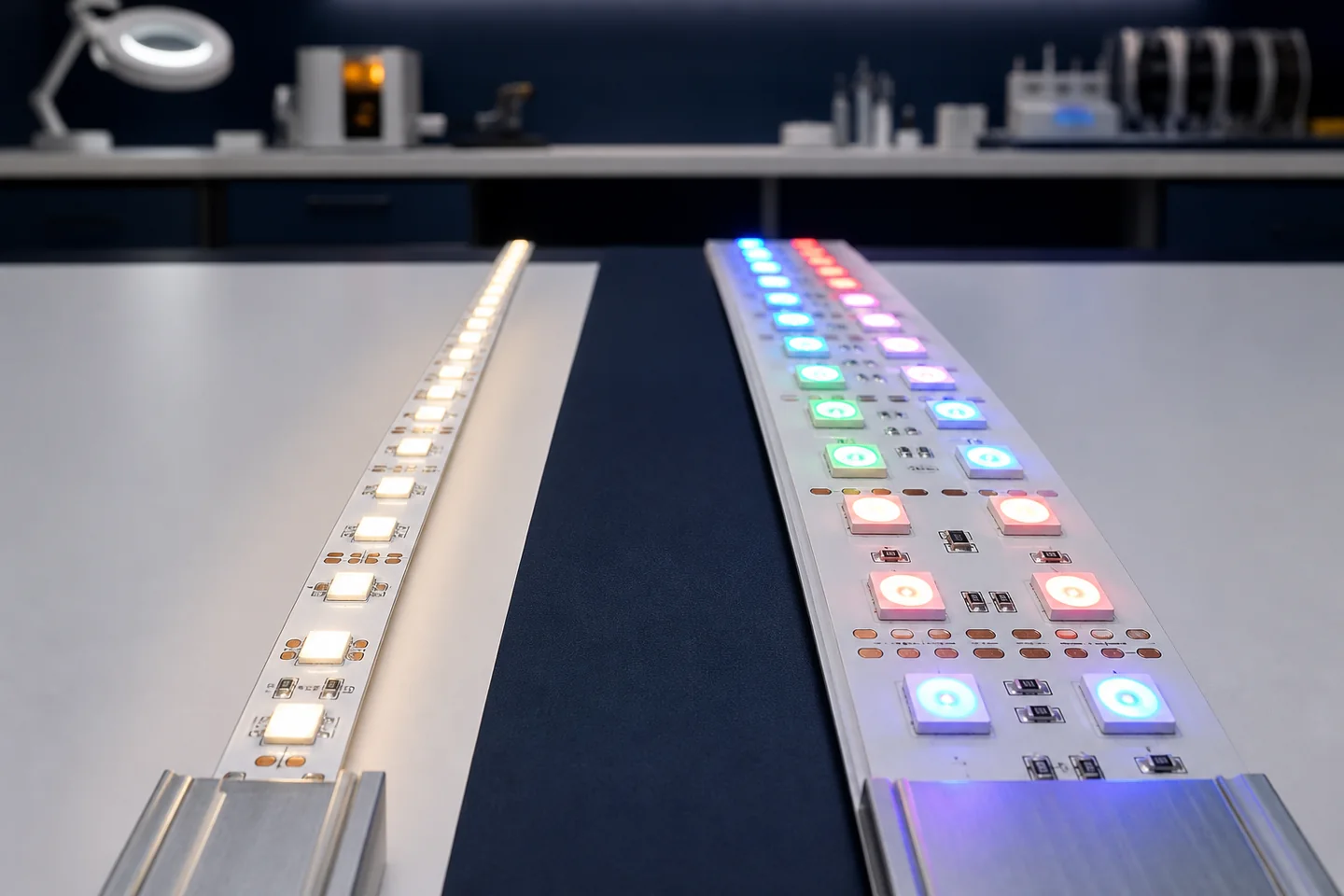
2835 vs 5050 LED strip comparison
| Question | SMD 2835 strip | SMD 5050 strip |
|---|---|---|
| Common role | White linear and general illumination | RGB, RGBW, addressable and some white-light designs |
| Package form | Smaller rectangular footprint | Larger square footprint |
| Color channels | Often one white channel per package | Can house several dies or channels in one package |
| Strip density | Available in many densities, including closely spaced designs | Density varies; multi-channel circuitry often needs more PCB space |
| PCB and controller | Often simple single-color constant-voltage circuits | RGB and pixel versions require matching channel or data control |
| Best comparison metric | Lumens, power, CRI, CCT and uniformity per meter | Color capability, channel power, protocol, pixel grouping and output |
These are common patterns, not universal rules. White 5050 and colored 2835 products exist. Ask the supplier to state the exact color architecture and circuit.
Start with the required light, not the package name
For white shelf, cabinet or cove lighting
Compare the proposed 2835 and 5050 models by measured lumens per meter, watts per meter, CRI, CCT, color consistency and appearance through the intended diffuser. A dense 2835 strip can produce a smoother line than a low-density 5050 strip, but density and profile depth must be assessed together.
Our current SMD LED strip category includes single-color models with different PCB widths, densities, voltages and protected constructions. It should be filtered by the project requirements, not treated as one interchangeable product family.
For RGB or dynamic effects
The 5050 platform is widely used because one package can contain multiple color dies. The buyer must still specify whether the system is analog RGB, RGBW or addressable, plus voltage, channel order, controller protocol and pixel grouping.
An RGB strip producing a visual white is not automatically a substitute for a dedicated white strip where CRI, CCT tolerance and white-light efficiency matter. For displays that need effects and useful white illumination, compare RGBW or a separate white-light circuit. Review the RGB and addressable strip range with the intended controller.
Six checks that matter more than package size
1. Output and power per meter
Ask for measured lumens and watts per meter under stated voltage, sample length and warm-up conditions. One LED package can be driven gently or aggressively; LED count does not reveal the result.
2. PCB electrical and thermal design
Confirm PCB width, copper specification, circuit layout, cut interval and maximum supported run. Higher current on a narrow or poorly cooled PCB can create voltage drop and heat even when the LED package is reputable.
3. Color quality
For white light, specify CCT, CRI and any project-specific fidelity or R9 requirement. Add a color-tolerance or approved-sample method for adjacent runs and repeat orders. The same nominal CCT can still show a visible difference between bins.
4. Dot visibility
LED density, emitting-surface size, distance to the diffuser, diffuser transmission and viewing angle all affect visible dots. Approve the strip inside the actual profile or cove. If a continuous exposed line is essential, compare a suitable COB LED strip as well.
5. Control-system load
For RGB and addressable 5050 designs, calculate total and per-channel current. Verify controller rating, amplifier need, data direction, signal reference and power injection. Test the longest representative branch at the most demanding scene.
6. Environmental construction
IP20, coated, sleeved, extruded and fully sealed products dissipate heat and handle bends differently. Do not assume the package type determines the IP rating. The tested construction, ends, connectors and cable entries matter.
How to compare samples fairly
Power both candidates with compatible equipment and use equal installed lengths. Record voltage at the strip input, power, profile, diffuser, warm-up time and ambient condition. Then inspect:
- brightness and uniformity at full load;
- color appearance on the actual materials;
- visible dots at the real viewing distance;
- feed-end and far-end difference;
- temperature behavior in the intended profile;
- dimming or animation performance;
- connector fit, cut interval and installation handling.
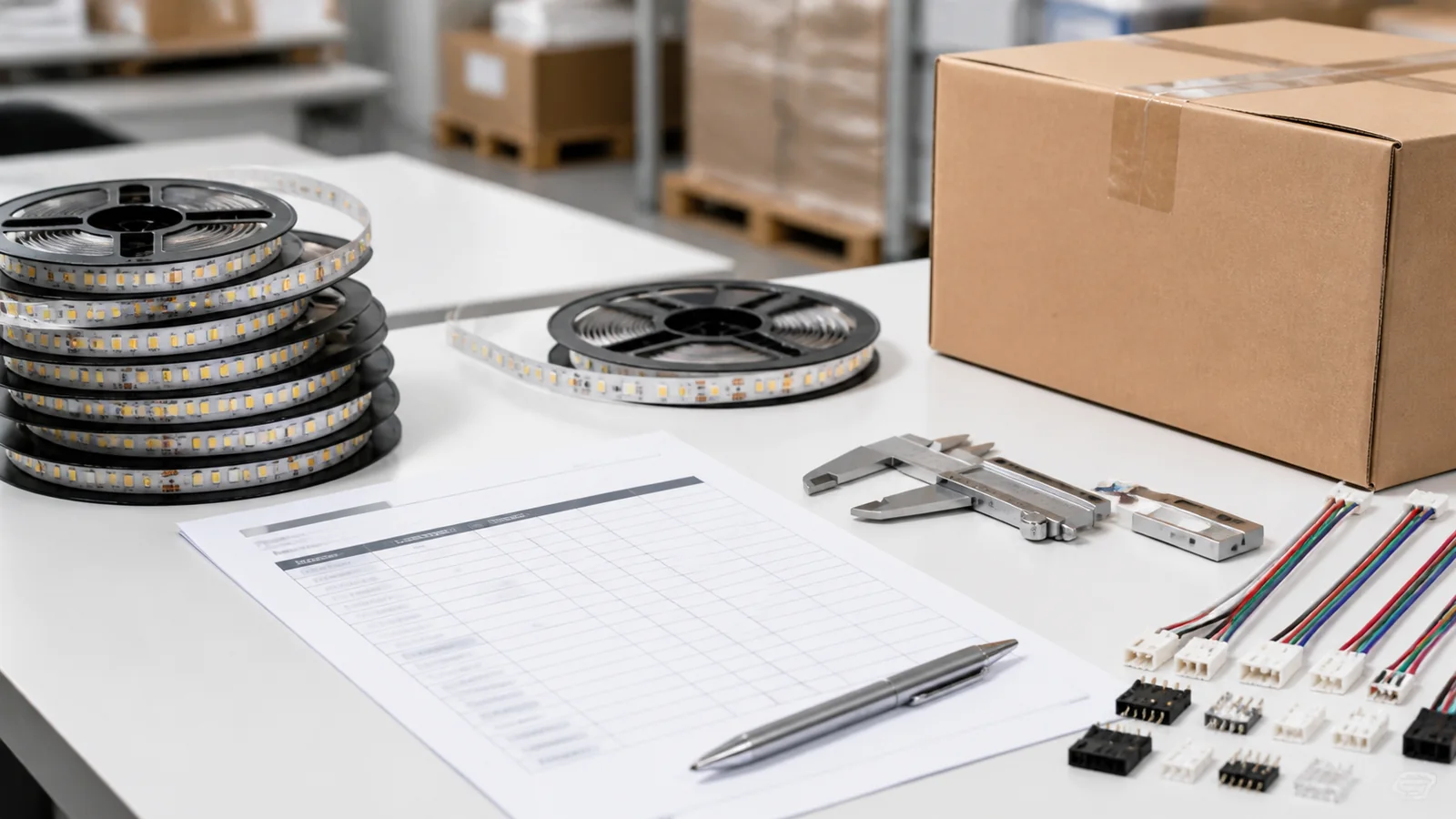
Do not compare a bare strip on a white table with another strip behind a diffuser. Use the controlled process in the LED strip sample approval guide, and retain the approved model revision.
What to put in the RFQ
- white, RGB, RGBW, tunable-white or addressable requirement;
- target voltage and total installed length;
- lumens per meter or project brightness target;
- CCT, CRI and color-tolerance requirement for white light;
- LED density, PCB-width or profile constraints;
- IP construction and exposure details;
- dimmer, controller and protocol;
- reel length, cut interval, cable and connector;
- destination market and required documents;
- sample and batch-approval method.
If the specification only says “2835” or “5050,” two quotations may represent completely different systems. Send the operating and installation requirements through the quotation form so the comparison is made model by model.
Catalog & Sourcing Note
This article is prepared from our current product catalog and B2B specification workflow. Electrical, waterproofing and installation requirements vary by model and market, so confirm the final specification and approved sample before ordering.
Discuss Your Specification